Artwork
Thunder (Un coup de foudre)
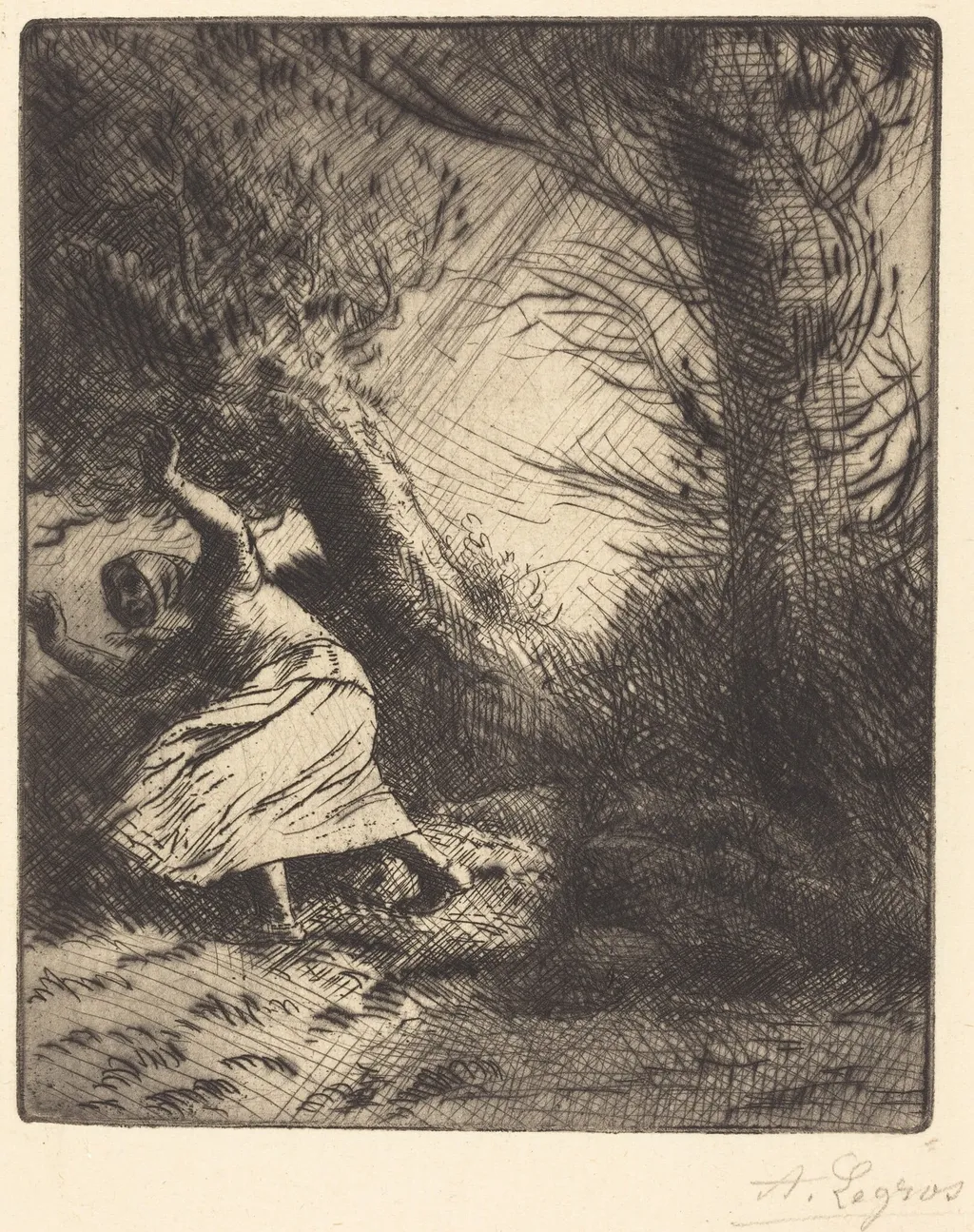
Thunder (Un coup de foudre) is an ink print by the Romanticist artist Alphonse Legros. It dates from 1874 and is held in the collection of the National Gallery of Art.
About this work
Overview
This piece exemplifies his focus on emotional intensity and natural forces, achieved through the tactile qualities of hand-incised plates.
Alphonse Legros, a French artist who moved to London in 1863 and later became a British citizen, produced *Thunder (Un coup de foudre)* in 1874 as an etching and drypoint. Known for his work across multiple media, Legros was instrumental in revitalizing printmaking in Britain during the late 19th century. This piece exemplifies his focus on emotional intensity and natural forces, achieved through the tactile qualities of hand-incised plates.
Subject & Meaning
The image depicts a solitary figure crouched low in a dense, oppressive forest, their face obscured and posture tense, as if caught between flight and stillness. The surrounding trees, rendered in swirling, jagged lines, dominate the composition, suggesting nature’s overwhelming power. The title evokes sudden, violent energy—perhaps a storm or spiritual shock—imbuing the scene with psychological unease rather than literal narrative.
Technique & Style
Legros employed etching and drypoint to build dense, textured surfaces through incised lines and burr. The dark, chaotic tangle of branches is created with rapid, scratchy strokes that trap ink unevenly, producing deep blacks and granular grays. This method enhances the sense of turbulence and immediacy, characteristic of his approach to printmaking, where manual mark-making conveys emotional weight over polished detail.
History & Provenance
Created in 1874 during Legros’s tenure at the Slade School of Art, the print emerged from a period when he was actively influencing British print culture. Though not widely exhibited at the time, it reflects his commitment to expressive printmaking as a serious art form. Its survival in institutional collections underscores its significance within the revival of etching in Victorian Britain.
Context
In the 1870s, British artists were re-engaging with etching as a medium for personal expression, moving away from reproductive prints. Legros, trained in France and immersed in the Barbizon tradition, brought a somber, naturalistic sensibility to his work. *Thunder* aligns with broader European trends exploring mood and atmosphere, contrasting with the era’s more decorative or illustrative prints.
Legacy
Legros’s technical rigor and emotional depth in prints like *Thunder* influenced a generation of British etchers. His emphasis on direct, hand-crafted mark-making helped establish etching as a legitimate artistic medium rather than a reproductive tool. Though less known today, his work laid foundational principles for the 20th-century revival of expressive printmaking in Britain.
Artist & collection

Artist
Alphonse Legros (French pronunciation: ; 8 May 1837 – 8 December 1911) was a French, later British, painter, etcher, sculptor, and medallist.

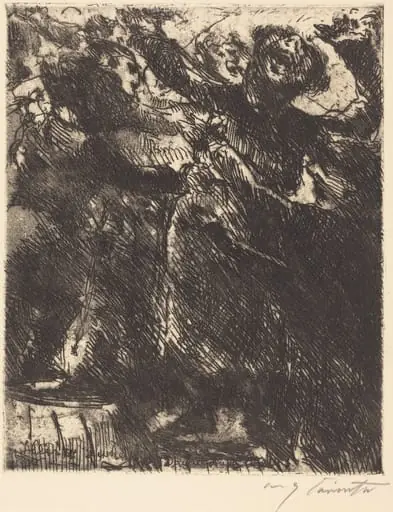 Kapuzinerpredigt—"Hetzt sich lieber herum mit der Dirn'" (The Capuchin's Sermon—"He Prefers to Run Around with a Girl")
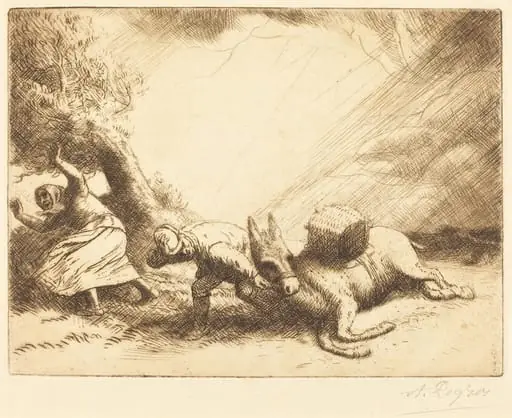 Donkey Upset by Storm (L'ane renverse par la foudre)
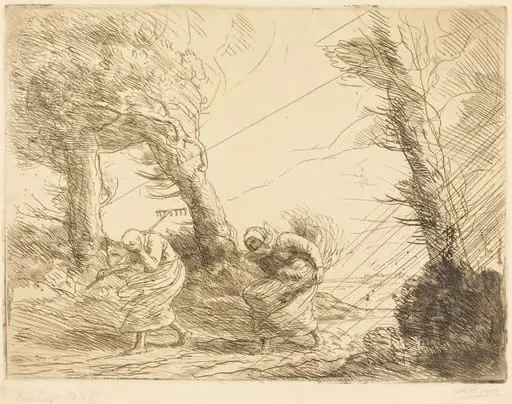 Harvesters Surprised by the Storm (Moissonneuses surprises par l'orage)
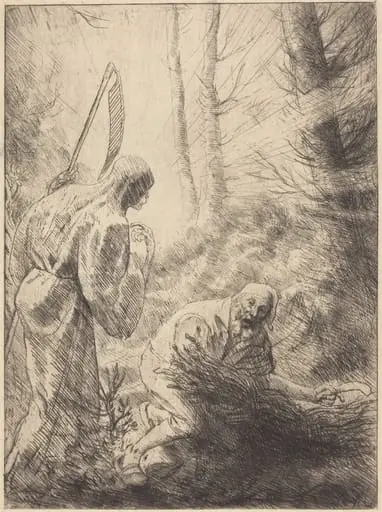 Death and the Woodcutter, 2nd plate (La Mort de le bucheron)
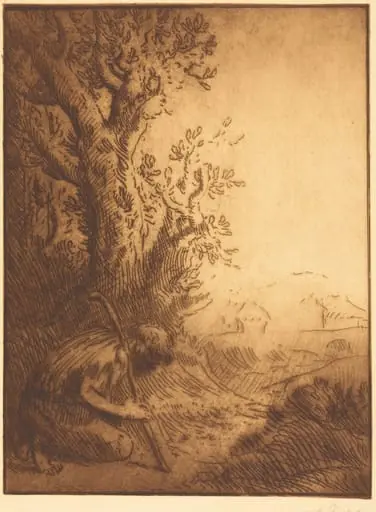 The Prodigal Son, 4th plate (L'enfant prodigue)
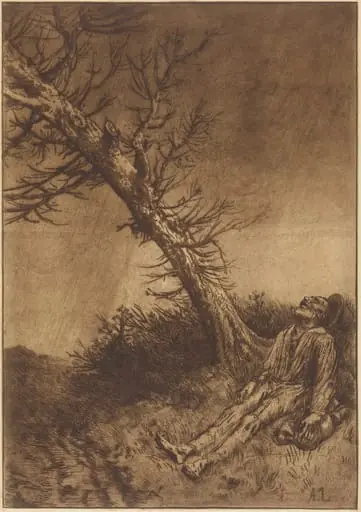 Death of the Vagabond (La mort du vagabond)
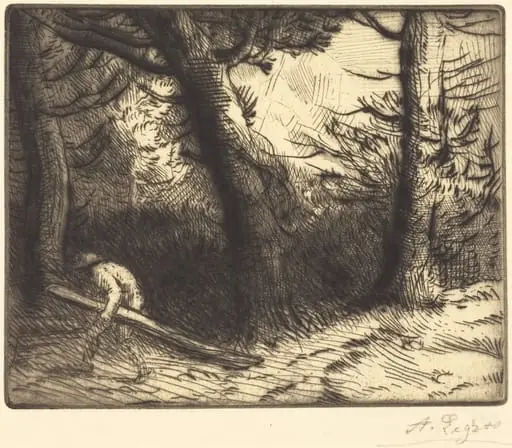 Edge of a Forest in Bourgogne (Un coin de foret en Bourgogne)