Artwork
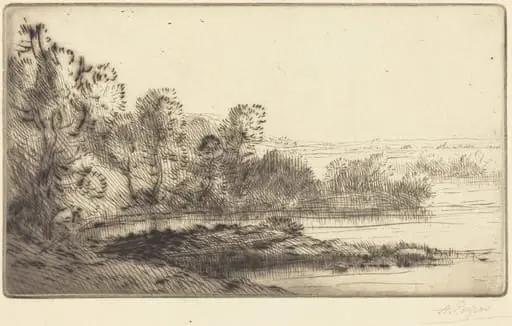
Trees at Water's Edge (Les arbres au bord de l'eau)
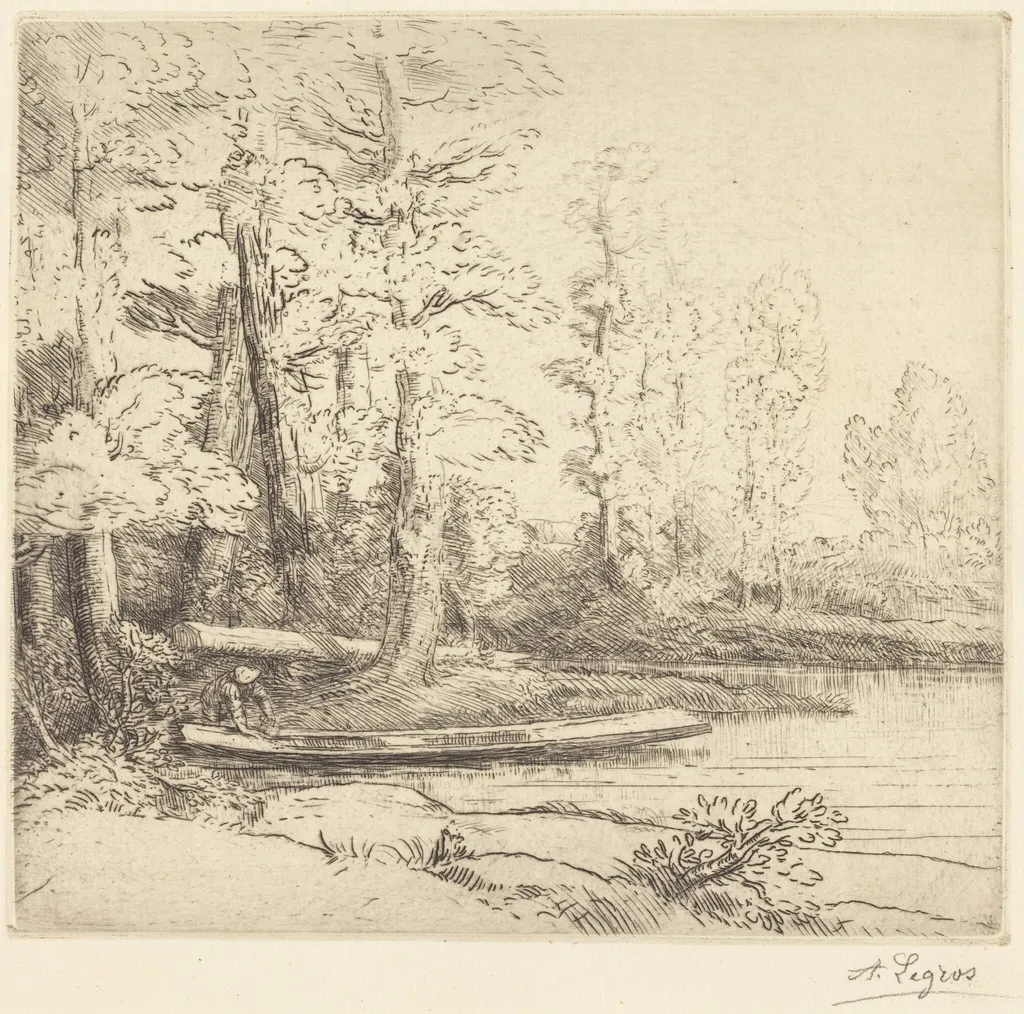
Trees at Water's Edge (Les arbres au bord de l'eau) is an ink print by the Romanticist artist Alphonse Legros. It dates from 1874 and is held in the collection of the National Gallery of Art.
About this work
Overview
Created in 1874 by Alphonse Legros, *Trees at Water's Edge* is a black-and-white print made using drypoint and etching techniques. Though born in France, Legros spent much of his career in Britain, where he influenced the revival of printmaking through both his art and teaching. This work exemplifies his interest in natural landscapes rendered with quiet precision and atmospheric depth.
Subject & Meaning
The scene captures a tranquil riverside with dense trees leaning over still water. Logs rest along the bank, suggesting a quiet, undisturbed environment. There is no human presence, and the focus lies in the organic forms of foliage and reflection. The composition evokes a sense of solitude and the quiet rhythm of nature, without overt symbolism or narrative.
Technique & Style
The absence of tone or color emphasizes line and texture, enhancing the impression of movement and breath within the forest.
Legros employed drypoint to carve directly into a metal plate, creating soft, grainy lines that hold ink unevenly. Combined with etching, this produced a range of delicate, blurred textures. The trees appear hazy and fluid, their branches dissolving into the surrounding air. The absence of tone or color emphasizes line and texture, enhancing the impression of movement and breath within the forest.
History & Provenance
The print was made during Legros’s early years in England, after he moved to London in 1863. It reflects his engagement with the British etching revival, a movement that sought to elevate printmaking as a fine art. While specific ownership history is not documented, the work aligns with his broader output of landscape prints circulated among collectors and students in the 1870s.
Context
In the 1870s, European artists increasingly turned to intimate natural scenes as industrialization reshaped the landscape. Legros’s work resonated with contemporaries like Whistler and Rembrandt revivalists, who valued expressive line over detail. His prints, including this one, offered a meditative counterpoint to academic painting, emphasizing process and mood over finish.
Legacy
Legros’s prints, including *Trees at Water's Edge*, helped redefine etching as a medium for personal expression rather than mere reproduction. His teaching at the Slade School influenced generations of British artists. Though less widely known today, his quiet, textured landscapes remain significant for their emotional restraint and technical innovation in 19th-century printmaking.
Own this work as a print
Artist & collection

Artist
Alphonse Legros (French pronunciation: ; 8 May 1837 – 8 December 1911) was a French, later British, painter, etcher, sculptor, and medallist.

 Valley in Bourgogne (Une vallee en Bourgogne)
 Banks of the Saint-Pre (Rive du Saint-Pre)
 The Virgin Islands in Bezons (Les Iles vierges a Bezons)
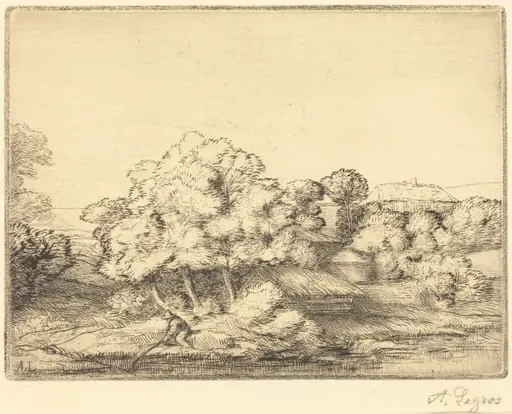 Hamlet near the Lake (Le hameau pres du lac)
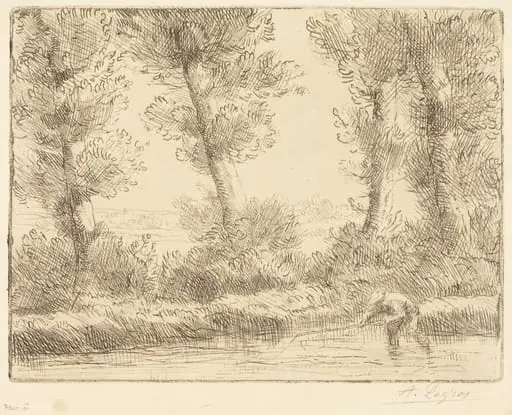 Banks of the Liane (Les bords de la Liane)
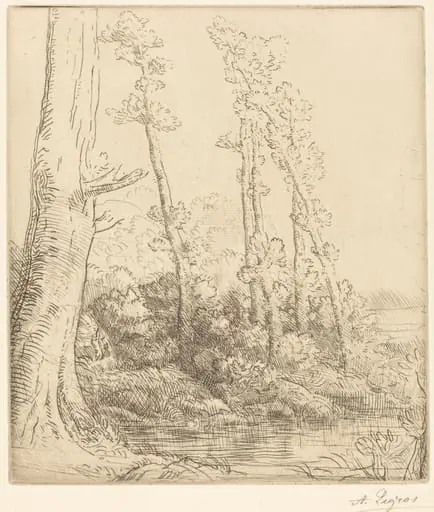 Little Pond (La petite mare)
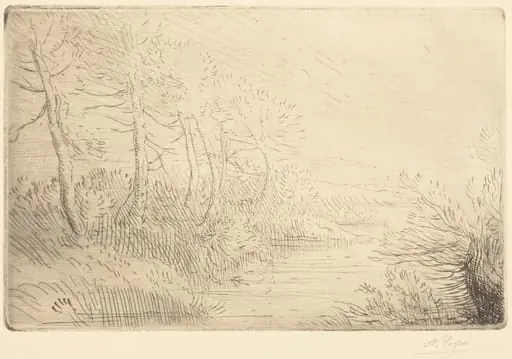 Riverbank (Bord de la riviere)
 Along the Terne (Sur la terne)