Artwork
Livre de Tables
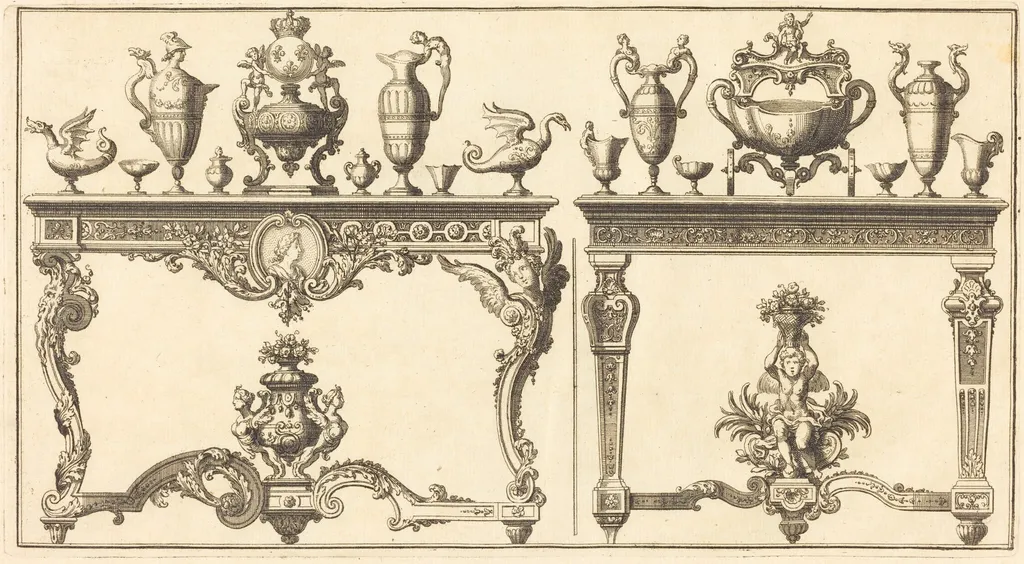
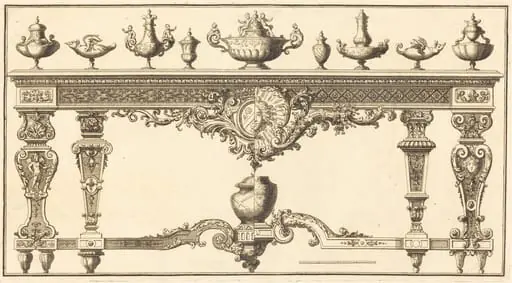
Livre de Tables is an ink print by the Baroque artist Pierre Lepautre. It dates from 1702 and is held in the collection of the National Gallery of Art.
About this work
Overview
The image functions as a design reference, capturing the decorative vocabulary of early 18th-century French interior furnishings with precision and clarity.
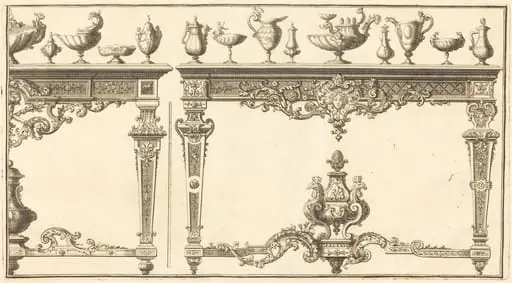
Livre de Tables, created in 1702 by Pierre Lepautre, is an etching that presents a meticulously rendered arrangement of ornate furniture. The composition centers on elaborately carved cabinets, their surfaces adorned with scrolling forms and figurative details. The image functions as a design reference, capturing the decorative vocabulary of early 18th-century French interior furnishings with precision and clarity.
Subject & Meaning
The scene depicts a curated display of luxury furnishings, likely intended to guide artisans and patrons in interior design. Vases shaped as urns and pitchers, crowned with mythic creatures, sit atop cabinets whose legs twist into vegetal scrolls. Tiny faces emerge from the carvings, suggesting a blend of classical and fantastical motifs. The inclusion of a central clock implies a concern with time and order, reinforcing the piece’s role as a catalog of refined taste.
Technique & Style
Lepautre employed etching to achieve fine, controlled lines across the entire composition. The metal plate was coated with wax, then incised with a needle to expose the copper beneath, which was later bitten by acid to create grooves. Ink filled these lines, transferring the image onto paper with sharp definition. The technique allowed for intricate detailing—leafy tendrils, dragon handles, and facial expressions—rendered with consistent clarity and depth.
History & Provenance
Created during the reign of Louis XIV, the print emerged from a Parisian milieu where design manuals were in demand among craftsmen and aristocrats. Lepautre, part of a family of artists and designers, contributed to the dissemination of decorative styles through printed plates. While its early ownership is undocumented, the work aligns with a broader trend of publishing architectural and furniture designs for professional use.
Context
In early 1700s France, the courtly aesthetic favored elaborate ornamentation, and printed pattern books served as essential tools for cabinetmakers and decorators. Lepautre’s etching reflects this culture, translating three-dimensional objects into two-dimensional templates. The emphasis on symmetry, gilded surfaces, and mythological motifs mirrors the prevailing tastes of the Régence period, bridging the grandeur of Louis XIV’s era with emerging lighter styles.
Legacy
Livre de Tables remains a valuable record of French decorative arts at the turn of the 18th century. Its detailed renderings informed subsequent generations of designers and preserved stylistic conventions that might otherwise have been lost. Though not widely exhibited today, it endures in institutional collections as a primary source for understanding the craftsmanship and visual language of its time.
Artist & collection


 Fantastic Vases
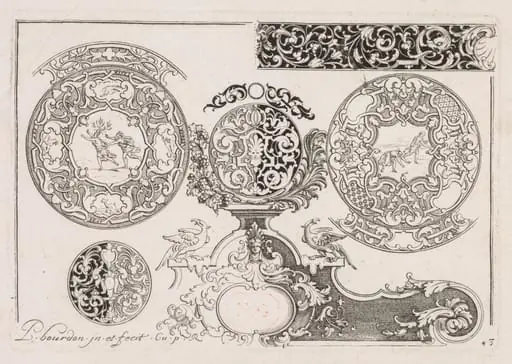 # 3 from " Livre second essais de Gravjre "
Second book of Engraved Designs
# 3 from " Livre second essais de Gravjre "
Second book of Engraved Designs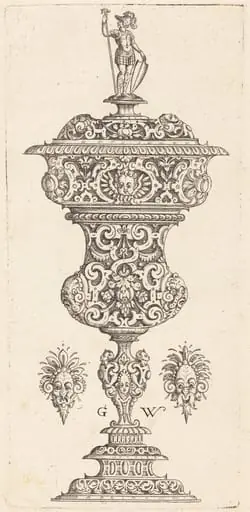 Goblet with lid surmounted by a Roman soldier
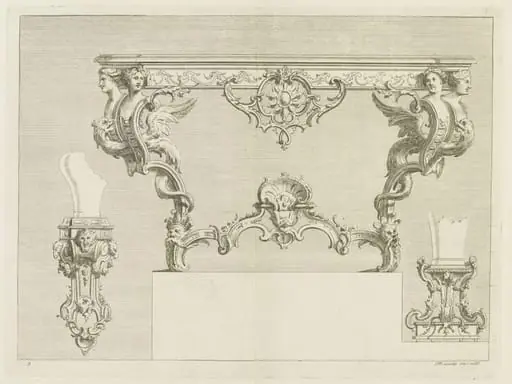 Nouveaux Desseins de Pieds de Tables et de Vases et Consoles de sculpture en bois Inventes par le sieur Pineau sculpteur
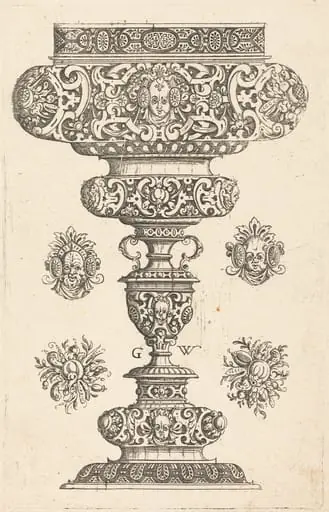 Goblet, rim decorated with masque and bouquet of fruit
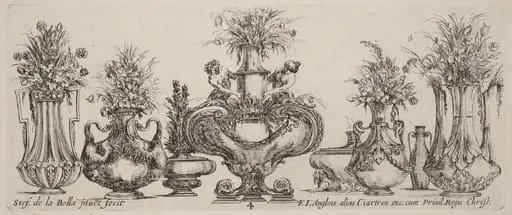
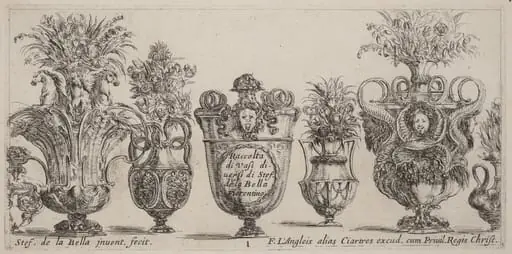 Fantastic Vases
 Design for Daggers