Artwork
Entrance to the Tomb of Sultan Mehmet I, Bursa
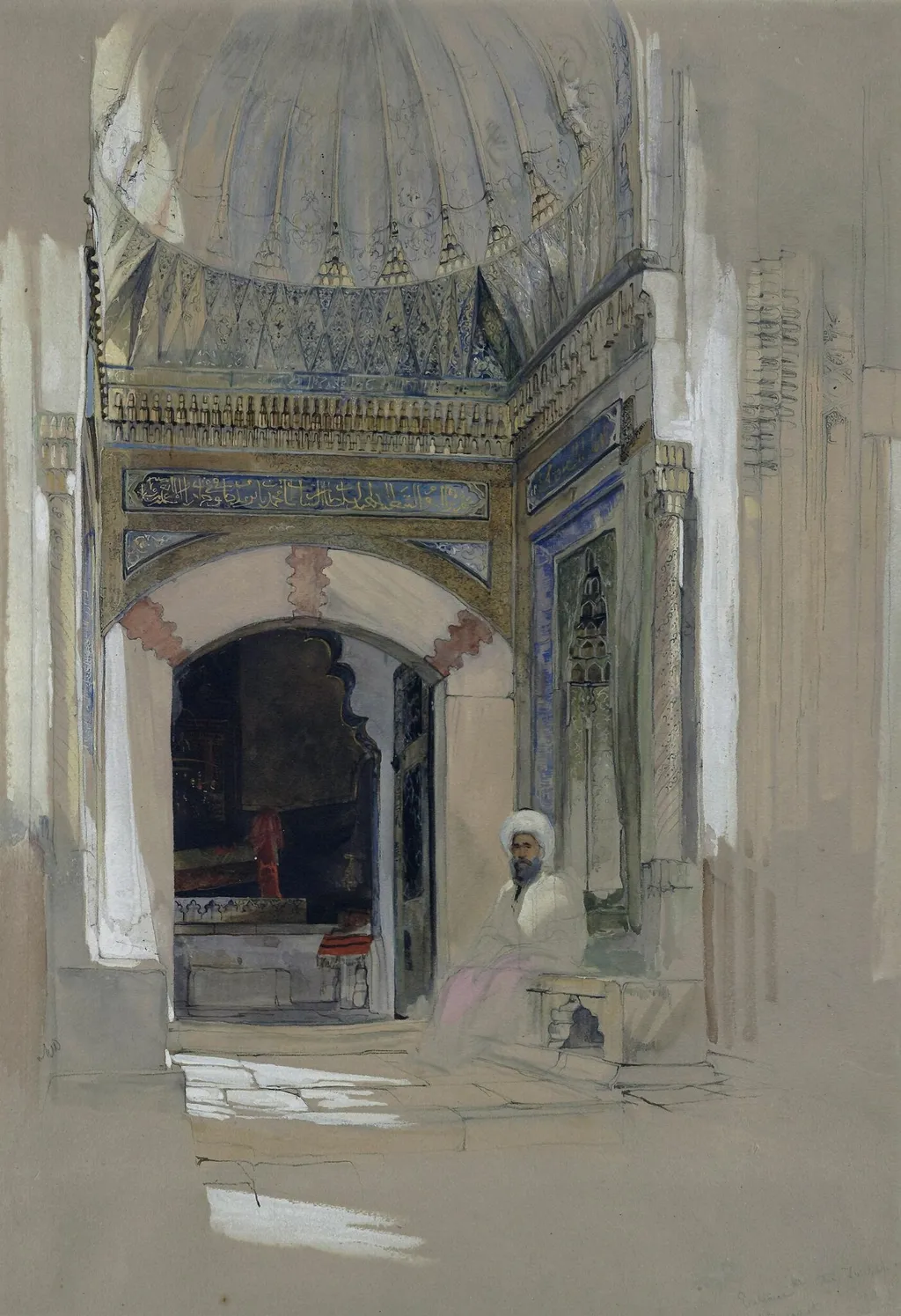
Entrance to the Tomb of Sultan Mehmet I, Bursa is a watercolor work on paper by the Romanticist artist John Frederick Lewis. It dates from 1841 and is held in the collection of the Victoria and Albert Museum.
About this work
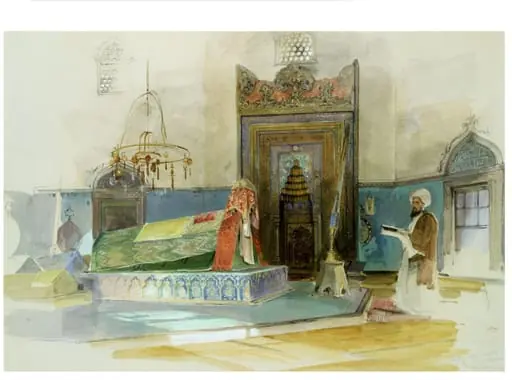
John Frederick Lewis painted the inside of a famous tomb in Bursa in 1841.
John Frederick Lewis painted the inside of a famous tomb in Bursa in 1841. He used watercolour to show the space. The tomb belongs to Sultan Mehmet I, who ruled long before.
This was part of a bigger trip. Lewis went from Rome through Greece to Istanbul. Then he visited Bursa, where the Green Tomb stands. He left for Egypt soon after.
Check out the artist’s other works at the Victoria and Albert Museum.
Overview
John Frederick Lewis created this watercolour in 1841 during a journey through the eastern Mediterranean. After traveling from Rome through the Balkans and Greece, he reached Constantinople and then proceeded to Bursa, the early Ottoman capital. There, he depicted the interior of the Green Tomb, a mausoleum built for Sultan Mehmet I, whose reign ended nearly four centuries earlier. Lewis completed the work shortly before departing for Egypt.
Subject & Meaning
The painting captures the interior of the Yesil Türbe, the burial chamber of Sultan Mehmet I. It presents a quiet, reverent space marked by geometric tilework and architectural symmetry. The lone figure, likely a religious custodian, suggests ongoing ritual use of the site. The image conveys neither grandeur nor decay, but a sustained, solemn presence of memory within sacred architecture.
Technique & Style
Lewis employed fine, controlled watercolour washes to render the intricate tile patterns and architectural details of the tomb. His technique emphasizes light filtering through openings, highlighting the polished surfaces of glazed ceramics and stone. The composition is restrained, avoiding dramatic effects in favor of precise observation and tonal harmony, characteristic of his documentary approach to architectural interiors.
History & Provenance
The watercolour was made during Lewis’s extended tour of the Ottoman Empire in 1841. It reflects his interest in documenting historical sites with ethnographic accuracy. The work entered the collection of the Victoria and Albert Museum, where it remains as part of a broader group of his Middle Eastern studies. No record suggests it was exhibited publicly during his lifetime.
Context
Bursa served as the first capital of the Ottoman Empire before the conquest of Constantinople. The Green Tomb, constructed between 1419 and 1421, exemplifies early Ottoman architectural synthesis, blending Byzantine, Seljuk, and Persian influences. Lewis’s visit occurred during a period of growing European interest in Ottoman heritage, though few Western artists had recorded such interiors with such attention to detail.
Legacy
Lewis’s watercolour contributes to a small but significant body of 19th-century visual records of Ottoman sacred spaces. Unlike later orientalist works, it avoids exoticism, focusing instead on spatial clarity and material texture. The piece remains a reference for architectural historians studying the preservation and perception of early Ottoman monuments in the pre-photographic era.
Artist & collection
Artist
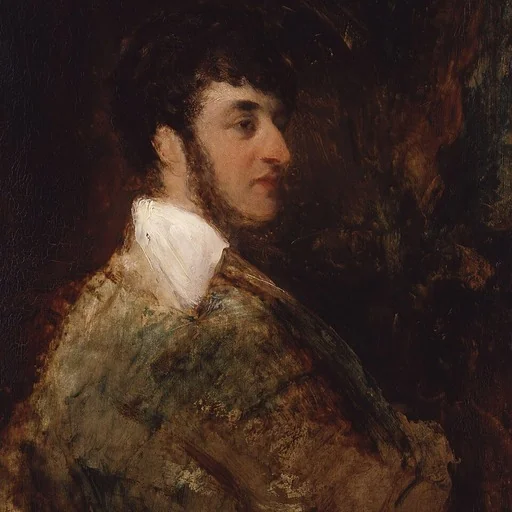
John Frederick Lewis (1804–1876) was an English Orientalist painter. He specialized in Oriental and Mediterranean scenes in detailed watercolour or oils, very often repeating the same composition in a version in each…

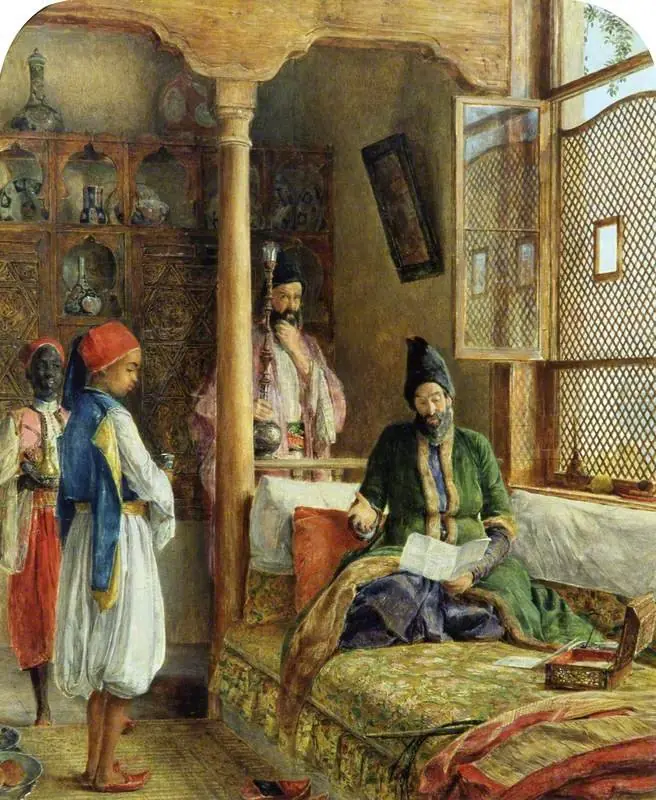
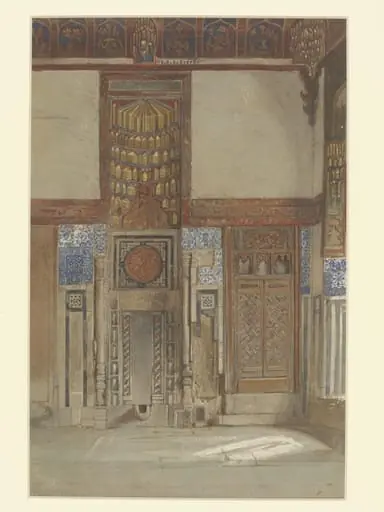 An Interior (the Eastern End) in the House of the Mufti Sheikh El Mahadi
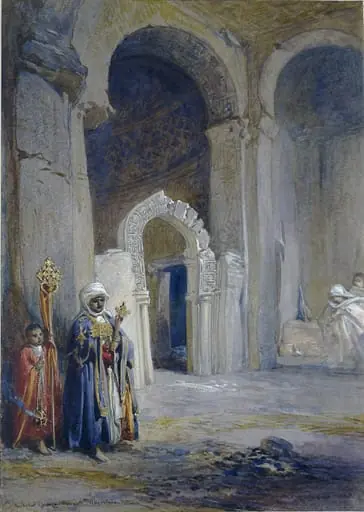 The Rock-Cut Church of Kados Kirkos at Dongola, Abyssinia
 Mosque of Sidi Bu Madyan, Tlemcen
 The Mosque of Berkouk Cairo
 Interior of the House of the Mufti Sheikh El Mahadi, Cairo
 Interior of a Mosque, Cairo
 Courtyard, Tetuan, Morocco
 The Alhambra in Granada
 Mosque. Souk el Hommos. Byrout
 At the Gate of the Seraglio
 The Gate called Bab-el-Khataneen, at Jerusalem
 Interior of the Tomb of Sultan Mehmet I, Bursa