Artwork
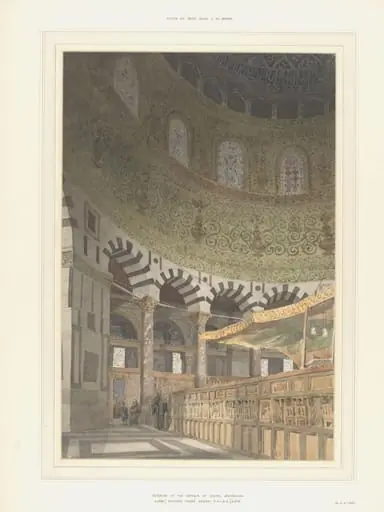
Interior of the Mosque of Aya Sofya, Istanbul [Interior of Hagia Sophia, Constantinople]
![Interior of the Mosque of Aya Sofya, Istanbul [Interior of Hagia Sophia, Constantinople], by John Frederick Lewis, watercolor, 1840](https://artifactworldgallery.com/img/john-frederick-lewis--interior-of-the-mosque-of-aya-sofya-istanbul-interior-of-hag--f81f7cc6554fed68-w1024.webp)
Interior of the Mosque of Aya Sofya, Istanbul [Interior of Hagia Sophia, Constantinople] is a watercolor work on paper by the Orientalist artist John Frederick Lewis. It dates from 1840 and is held in the collection of the Victoria and Albert Museum.
About this work
Artist John Frederick Lewis captures its vast space with quiet skill—mostly pencil, a little color, and a few bright red fezzes in the crowd.
This watercolor shows Hagia Sophia’s grand interior in 1840-41, when it was still a mosque. Artist John Frederick Lewis captures its vast space with quiet skill—mostly pencil, a little color, and a few bright red fezzes in the crowd.
Lewis lived in Turkey and Egypt, making small studies like this. The sketch feels spare yet alive, focusing on the mosque’s eastern end and its painted name plaques.
Look next at the Romanticism movement.
Overview
John Frederick Lewis created this watercolour during his year-long stay in Constantinople beginning in 1840. Rendered in pencil with minimal colour, the work captures the interior of Hagia Sophia as it functioned under Ottoman use. Its restrained palette and delicate lines reflect Lewis’s observational precision, avoiding theatricality in favour of quiet documentation. The sketch belongs to a series of intimate studies made during his time in the Ottoman Empire, prior to his extended stay in Egypt.
Subject & Meaning
The scene focuses on the eastern end of the mosque, centered on the minbar and the large wooden plaques悬挂 on the piers, inscribed with sacred Islamic names. These levhas, later replaced during the 1840s restorations, anchor the composition in its specific historical moment. A small congregation, identified by red fezzes, occupies the space without dominating it, suggesting daily religious practice rather than ceremonial grandeur. The image conveys the building’s spiritual function under Islamic use, not as a relic but as a living place of worship.
Technique & Style
Lewis employed a light pencil underdrawing, enhanced with sparse watercolour washes and precise white highlights to suggest light falling on marble and mosaic. The red accents of the fezzes are the only deliberate bursts of colour, drawing attention without disrupting the tonal harmony. The technique is economical, avoiding detail for its own sake; instead, it implies volume and depth through suggestion. This restrained approach aligns with the artist’s broader practice of capturing atmosphere through subtlety rather than spectacle.
History & Provenance
Lewis arrived in Constantinople in October 1840 and remained for approximately a year before traveling to Egypt, where he lived until 1851. This watercolour was made during his early months in the city, likely as a preparatory study. It predates the Fossati brothers’ major restoration of Hagia Sophia, which altered the shape and placement of the inscribed plaques. As such, the work preserves a visual record of the interior as it appeared just before significant architectural changes.
Context
In the 1840s, Western artists increasingly traveled to the Ottoman Empire, drawn by its architectural heritage and perceived exoticism. Lewis’s work stood apart by avoiding orientalist fantasy; his sketches prioritized accuracy and quiet observation. This piece reflects a moment when European interest in Islamic architecture was growing, yet few artists documented its daily use with such restraint. His focus on the building’s functional details, rather than its imperial past, distinguishes his approach from contemporaries.
Legacy
Lewis’s watercolours of Hagia Sophia remain valuable as documentary records of the building’s Ottoman-era interior before modern restorations. His method—minimalist, attentive to light and detail—offered an alternative to the dramatic Romantic depictions common in his time. Though less celebrated than his later Orientalist scenes, these early studies influenced later topographical artists and remain key references for understanding the visual history of the structure in the mid-nineteenth century.
Artist & collection
Artist
John Frederick Lewis (1804–1876) was an English Orientalist painter. He specialized in Oriental and Mediterranean scenes in detailed watercolour or oils, very often repeating the same composition in a version in each…