Artwork
Figure Studies
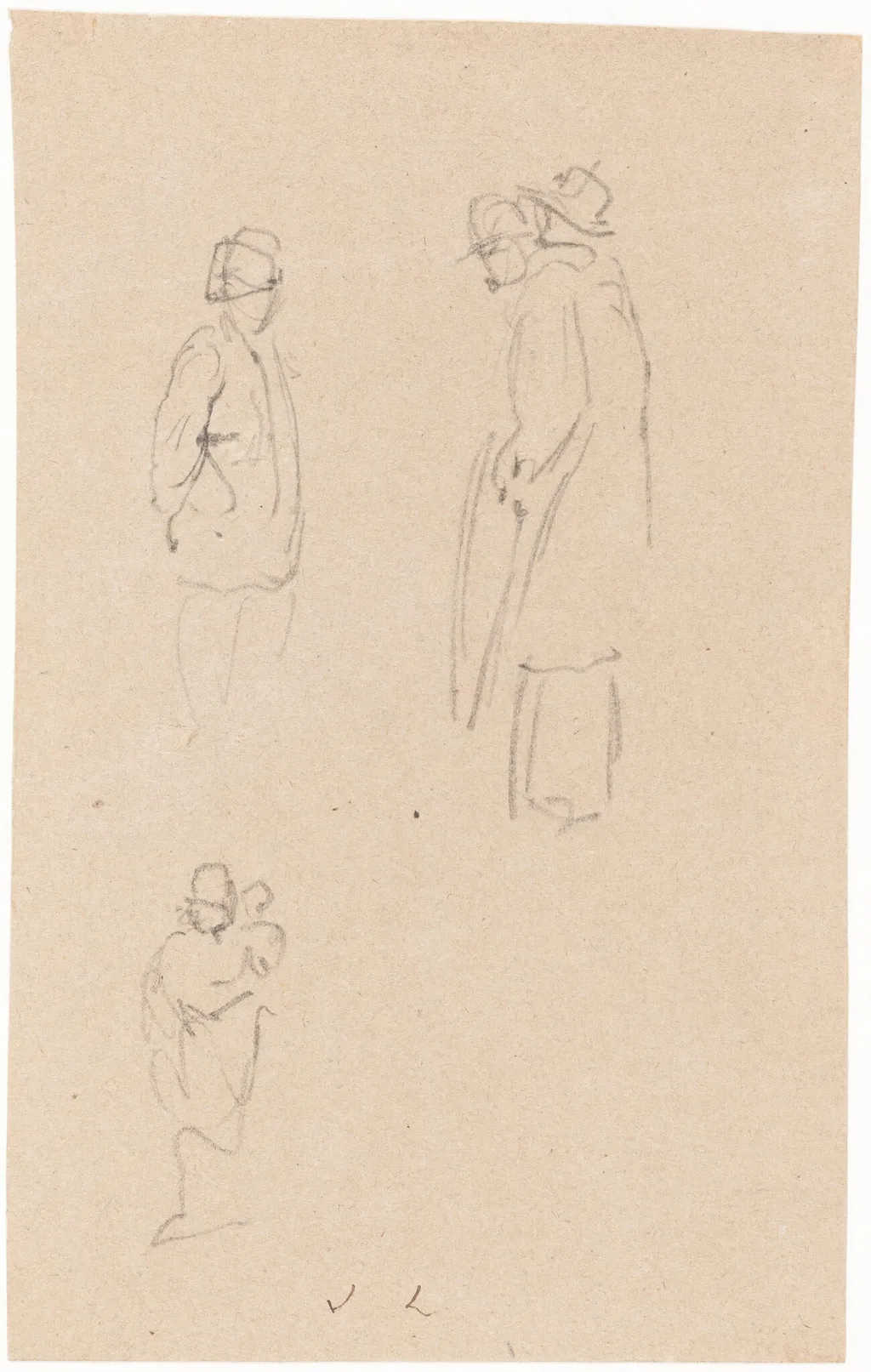
Figure Studies is a graphite drawing by the Romanticist artist John Linnell. It dates from 1837 and is held in the collection of the National Gallery of Art.
About this work
Overview
Created in 1837 by John Linnell, this graphite drawing on brown wove paper captures three human figures in fleeting, spontaneous strokes. The work lacks detailed backgrounds or tonal modeling, focusing instead on posture and motion. The warm tone of the paper complements the light, erasable lines, suggesting an immediate, observational approach rather than a polished composition.
Subject & Meaning
The three figures—standing with a cane, walking away, and bending forward—suggest everyday human activity, stripped of narrative or symbolism. Their gestures imply transient moments, perhaps caught during a stroll or pause in routine. The absence of identity or context invites contemplation of movement and presence rather than story, aligning with a quiet, observational realism.
Technique & Style
Linnell employed minimal graphite strokes to suggest form, relying on line weight and direction rather than shading. The loose, rapid handling evokes sketchbook immediacy, with no attempt to define textures or environments. The brown paper serves as a mid-tone base, allowing the lighter graphite to define contours with economy, emphasizing gesture over detail.
History & Provenance
The drawing originates from Linnell’s personal sketching practice during the 1830s, a period when he frequently recorded figures in outdoor and domestic settings. It remained within his circle until entering a public collection in the late 19th century. No evidence suggests it was intended for public display, reinforcing its role as a private study.
Context
Linnell worked amid the Romantic era’s interest in nature and human expression, yet his figure studies diverge from dramatic or idealized portrayals. Instead, they reflect a quiet, empirical tradition rooted in direct observation—akin to the sketching practices of contemporaries like Turner, but without theatricality or emotional intensity.
Legacy
This drawing exemplifies Linnell’s commitment to recording the ordinary with sensitivity and restraint. Though not widely exhibited in his lifetime, such works influenced later generations of British draftsmen who valued immediacy and honesty in figure study, contributing to a quieter lineage of observational drawing in 19th-century art.
Artist & collection


![A Person Holding an Umbrella and a Seated Man with a Hat and a Glass [verso], by Paul Gauguin](https://artifactworldgallery.com/img/paul-gauguin--a-person-holding-an-umbrella-and-a-seated-man-with-a-hat-and--8307c4522b7d6e38-w320.webp) A Person Holding an Umbrella and a Seated Man with a Hat and a Glass [verso]
A Person Holding an Umbrella and a Seated Man with a Hat and a Glass [verso]![Four Heads and Two Figures [verso], by Paul Gauguin](https://artifactworldgallery.com/img/paul-gauguin--four-heads-and-two-figures-verso--c2dab012b6be4f36-w320.webp) Four Heads and Two Figures [verso]
Four Heads and Two Figures [verso] African-American Figure
![Five Studies of Soldiers and a Woman's Face; Two Figures [recto], by Paul Gauguin](https://artifactworldgallery.com/img/paul-gauguin--five-studies-of-soldiers-and-a-woman-s-face-two-figures-rect--9d09632e7e517067-w320.webp) Five Studies of Soldiers and a Woman's Face; Two Figures [recto]
Five Studies of Soldiers and a Woman's Face; Two Figures [recto]![Three Studies of Men's Heads, One with Spectacles; Dogs, Children, and Two Bearded Men in Profile [verso], by Paul Gauguin](https://artifactworldgallery.com/img/paul-gauguin--three-studies-of-men-s-heads-one-with-spectacles-dogs-childr--5397d62ca5c9a48b-w320.webp) Three Studies of Men's Heads, One with Spectacles; Dogs, Children, and Two Bearded Men in Profile [verso]
Three Studies of Men's Heads, One with Spectacles; Dogs, Children, and Two Bearded Men in Profile [verso]![A Man Leaning on a Wall with Five Other Studies; Two Bearded Men Wearing Hats, and Five Other Studies [recto], by Paul Gauguin](https://artifactworldgallery.com/img/paul-gauguin--a-man-leaning-on-a-wall-with-five-other-studies-two-bearded--2df262058c2bfe48-w320.webp) A Man Leaning on a Wall with Five Other Studies; Two Bearded Men Wearing Hats, and Five Other Studies [recto]
A Man Leaning on a Wall with Five Other Studies; Two Bearded Men Wearing Hats, and Five Other Studies [recto] A cowherd and cow
 Sketches made during the Campaign of 1854-55 in the Crimea, Circassia and Constantinople