Artwork
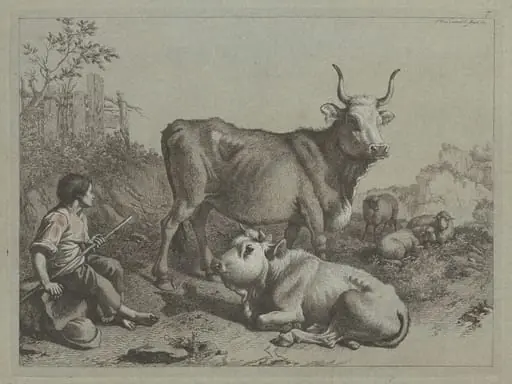
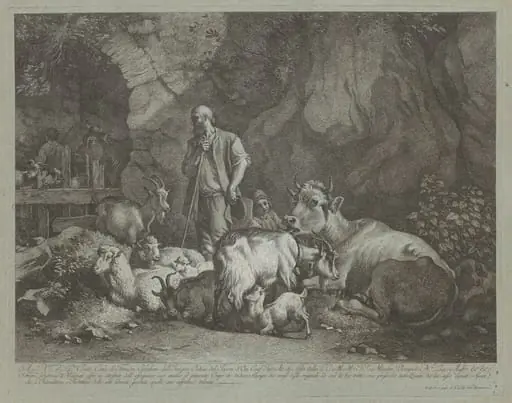
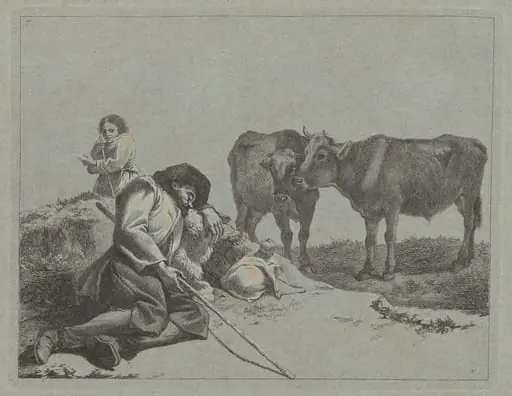
Shepherd Resting on a Walking Stick with an Old Horse and a Reclining Bull
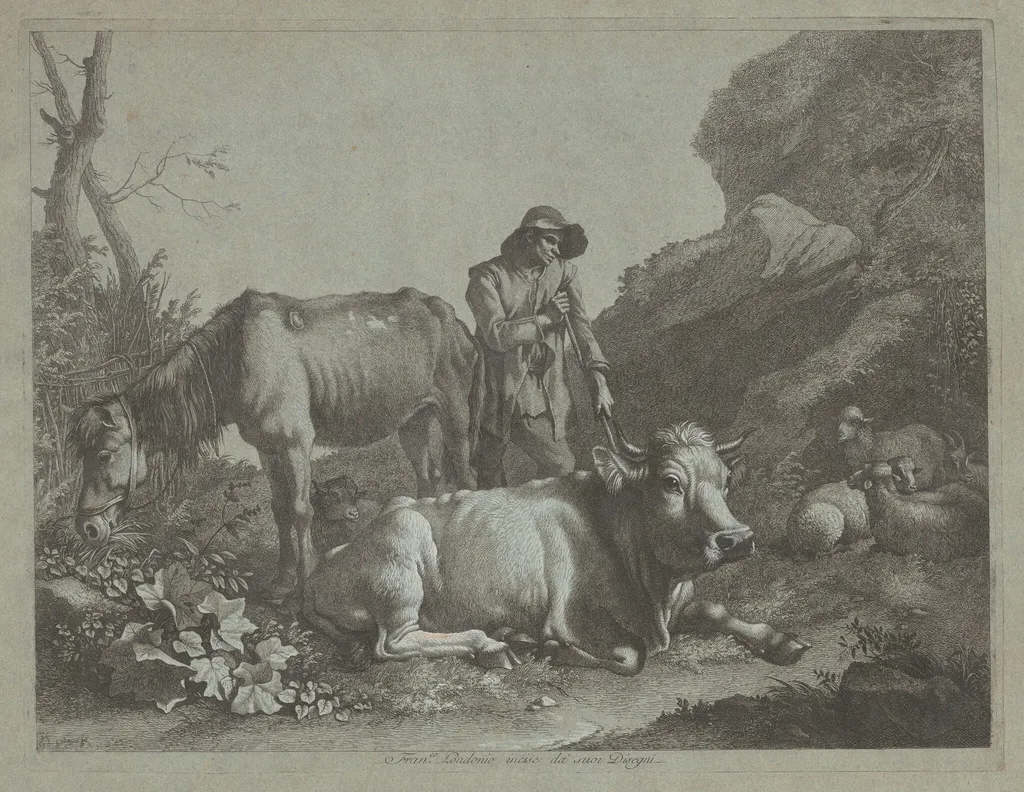
Shepherd Resting on a Walking Stick with an Old Horse and a Reclining Bull is an ink print by the Romanticist artist Francesco Londonio. It dates from 1767 and is held in the collection of the National Gallery of Art.
About this work
Overview
Created in 1767, this etching by Francesco Londonio depicts a quiet rural scene on blue laid paper, enhanced with white highlights to suggest light and texture.
Created in 1767, this etching by Francesco Londonio depicts a quiet rural scene on blue laid paper, enhanced with white highlights to suggest light and texture. As a printmaker active in Milan during the late Baroque and Rococo eras, Londonio specialized in pastoral subjects, often portraying animals and rural laborers with careful attention to natural detail. The work exemplifies his technical skill in etching and his interest in everyday rural life.
Subject & Meaning
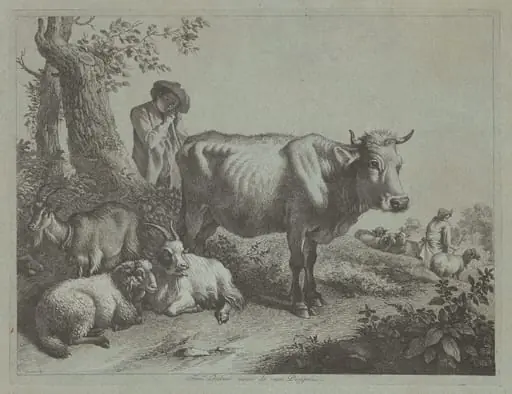
The composition centers on a shepherd leaning on a walking stick, flanked by an aged horse resting against a stone and a massive bull lying in repose. Sheep graze distantly, while a narrow stream and scattered shrubs frame the foreground. The scene conveys stillness and endurance, emphasizing the quiet rhythm of pastoral existence rather than narrative drama. The animals, rendered with anatomical precision, suggest a life shaped by labor and time.
Technique & Style
Londonio employed fine, controlled etching lines to define the textures of fur, wool, and fabric, while white heightening on the blue paper enhances contrasts and suggests atmospheric light. The blue ground adds depth and tonal richness, a technique common among Northern Italian printmakers of the period. The composition avoids theatricality, favoring a grounded, observational approach that renders the landscape and figures with quiet realism.
History & Provenance
Londonio trained in Milan under Ferdinando Porta and Giovanni Battista Sassi, later studying engraving with Benigno Bossi. He traveled to Rome and Naples, absorbing regional influences that informed his pastoral themes. This print likely circulated among collectors in Lombardy and Piedmont, where depictions of rural life were prized by aristocratic patrons seeking refined, non-religious imagery rooted in local tradition.
Context
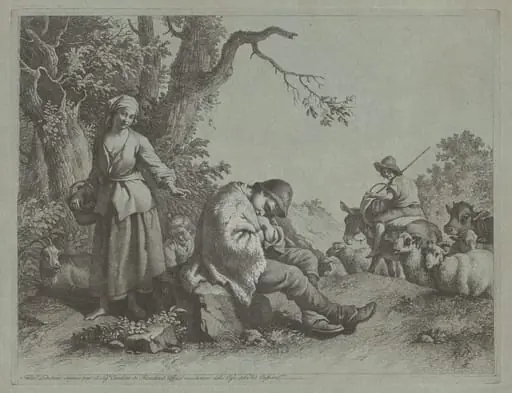
In mid-18th century Northern Italy, interest in pastoral scenes grew among urban elites who viewed rural life as both idyllic and authentically grounded. Londonio’s work aligned with this taste, offering detailed, unsentimental portrayals of animals and laborers. Unlike grand historical or mythological prints, his subjects reflected a quieter, more intimate aesthetic favored in private collections and domestic interiors.
Legacy
Londonio’s etchings contributed to the persistence of pastoral themes in Italian printmaking beyond the Baroque. His focus on naturalistic animal forms and restrained composition influenced later regional artists who sought to document rural life without idealization. Though not widely known outside Italy, his prints remain valued for their technical restraint and empathetic observation of the countryside.
Artist & collection

Artist
Francesco Londonio (1723–1783) was an Italian painter, engraver, and scenographer, active mainly in his native Milan in a late-Baroque or Rococo style.