Artwork
Woman in Front of a Fireplace
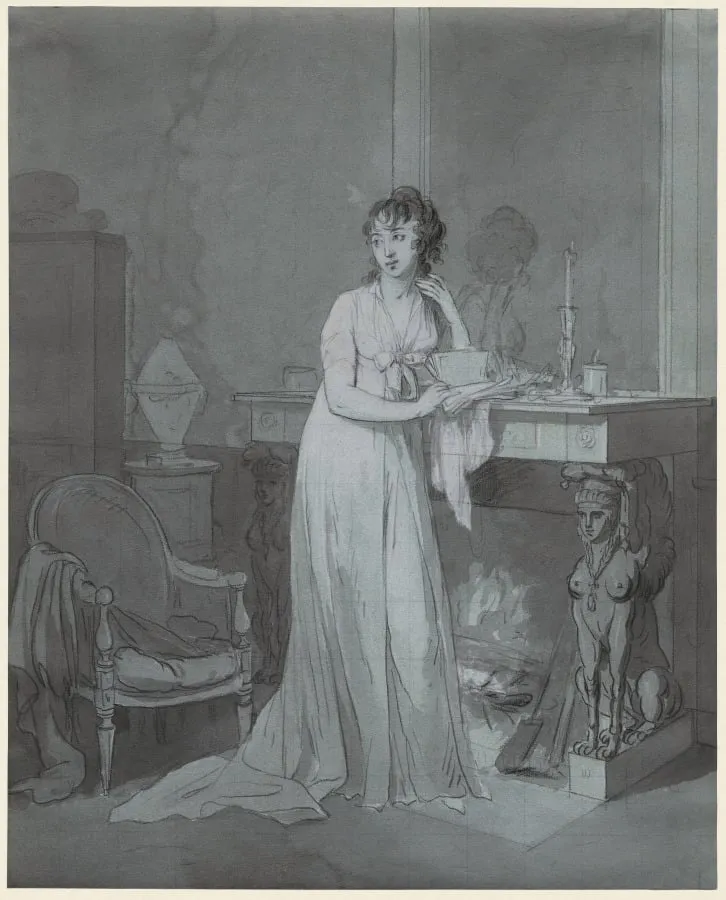
Woman in Front of a Fireplace is a drawing by the Romanticist artist Louis-Léopold Boilly. It dates from 1806 and is held in the collection of the Cleveland Museum of Art. This pencil drawing by Louis Léopold Boilly depicts Marie-Élisabeth Godard d’Aucourt de Saint-Just standing near a fireplace, holding a fan.
About this work
In the real painting, she’s outside in a cave, not by the fire, because rich women then were often shown in nature.
A woman in a high-waisted dress stands by a fireplace, holding a fan. Tiny pencil lines form a grid over her face and body.
This isn’t the final portrait—it’s the sketch the artist showed the family first. The grid let him copy the drawing onto a bigger canvas later. In the real painting, she’s outside in a cave, not by the fire, because rich women then were often shown in nature.
Look up more portraits from France, early 19th century to see how other artists painted women at the time.
Overview
This pencil drawing by Louis Léopold Boilly depicts Marie-Élisabeth Godard d’Aucourt de Saint-Just standing near a fireplace, holding a fan. Rendered with fine pencil lines and a grid overlay, it served as a preparatory study for a commissioned portrait. The grid indicates the artist’s intent to transfer the composition to canvas, though the final painting diverged significantly in setting and pose.
Subject & Meaning
The sitter, from a prominent French shipbuilding family, is portrayed in a domestic interior, a space associated with private life. Yet the finished portrait replaced this setting with a grotto, aligning with contemporary ideals that associated elite women with nature rather than cultural or intellectual spheres. The drawing thus captures an initial, more personal vision that was later altered to conform to social expectations.
Technique & Style
Boilly employed delicate pencil strokes to define the sitter’s form and attire, with meticulous attention to fabric folds and facial features. The grid drawn across the figure suggests a methodical transfer process, common in preparatory work for larger paintings. The precision of the lines reflects academic training, while the intimacy of the pose reveals a shift from formal portraiture toward observational realism.
History & Provenance
The drawing was likely presented to the sitter’s family for approval before the final painting was executed. Though the portrait’s final version is known to have been reimagined in a natural setting, this study remained in Boilly’s possession. Evidence suggests he later repurposed elements of the costume and interior in another work, depicting a working-class milliner, indicating his reuse of compositional ideas across social classes.
Context
In early 19th-century France, portraiture for women often emphasized idealized natural settings to signify virtue and refinement. Domestic interiors were rarely deemed appropriate for elite subjects, despite their real-life presence in such spaces. Boilly’s shift from fireplace to grotto reflects broader artistic conventions that prioritized symbolic meaning over personal authenticity in female representation.
Legacy
This drawing offers insight into Boilly’s working process and the negotiation between artistic intent and social expectation. Its survival, alongside the final painting, provides rare documentation of how preparatory studies were adapted—or discarded—to meet cultural norms. It also reveals how artists recycled visual elements across different social subjects, blurring boundaries between class and genre.
Artist & collection
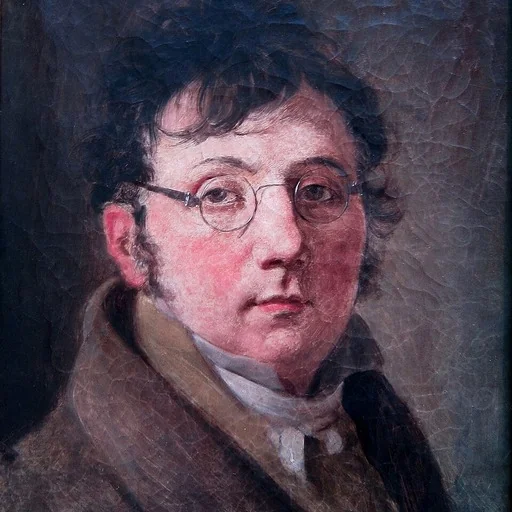
Artist
Louis-Léopold Boilly was a French painter and draftsman. A creator of popular portrait paintings, he also produced a vast number of genre paintings documenting French middle-class social life. His life and work spanned…