Artwork
A Turkish Mill, Chikoey, or River Village
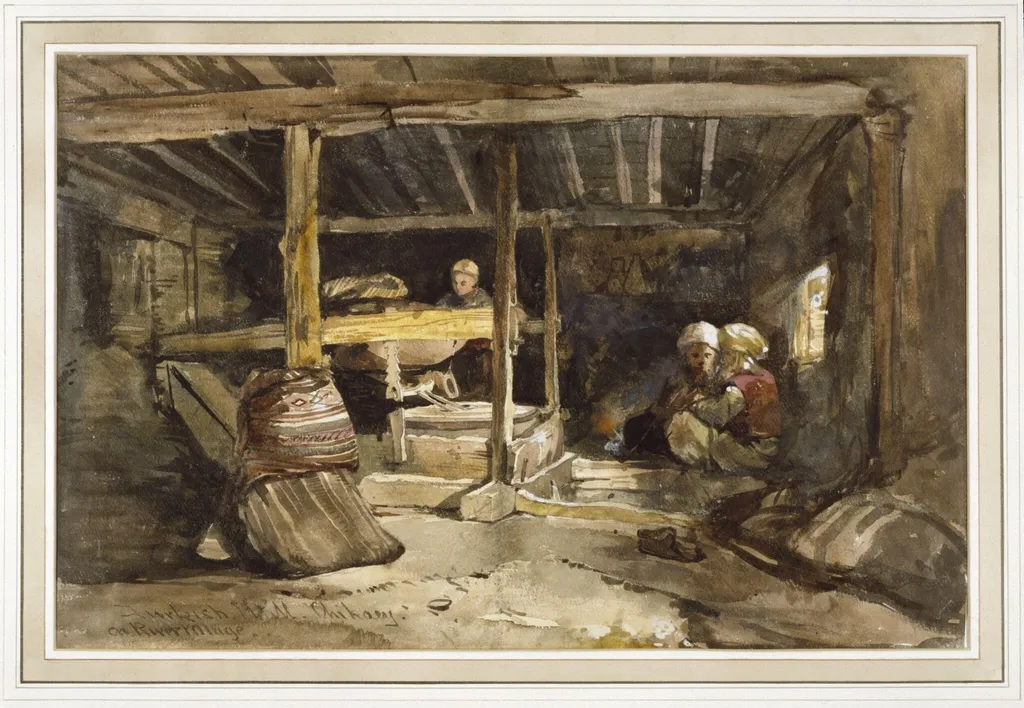
A Turkish Mill, Chikoey, or River Village is a watercolor work on paper by the Orientalist artist William James Müller. It dates from 1841 and is held in the collection of the Victoria and Albert Museum.
About this work
Overview
William James Müller’s watercolour depicts an interior scene of a rural mill in what is likely Çayköy, a village near Kaş in southwestern Turkey.
William James Müller’s watercolour depicts an interior scene of a rural mill in what is likely Çayköy, a village near Kaş in southwestern Turkey. The work is inscribed with both 'A Turkish Mill, Chikoey' and 'or River Village,' reflecting the literal meaning of Çayköy—'river village'—and suggesting Müller’s engagement with local geography. Rendered in warm, earthy tones, the painting captures quiet labor within a dim, timbered space, emphasizing atmosphere over narrative detail.
Subject & Meaning
Three figures are shown engaged in quiet work inside the mill, their postures suggesting routine rather than drama. One sits on the floor, another stands behind a large wooden mechanism, and a third is partially visible, absorbed in task. The absence of overt symbolism points to a documentary impulse: Müller records daily life in a remote settlement, valuing authenticity over idealization. The title’s dual phrasing reinforces the link between place and function—this is both a mill and a village shaped by water.
Technique & Style
Müller employs loose, expressive brushwork and a restrained palette of browns and beiges to evoke the mill’s interior. Light enters sparingly through narrow openings, casting soft pools that define form and depth. The use of chiaroscuro is subtle but effective, guiding the viewer’s gaze toward the central machinery and the figures around it. Watercolour’s transparency allows underlying layers to suggest texture, while the lack of sharp detail enhances the sense of quiet, humid stillness.
History & Provenance
Created during Müller’s travels in Anatolia in the 1840s, the work is part of a series documenting sites near Kaş, including the ancient ruins of Xanthus and Tlos. His watercolours from this period were often made on-site, serving as visual records for European audiences unfamiliar with Ottoman rural life. This piece likely originated as a study, later retained for its atmospheric quality rather than topographical precision, and remained in private hands until entering institutional collections.
Context
Müller’s depiction aligns with 19th-century European interest in the Ottoman Empire’s lesser-known regions, where artists sought to capture everyday life beyond imperial centers. Unlike grand historical scenes, this work focuses on vernacular architecture and labor, reflecting a shift toward ethnographic observation. The mill itself—powered by water from a nearby stream—illustrates traditional technology still in use, contrasting with industrializing Europe.
Legacy
Though not widely exhibited during Müller’s lifetime, this watercolour contributes to a body of work that expanded Western visual understanding of Anatolian rural communities. Its quiet realism stands apart from romanticized Orientalist tropes, offering a grounded view of domestic and economic life. Today, it remains a key example of how travel artists documented cultural specificity through intimate, unembellished observation.
Artist & collection


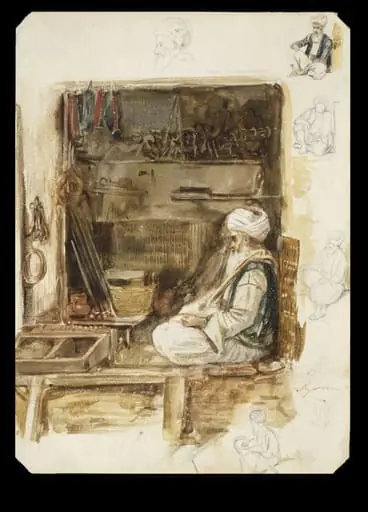 An old merchant in the Souk in Algiers; with figure studies
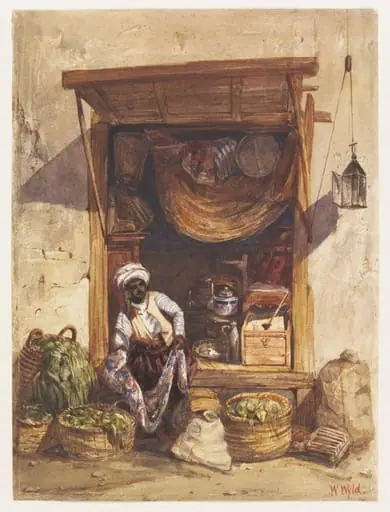 Marchand de Legumes à Alger
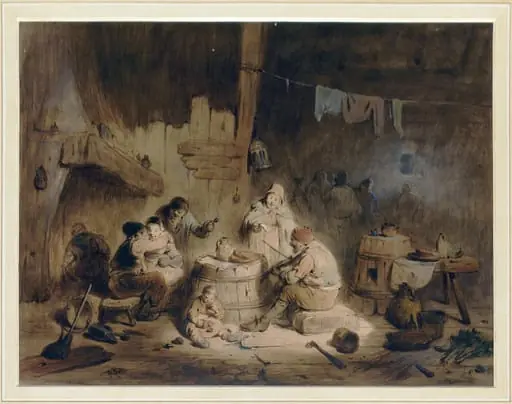 Boors in a beer shop
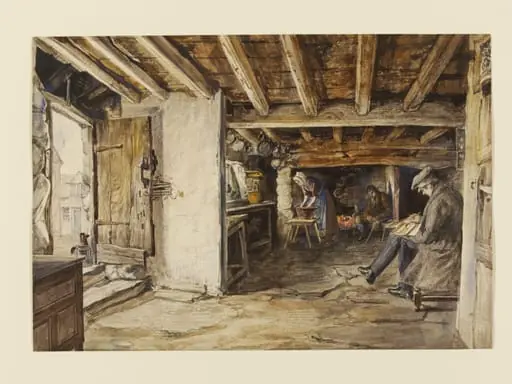 Interior of a cottage, North Wales
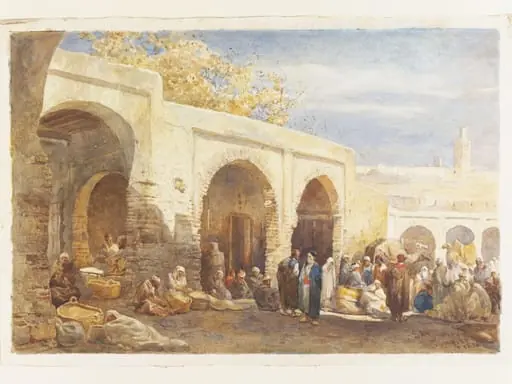 The Corn Market, Tangier
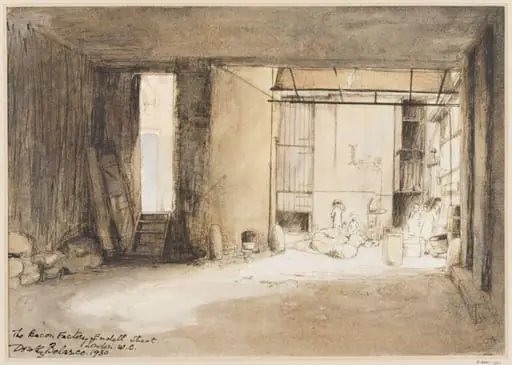 The Bacon Factory, Endell Street, London
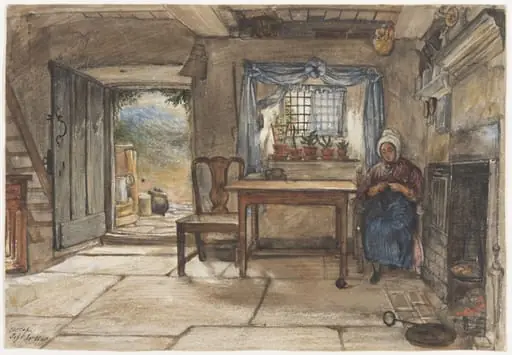 Interior of a cottage at Rievaulx, Yorkshire
 Study for The Blacksmith's Shop: Remembrance of Le Tréfort
 Egyptian Village Scene
 smithy
 Kehräävä eukko ahvenanmaalaisessa tuvassa
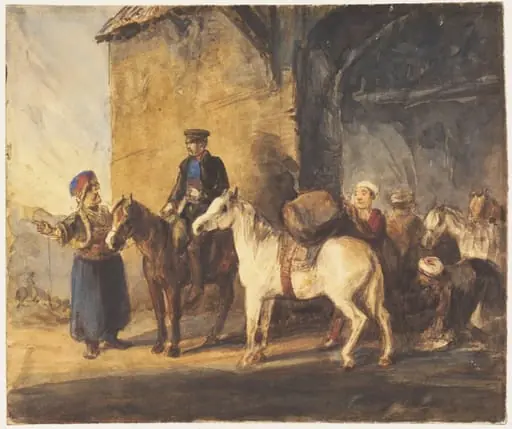 Travellers departure from a Caravanserai