Artwork
Still life – bumpkins and pumpkins in the field
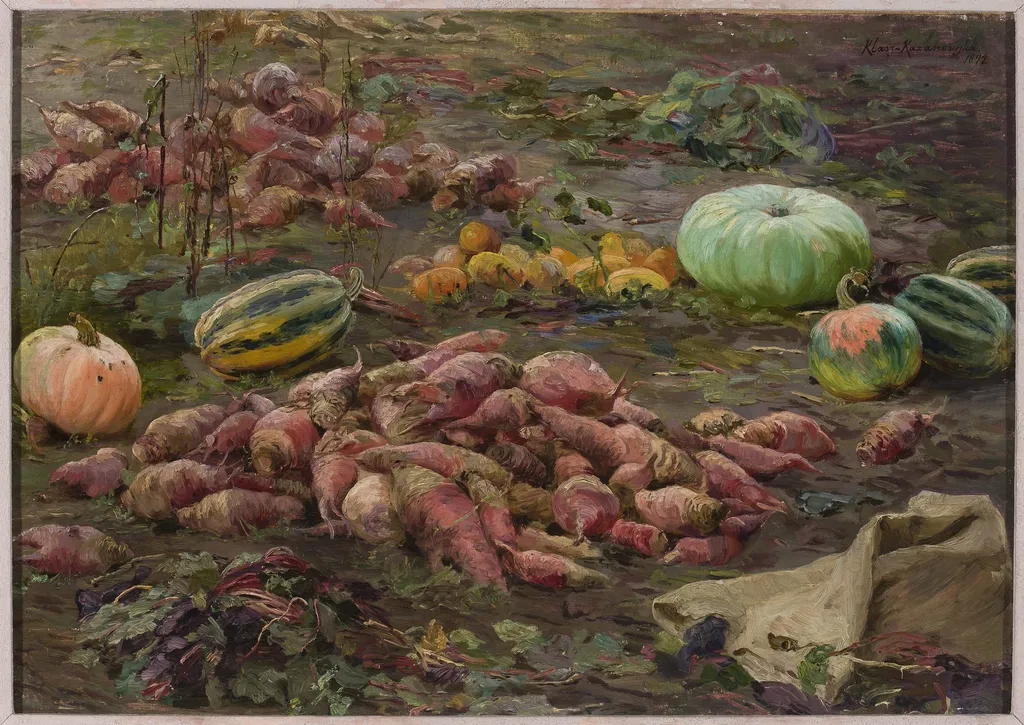
Still life – bumpkins and pumpkins in the field is an oil painting by the Impressionist artist Maria Klass-Kazanowska. It dates from 1896 and is held in the collection of the National Museum in Warsaw.
About this work
Overview
The work belongs to the collection of the National Museum in Warsaw, where it remains as a quiet testament to late 19th-century Polish realism.
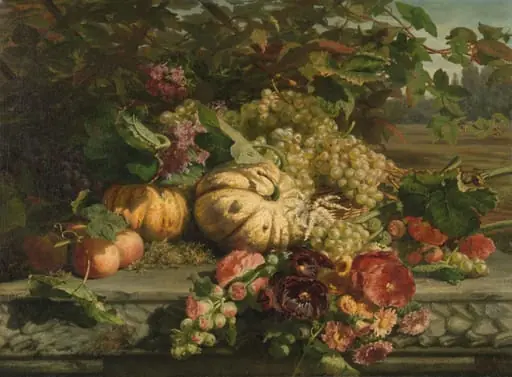
Painted in 1896 by Maria Klass-Kazanowska, this oil-on-canvas still life presents a rural scene where pumpkins and what appear to be gourds lie scattered across damp earth. Unlike traditional still lifes arranged on tables, the composition unfolds outdoors, grounding the objects in the soil of a harvested field. The work belongs to the collection of the National Museum in Warsaw, where it remains as a quiet testament to late 19th-century Polish realism.
Subject & Meaning
The painting centers on humble agricultural produce—pumpkins and gourds—left behind after harvest. Their placement on the ground suggests abandonment or casual discard, evoking themes of transience and rural labor. The absence of human figures intensifies the sense of quiet solitude, inviting reflection on the cycle of growth, harvest, and decay inherent in seasonal farming life.
Technique & Style
Klass-Kazanowska employs visible, deliberate brushwork to render the textured surfaces of the gourds and the muddy earth. Warm hues of orange and yellow contrast with the cool greens and browns of the field, creating subtle spatial depth. The paint is applied with tactile immediacy, emphasizing material presence over idealized form. Light falls unevenly, enhancing the three-dimensionality of the forms without theatrical effect.
History & Provenance
The painting was completed in 1896 and entered the National Museum in Warsaw’s collection shortly thereafter. Its provenance remains largely undocumented beyond its acquisition by the museum, suggesting it was likely acquired directly from the artist or through a contemporary Polish art dealer. It has not been widely exhibited outside Poland, preserving its status as a regional rather than international work.
Context
Created during a period when Polish artists were increasingly turning to native landscapes and rural subjects, the painting reflects a broader cultural movement away from academic idealism. Klass-Kazanowska’s focus on everyday agricultural objects aligns with the realist tendencies of the time, particularly among artists seeking to depict authentic Polish life beyond aristocratic or urban themes.
Legacy
Though not widely known outside Poland, the painting stands as an example of a quiet, unembellished realism practiced by female artists of the era. Its emphasis on ordinary, earth-bound objects challenges conventional still-life hierarchies and offers a grounded perspective on nature’s cycles. It remains a modest but significant artifact within the canon of Polish late-19th-century painting.
Own this work as a print
Artist & collection
Artist
This artist painted scenes in oil: quiet houses, animals, and the city of Kamianets-Podilskyi in the 1890s.