Artwork
Untitled
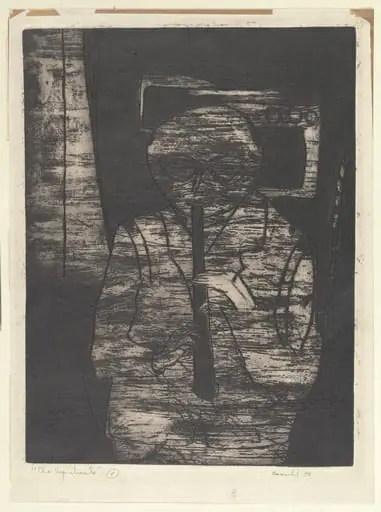
Untitled is an ink print by Mario Avati. It dates from 1950 and is held in the collection of the Museum of Modern Art.
About this work
Overview
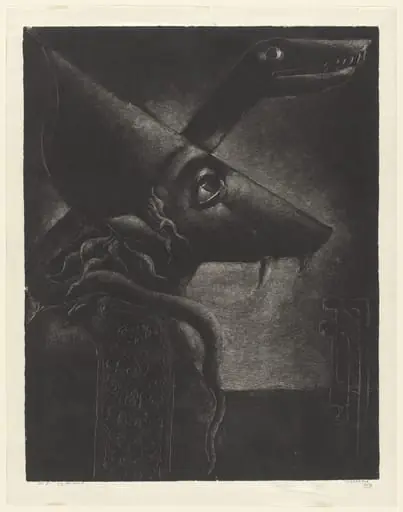
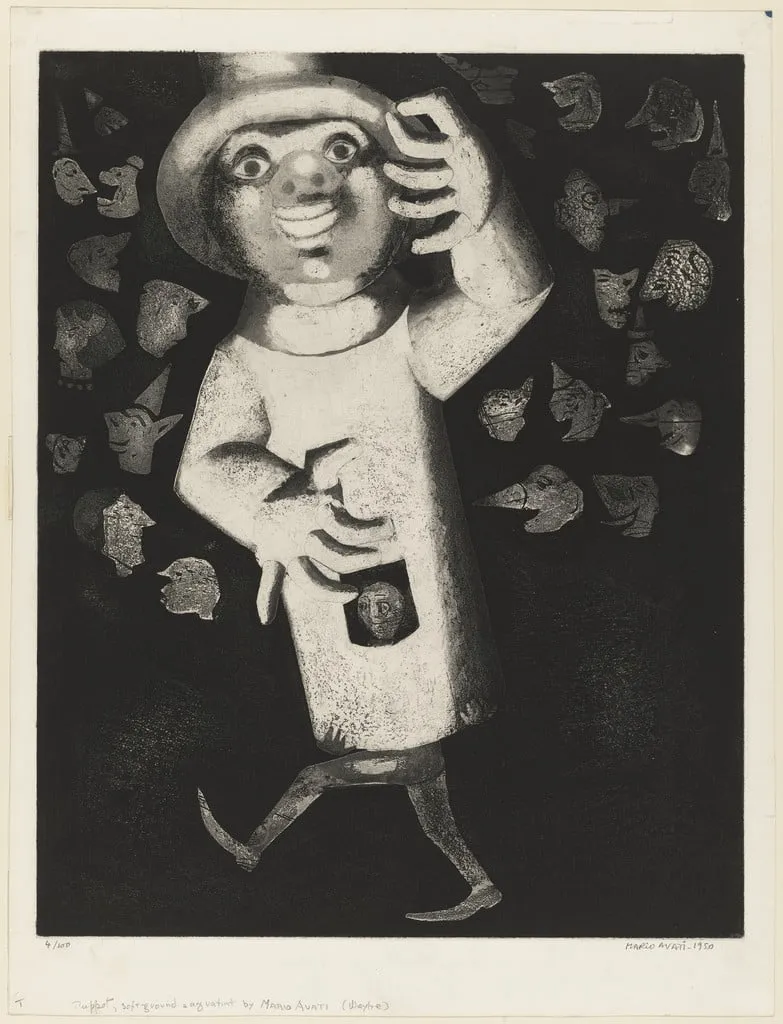
Created in 1950, this print by Mario Avati combines etching and aquatint techniques to produce a monochromatic image on paper. It is part of the collection at The Museum of Modern Art. The work presents a singular, abstracted human form against a dense black field, emphasizing contrast and texture through controlled line work and tonal variation.
Subject & Meaning
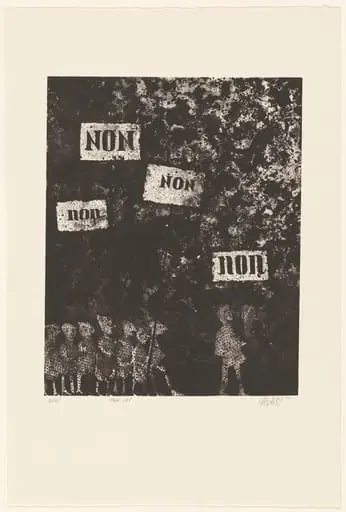
The central figure is a simplified, almost mask-like human form with exaggerated proportions—oversized hands, a broad hat, and a single supporting leg. Its posture suggests motion or strain, as if reaching upward into an unseen space. The ambiguity of the figure’s intent, combined with the abstracted background, invites interpretation without anchoring it to a specific narrative.
Technique & Style
Avati employed etching for precise linear contours and aquatint to generate soft, granular tones. The figure’s edges alternate between crisp and blurred, creating a sense of both presence and dissolution. The black background, achieved through dense aquatint, enhances the figure’s luminosity, while scattered, indistinct shapes suggest floating forms without defining them clearly.
History & Provenance
The work was produced during Avati’s early career in postwar Europe, a period marked by experimentation in printmaking. It entered The Museum of Modern Art’s collection in the mid-20th century, where it was recognized for its contribution to the revival of graphic arts. Its provenance remains tied to the artist’s studio and early exhibitions in Italy and Germany.
Context
Made in the decade following World War II, the piece reflects broader European artistic trends that favored abstraction and psychological resonance over realism. Avati’s approach aligns with contemporaries exploring the expressive potential of print media, using minimal forms to evoke emotional or existential states rather than depict literal scenes.
Legacy
This print exemplifies Avati’s role in expanding the expressive range of etching and aquatint beyond traditional illustration. Though not widely reproduced, it remains a key example of mid-century German-Italian printmaking, influencing later artists interested in the interplay of form, tone, and psychological ambiguity in graphic works.
Artist & collection