Artwork
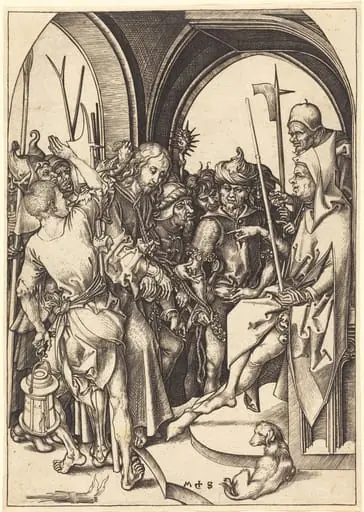
Christ Crowned with Thorns
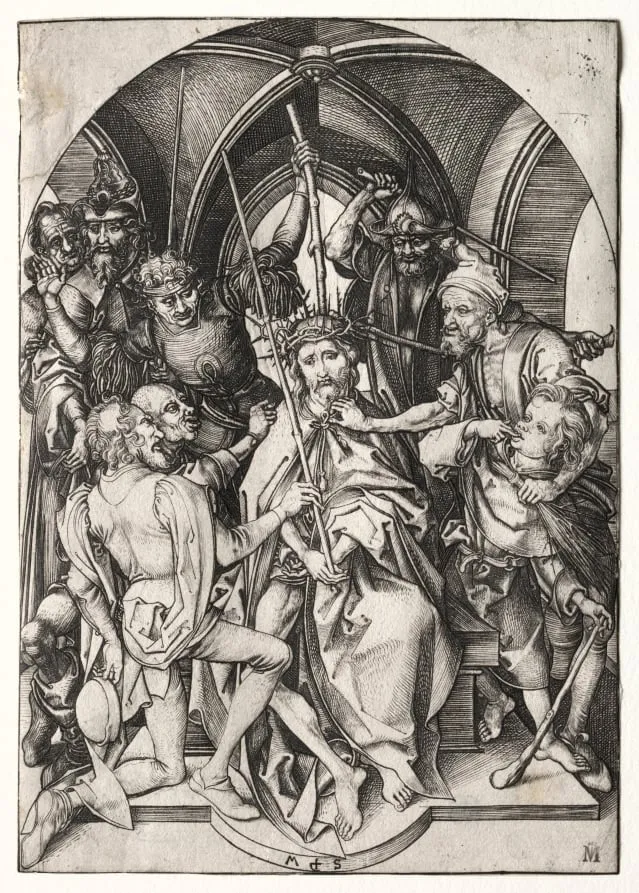
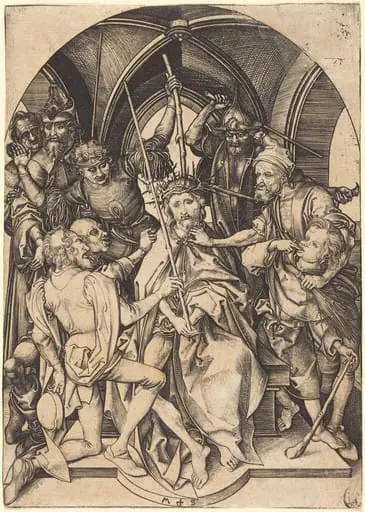
Christ Crowned with Thorns is a print by the Renaissance artist Martin Schongauer. It dates from 1476 and is held in the collection of the Cleveland Museum of Art.
About this work
Overview
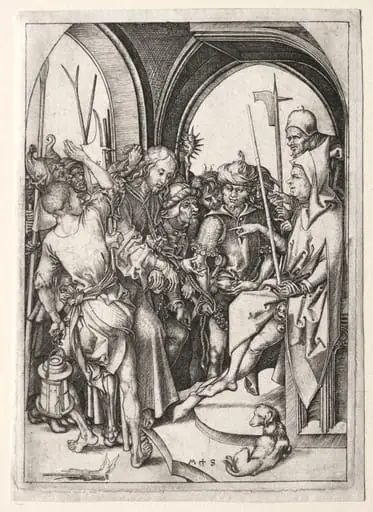
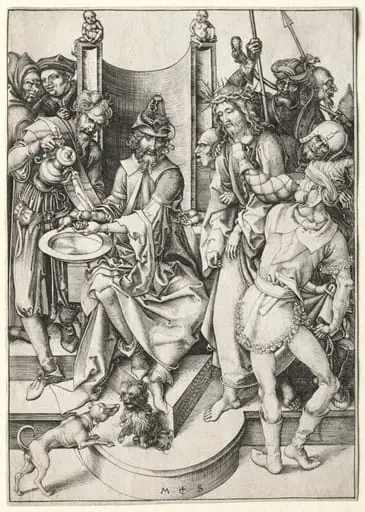
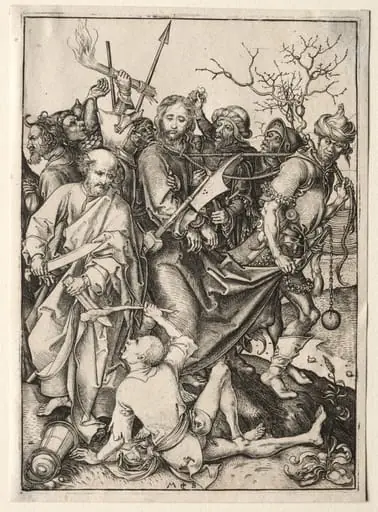
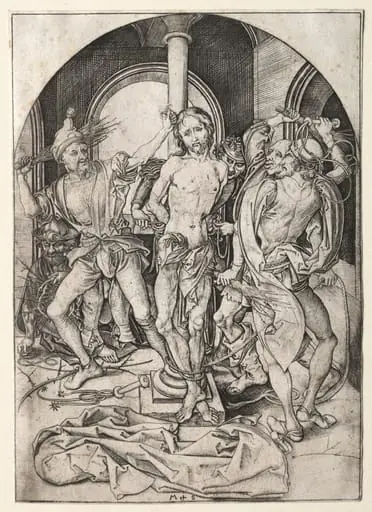
The image captures a moment of humiliation during Christ’s trial, rendered with fine, precise lines characteristic of engraving on metal.
Martin Schongauer created this engraving around 1480 as part of a twelve-print series depicting the Passion of Christ. It is among his most extensive and widely disseminated works, reproduced across Europe in the late 15th and early 16th centuries. The image captures a moment of humiliation during Christ’s trial, rendered with fine, precise lines characteristic of engraving on metal. Its popularity stemmed from its emotional intensity and detailed composition.
Subject & Meaning
Christ is shown seated on a wooden bench, crowned with thorns and clutching a reed as a mock scepter. Surrounding him are four figures, including an adult pressing the crown and another holding a rod, while a child observes silently. The scene emphasizes mockery and suffering, with the tormentors’ exaggerated expressions heightening the sense of cruelty. The inclusion of a child underscores the pervasiveness of the abuse, suggesting moral decay among all ages.
Technique & Style
Schongauer employed engraving to achieve fine, controlled lines that define texture, shadow, and form. His use of dense hatching and cross-contouring creates dramatic contrasts, lending depth to the figures and their garments. The tormentors’ faces are rendered with grotesque, almost caricatured features, intensifying the emotional weight. Unlike painting, the medium’s precision allowed for sharp detail and mass reproduction, contributing to the print’s wide circulation.
History & Provenance
Produced in the 1480s, this engraving was part of a larger Passion cycle that became one of Schongauer’s most influential works. Copies appeared in Germany, the Netherlands, and Italy, often adapted by other artists. Its dissemination helped standardize visual narratives of Christ’s suffering in Northern Europe. Original impressions survive in major collections, including those of the British Museum and the Metropolitan Museum of Art.
Context
In the late 15th century, devotional imagery focused on Christ’s physical suffering as a means of fostering empathy and piety. Schongauer’s emphasis on the brutality of the crowd aligned with contemporary religious trends that prioritized emotional engagement over idealized beauty. The print’s accessibility through reproduction made it a tool for private devotion and public instruction in an increasingly literate society.
Legacy
Schongauer’s engraving influenced generations of Northern Renaissance artists, including Albrecht Dürer, who admired his technical mastery. The composition’s emotional clarity and expressive distortion became a model for depicting sacred suffering. Its widespread circulation helped establish engraving as a serious artistic medium, bridging the gap between manuscript illumination and the later print revolutions of the 16th century.
Artist & collection

Artist
Martin Schongauer, also known as Martin Schön or Hübsch Martin by his contemporaries, was an Alsatian engraver and painter.