Artwork
The Passion: Christ Before Pilate
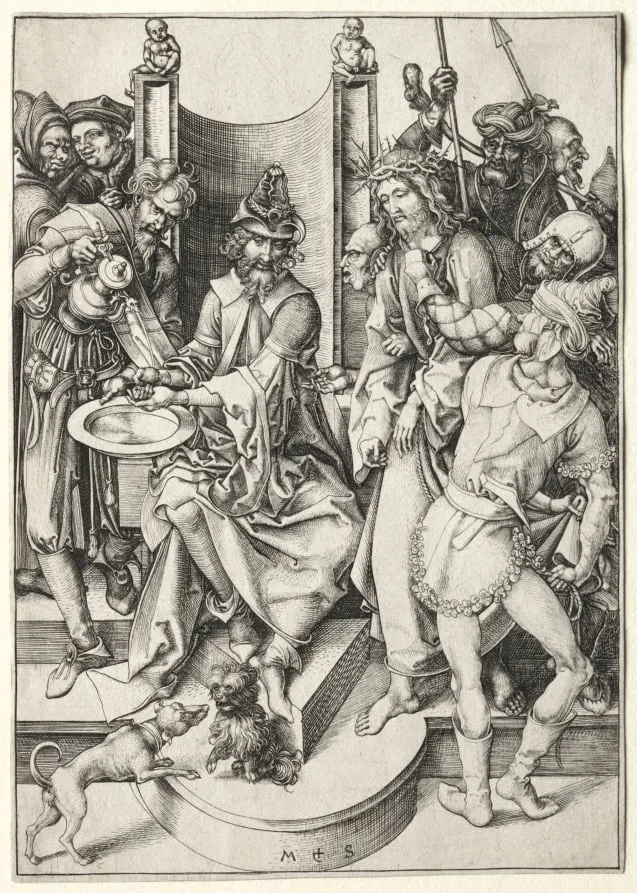
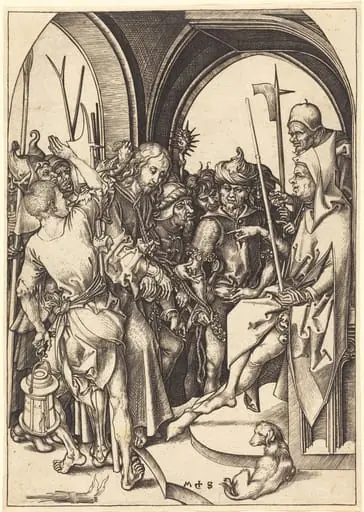
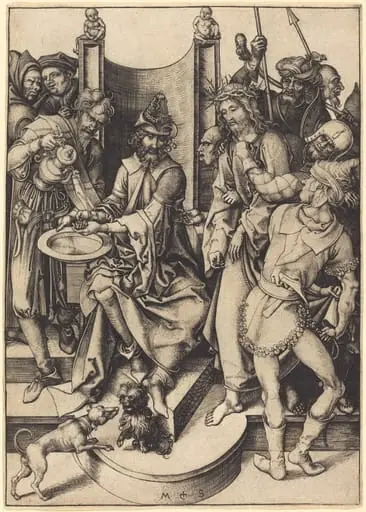
The Passion: Christ Before Pilate is a print by the Renaissance artist Martin Schongauer. It dates from 1480 and is held in the collection of the Cleveland Museum of Art.
About this work
Overview
This work, among the earliest to achieve wide circulation across Europe, captures key moments from Christ’s final days with intense emotional detail.
Martin Schongauer created a series of twelve engravings depicting the Passion of Christ around 1480, his most extensive print cycle. This work, among the earliest to achieve wide circulation across Europe, captures key moments from Christ’s final days with intense emotional detail. The series was widely reproduced, influencing generations of artists through its precise line work and dramatic compositions.
Subject & Meaning
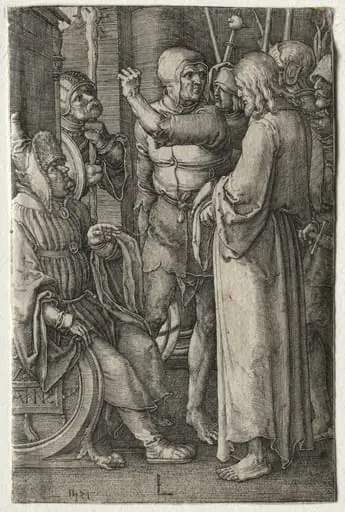
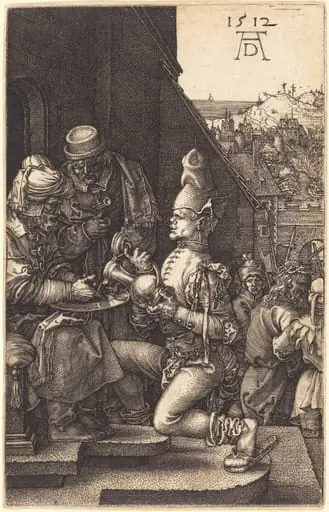
The scene portrays Christ standing before Pontius Pilate, the Roman governor who, after washing his hands in a basin, condemns him to crucifixion. The act of hand-washing symbolizes Pilate’s attempt to absolve himself of moral responsibility. Around them, a dense assembly of soldiers, priests, and spectators reveals varied reactions—hostility, indifference, and curiosity—emphasizing the human dimensions of divine judgment.
Technique & Style
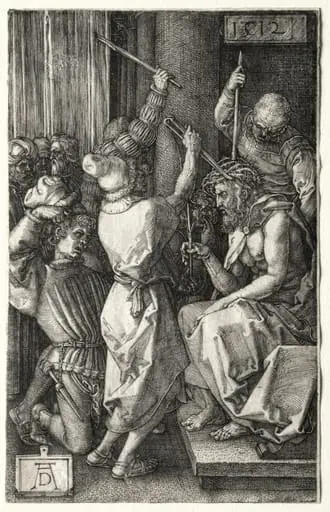
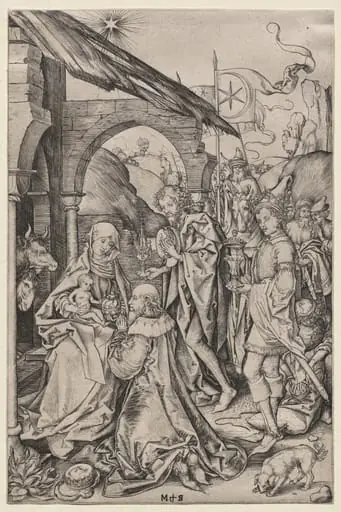
Schongauer employed fine-line engraving on copper, achieving remarkable detail through controlled incisions. The folds of Christ’s robe, the texture of skin, and the gleam of the silver basin are rendered with precision. He used dense cross-hatching to model form and suggest depth, creating a sense of volume and atmosphere. The composition’s tight clustering of figures heightens tension, while subtle tonal contrasts enhance emotional gravity.
History & Provenance
Produced in the late 15th century in Colmar, the prints were distributed widely through trade networks, reaching Italy, Germany, and the Low Countries. Copies and adaptations by other artists attest to their influence. Original impressions are rare; surviving examples reside in major European collections, valued for their technical innovation and early role in the dissemination of religious imagery.
Context
Schongauer worked during a period when printmaking was emerging as a medium for mass religious instruction. His engravings responded to growing lay piety and the demand for devotional images outside church walls. The detailed, emotionally charged scenes mirrored contemporary sermons and Passion plays, making biblical narratives accessible to a broader, non-literate audience.
Legacy
Schongauer’s Passion series set a standard for narrative clarity and emotional intensity in early printmaking. His handling of line and expression influenced Albrecht Dürer and other Northern Renaissance artists. The technical mastery demonstrated in these engravings helped elevate printmaking from craft to a respected artistic discipline, securing its place in the visual culture of early modern Europe.
Artist & collection

Artist
Martin Schongauer, also known as Martin Schön or Hübsch Martin by his contemporaries, was an Alsatian engraver and painter.