Artwork
Mirabeau arrive aux Champs-Élisées
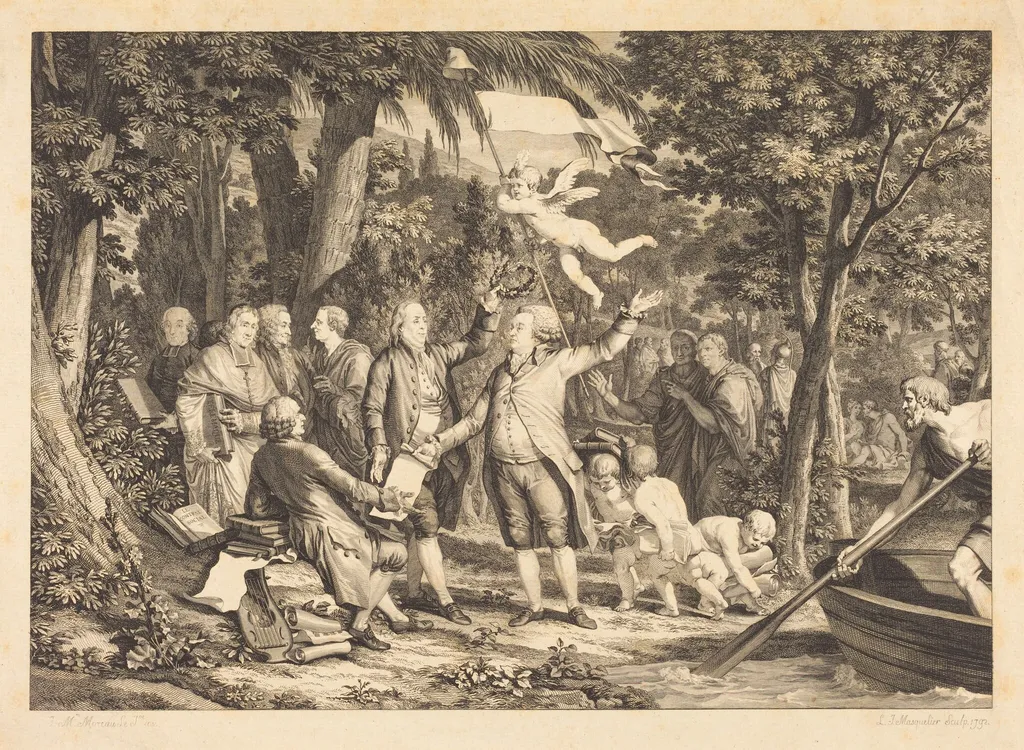
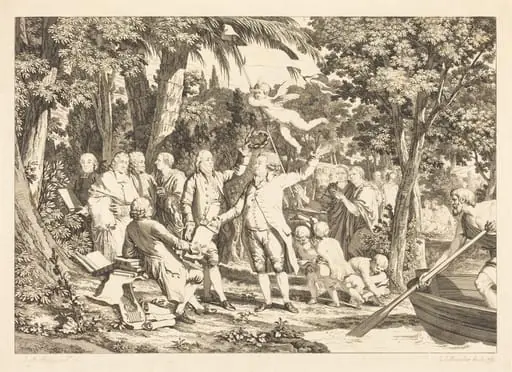
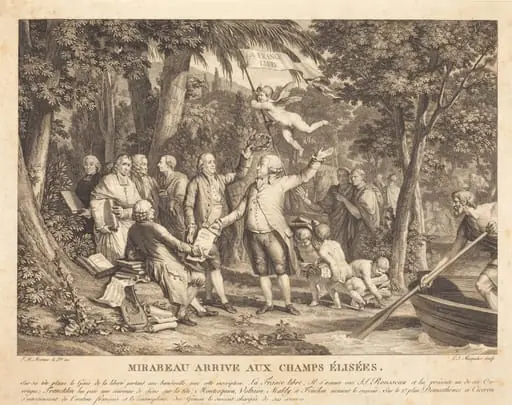
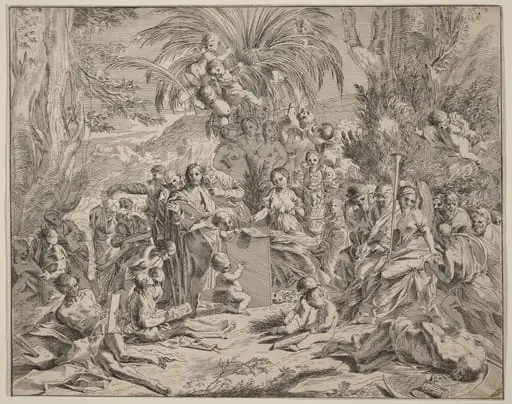
Mirabeau arrive aux Champs-Élisées is an ink print by the Romanticist artist Louis-Joseph Masquelier. It dates from 1792 and is held in the collection of the National Gallery of Art.
About this work
Overview
Mirabeau arrive aux Champs-Élisées is an etching and engraving print created by Louis-Joseph Masquelier in 1792. The work depicts a scene of communal gathering and celebration.
Subject & Meaning
At the center, a man in 18th-century attire holds a paper and gazes upwards towards a flying cherub, conveying a sense of joyful announcement or revelation. Surrounding figures in robes observe with interest, suggesting a moment of shared significance.
Technique & Style
Executed in etching and engraving, the print showcases Masquelier's use of line work to define figures, textures, and spatial depth, characteristic of late 18th-century printmaking techniques.
History & Provenance
Created in 1792, the print's historical context coincides with the French Revolution's early years, though its direct thematic relation to this period is not explicitly clear from the depicted scene.
Context
While the scene's elements (cherub, robes) might evoke religious or allegorical themes, the overall mood aligns with the emerging expressive and emotive qualities of the Romantic movement, though it is more closely tied to the transitional period from Neoclassicism.
Legacy
The print reflects Masquelier's contribution to late 18th-century French printmaking, with its style and themes bridging between Neoclassical clarity and the expressive tendencies of early Romanticism.
Artist & collection