Artwork
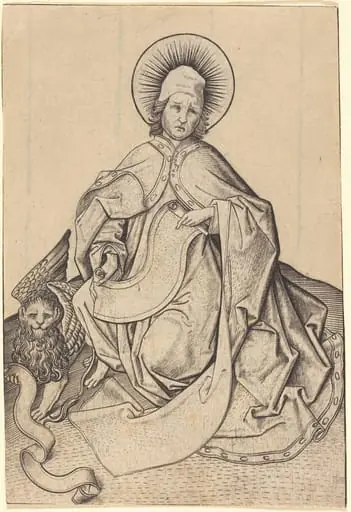
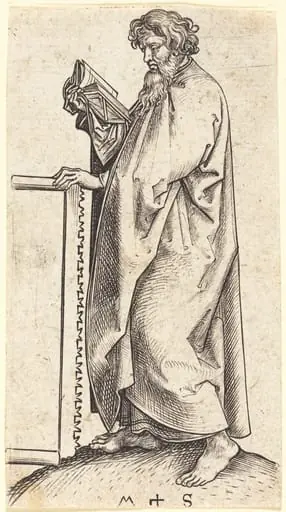
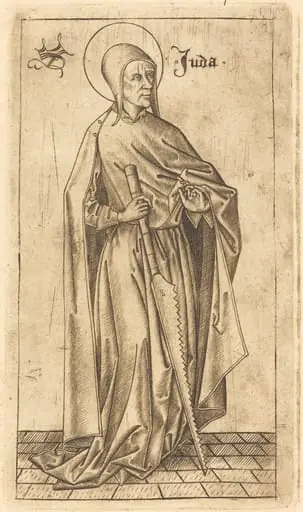
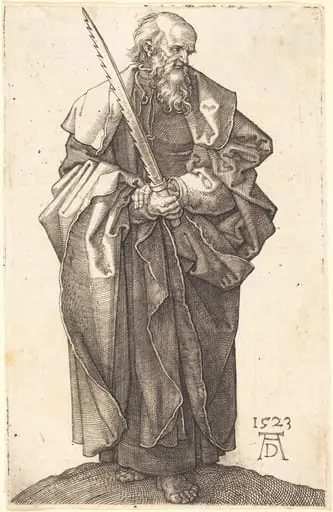
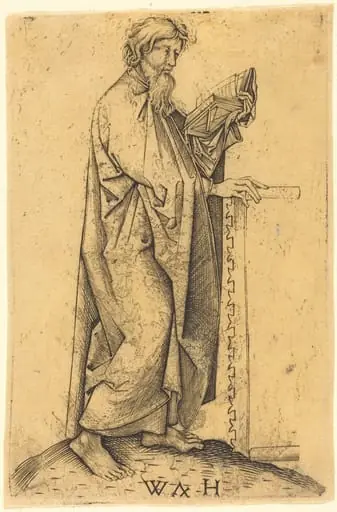
The Apostle Simon Zelotes
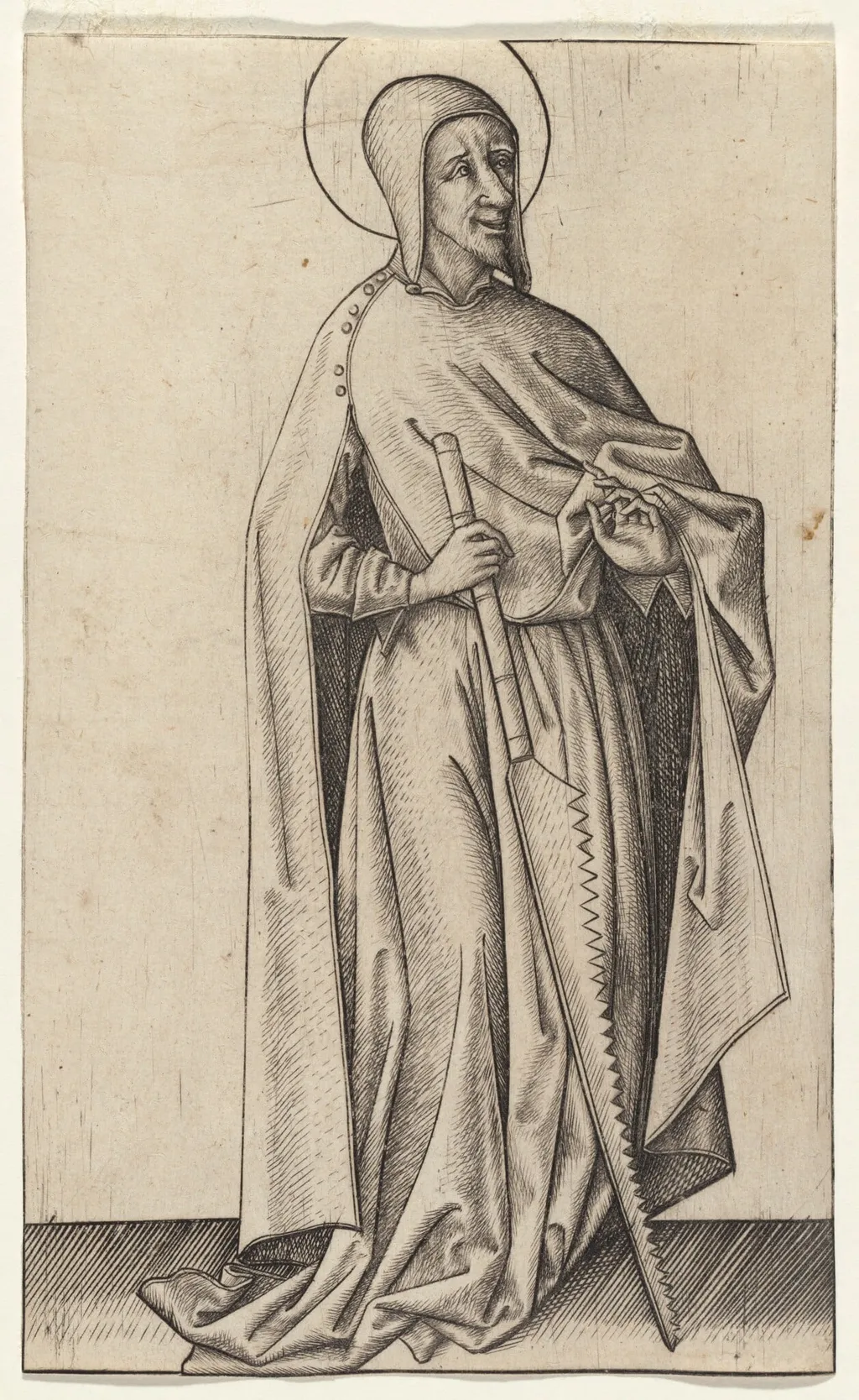
The Apostle Simon Zelotes is an ink print by the Renaissance artist Master E.S.. It dates from 1462 and is held in the collection of the National Gallery of Art.
About this work
Overview
This work is one of eighteen surviving pieces bearing his monogram, a practice that helped establish the artist’s identity in the emerging print market.
Created around 1462, *The Apostle Simon Zelotes* is an engraving on laid paper by an anonymous German artist known as Master E. S. Active between 1420 and 1468, he was among the earliest practitioners of fine printmaking in Germany. This work is one of eighteen surviving pieces bearing his monogram, a practice that helped establish the artist’s identity in the emerging print market. The piece resides in the National Gallery of Art in Washington, D.C.
Subject & Meaning
The image depicts Simon the Zealot, one of Christ’s twelve apostles, shown in prayerful repose. He kneels on one knee, clad in a hooded robe secured by a simple belt, with a halo marking his sanctity. In one hand he holds a long staff, possibly symbolizing his missionary journey; in the other, a small object—perhaps a saw, referencing his traditional martyrdom. His composed expression conveys quiet devotion rather than dramatic intensity.
Technique & Style
Master E. S. employed fine-line engraving on copper, using cross-hatching to model form and depth. Layers of intersecting lines build tonal gradations, defining the folds of fabric and the contours of the figure with precision. The meticulous control of line suggests training in metalwork, likely as a goldsmith. The composition is tightly focused, with no background distractions, emphasizing the figure’s spiritual presence.
History & Provenance
The print was produced in the mid-15th century, during a period when engraved images began circulating beyond ecclesiastical circles. Master E. S.’s signed works, including this one, represent some of the earliest instances of artists marking their prints with monograms to assert authorship. The National Gallery of Art acquired the work as part of its broader collection of early European prints, preserving its historical significance.
Context
In the decades before Dürer, German printmakers like Master E. S. laid the groundwork for the medium’s artistic legitimacy. His work emerged alongside devotional imagery used in private worship and monastic settings. The use of a monogram, rather than a full signature, reflects both guild traditions and the nascent concept of the individual artist in a pre-industrial craft economy.
Legacy
Master E. S. helped transition printmaking from a reproductive craft to a vehicle for individual artistic expression. His disciplined technique and consistent monogram influenced later engravers in the Rhineland and beyond. Though little is known of his life, his signed works remain key references in the study of early German print culture and the evolution of artist identity.
Artist & collection

Artist
Master E. S. (c. 1420 – c. 1468; previously known as the Master of 1466) is an unidentified German engraver, goldsmith, and printmaker of the late Gothic period. He was the first major German artist of old master prints…