Artwork
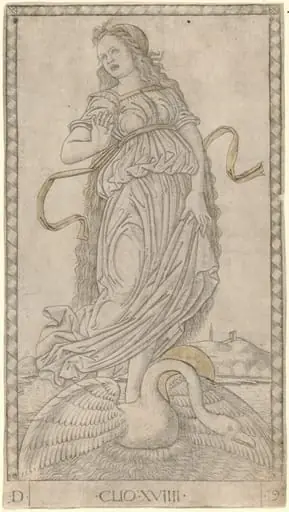
Caliope (Calliope)
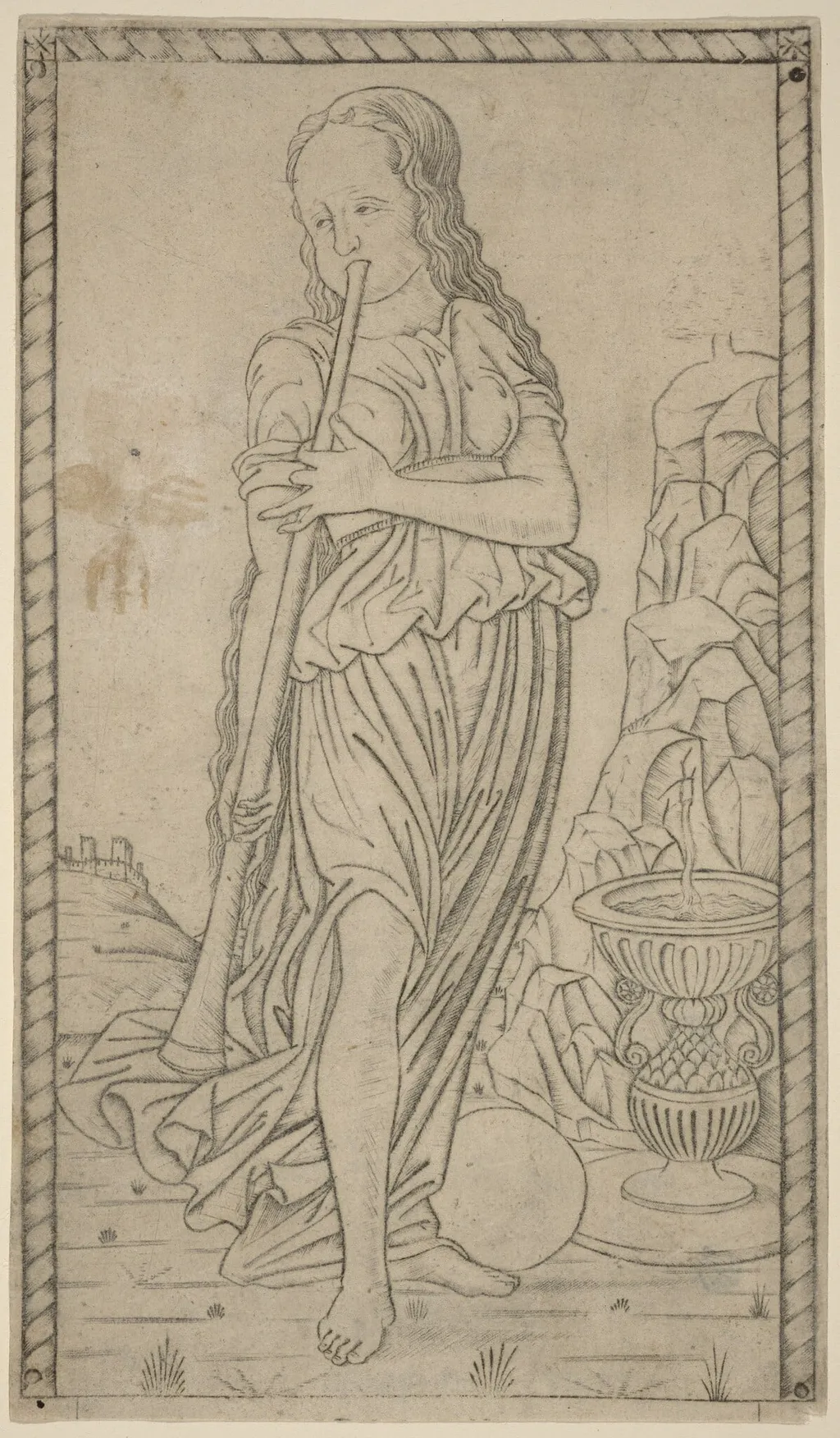
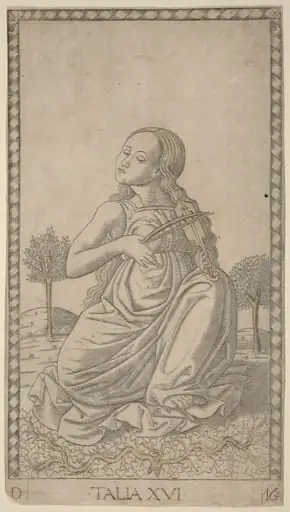
Caliope (Calliope) is an ink print by the Renaissance artist Master of the E-Series Tarocchi. It dates from 1465 and is held in the collection of the National Gallery of Art. Caliope, an engraving dated to around 1465, is attributed to the anonymous hand known as the Master of the E‑Series Tarocchi.
About this work
Overview
Caliope, an engraving dated to around 1465, is attributed to the anonymous hand known as the Master of the E‑Series Tarocchi. Executed in black and white on a metal plate, the print presents a solitary female figure within a tranquil garden setting.
Subject & Meaning
The central figure, identified as the muse Calliope, stands barefoot, holding a slender staff in one hand while the other rests on her hip, a finger gently placed to her lips. The surrounding garden, a fountain, and a distant castle suggest an allegorical space that blends poetic inspiration with a serene, slightly enigmatic atmosphere.
Technique & Style
The artist employed fine linear incisions and delicate cross‑hatching to render the folds of the woman's garments and the texture of the stone wall. Subtle gradations of tone create depth, while the crisp outlines define the composition, exemplifying the precision characteristic of mid‑15th‑century Northern European engraving.
History & Provenance
Attributed to the Master of the E‑Series Tarocchi, a figure associated with a series of tarot‑related prints, the work reflects the period’s interest in allegorical and mythological subjects. Its survival in print form has allowed scholars to trace the dissemination of such iconography across European artistic circles of the late medieval era.
Artist & collection
Artist
Master of the E-Series Tarocchi
Master of the E-Series Tarocchi (b. 1400) was an Italian artist.