Artwork
Talia (Thalia)
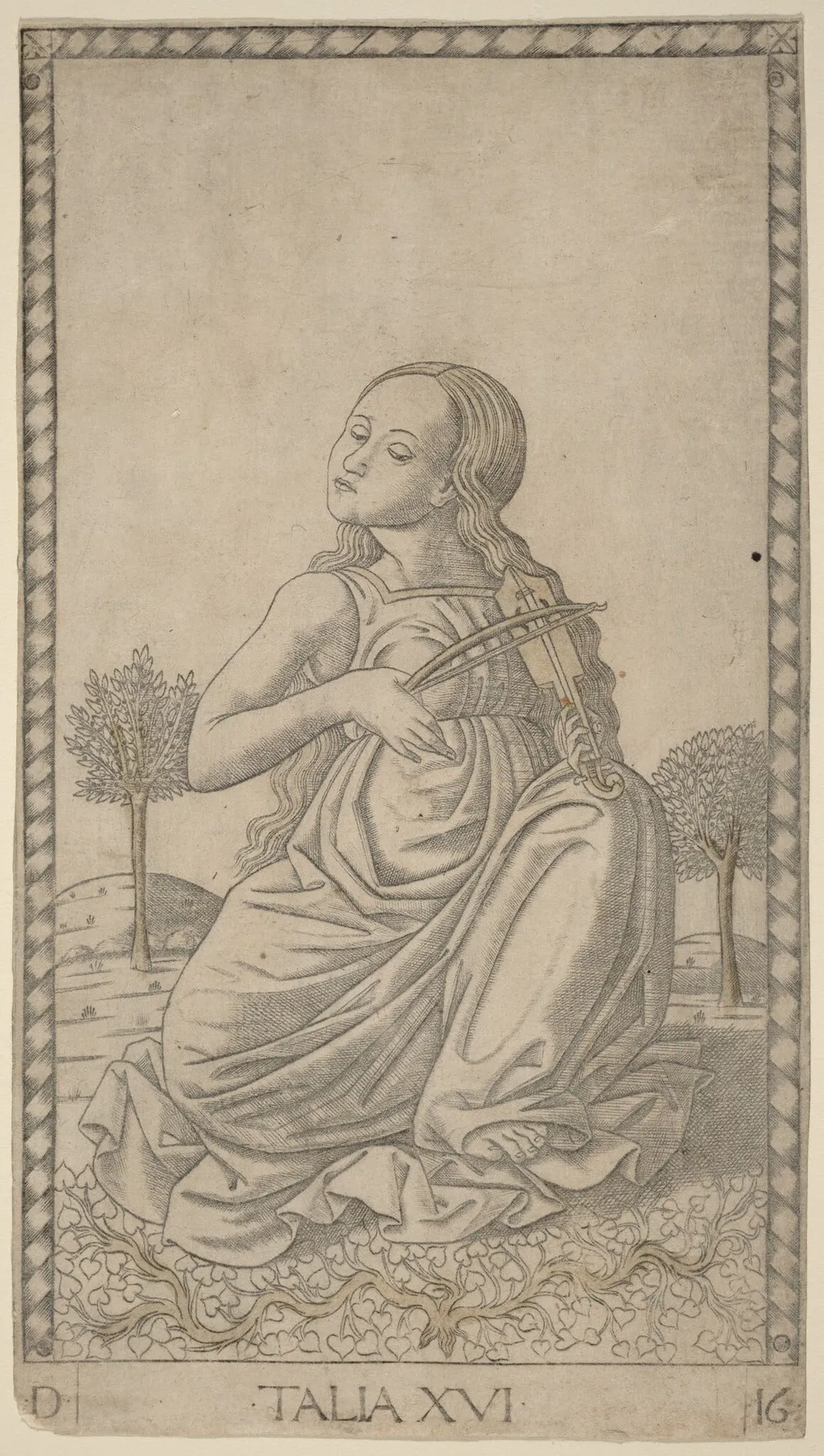
Talia (Thalia) is an ink print by the Renaissance artist Master of the E-Series Tarocchi. It dates from 1465 and is held in the collection of the National Gallery of Art. Created around 1465, this engraving by the anonymous Master of the E‑Series Tarocchi depicts the figure known as Talia (or Thalia).
About this work
Overview
Created around 1465, this engraving by the anonymous Master of the E‑Series Tarocchi depicts the figure known as Talia (or Thalia). Executed on paper with traces of gilding, the work belongs to the late medieval tradition of illustrated tarot or allegorical series, where each plate represents a personified concept or character.
Subject & Meaning
The central figure is a woman rendered with a solemn expression, dressed in period attire that suggests a timeless, perhaps mythological, identity. Her pose and the surrounding motifs invite interpretation as an embodiment of a particular virtue or muse, consistent with the allegorical purposes of the Tarocchi series.
Technique & Style
The image is produced through fine engraving, a process that incises lines into a metal plate before transferring the design onto paper. The artist employs dense cross‑hatching and parallel strokes to model the textures of the garment and to suggest depth in the background, while occasional gilded highlights accentuate key details.
History & Provenance
Attributed to the Master of the E‑Series Tarocchi, an anonymous workshop active in mid‑15th‑century Italy, the print forms part of a broader corpus of tarot‑like cards that circulated among collectors and scholars. Its survival in multiple impressions indicates it was reproduced for a niche audience interested in esoteric or educational imagery.
Artist & collection
Artist
Master of the E-Series Tarocchi
Master of the E-Series Tarocchi (b. 1400) was an Italian artist.

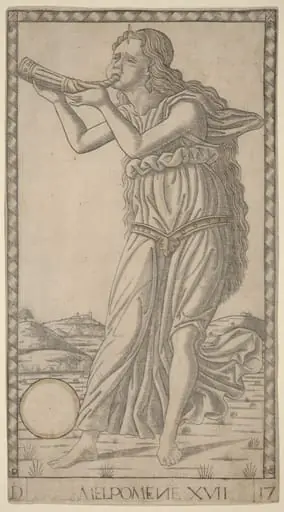
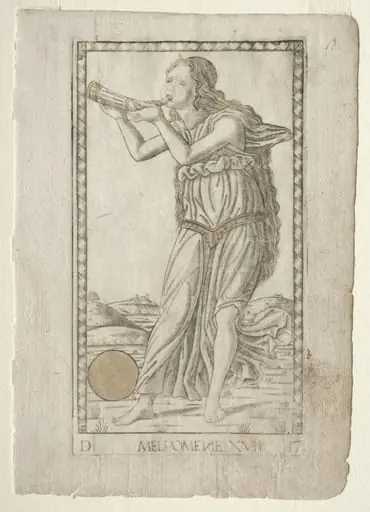 Melpomene (tragedy) (from the Tarocchi series D: Apollo and the Muses, #17)
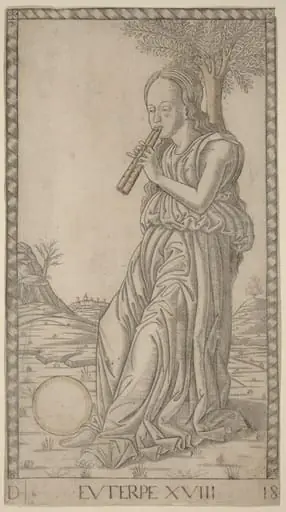 Euterpe
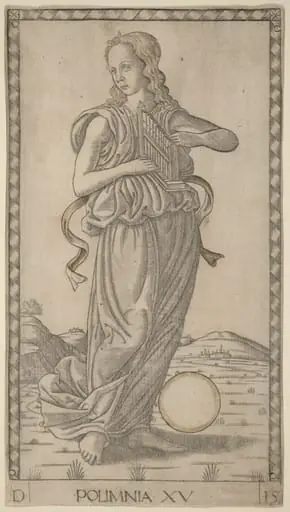 Polimnia (Polyhymnia)
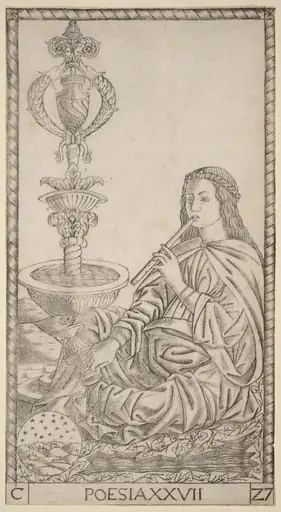 Poesia (Poetry)
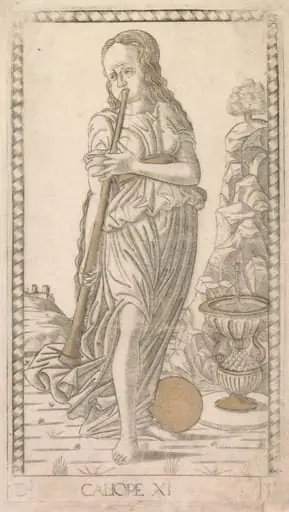 Calliope (from the Tarocchi series D: Apollo and the Muses, #11)
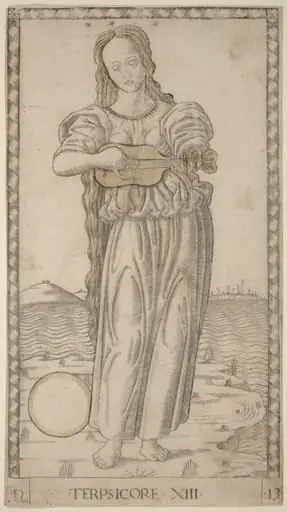 Terpsicore (Terpsichore)
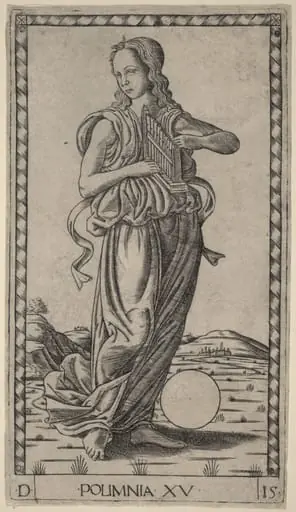 Polimnia (Polyhymnia)
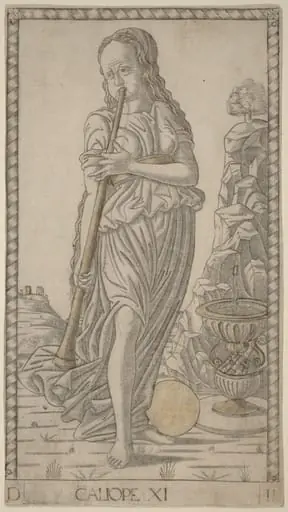 Caliope (Calliope)
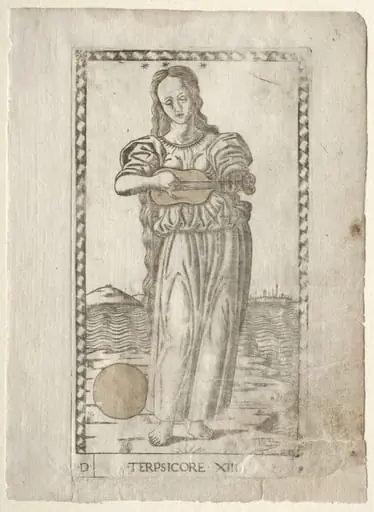 Terpsichore (dancing and song) (from the Tarocchi series D: Apollo and the Muses, #13)