Artwork
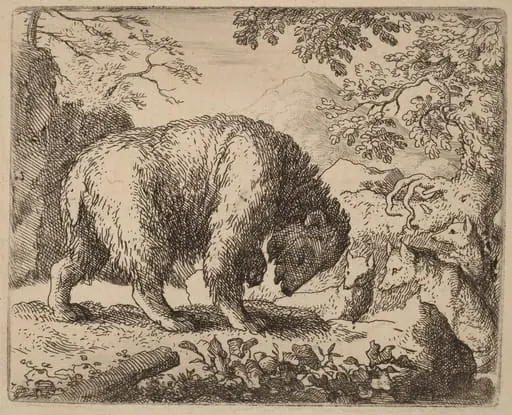
Mountainous Landscape with Bear in the Foreground
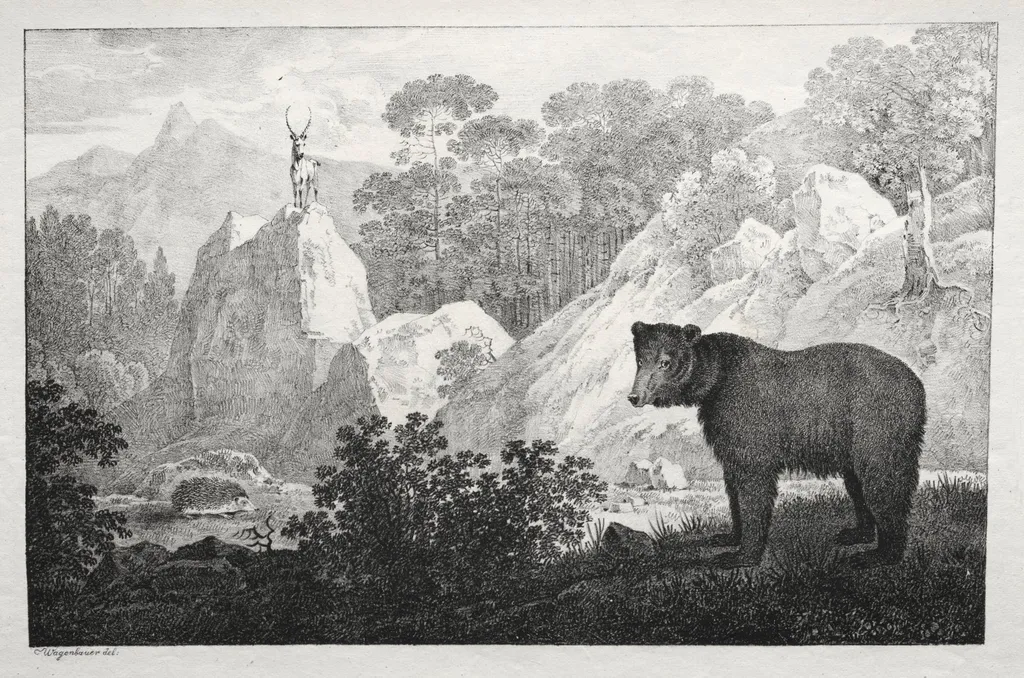
Mountainous Landscape with Bear in the Foreground is a print by Maximilian Josef Wagenbauer. It dates from 1811 and is held in the collection of the Cleveland Museum of Art.
About this work
Overview
Wagenbauer, trained in Munich under Johann Jakob Dorner the Elder, transitioned from Neo-Classical watercolors to oil painting after receiving royal patronage.
Created around 1811 by Bavarian artist Maximilian Joseph Wagenbauer, this print captures a remote alpine environment with precise attention to natural detail. Wagenbauer, trained in Munich under Johann Jakob Dorner the Elder, transitioned from Neo-Classical watercolors to oil painting after receiving royal patronage. The work reflects his mature interest in untamed landscapes, rendered with careful tonal modeling to suggest depth and atmosphere.
Subject & Meaning
The scene presents a solitary bear seated on a rocky outcrop, gazing directly at the viewer, while a deer stands atop a distant peak, turned away. Below, a modest village rests in the valley, framed by trees and a winding river. The juxtaposition of wild and settled life suggests a quiet tension between nature and human habitation, without overt symbolism—offering instead a contemplative view of alpine ecology.
Technique & Style
Wagenbauer employed subtle shading and graduated tones to model form and space, using chiaroscuro to define the bear’s fur and the snow-capped ridges. The composition layers foreground, midground, and background with deliberate spatial recession, enhancing the sense of depth. Lines are controlled and precise, avoiding dramatic brushwork in favor of quiet realism, characteristic of his shift from academic watercolor to more textured oil-based techniques.
History & Provenance
The print was produced during Wagenbauer’s period of royal support, following his studies in Munich and his early career in watercolor. Though few records detail its immediate ownership, it aligns with his documented focus on Bavarian alpine scenery during the early 1810s. The work likely originated as a preparatory study or independent print, reflecting his personal engagement with regional topography rather than commissioned patronage.
Context
In early 19th-century Bavaria, landscape art was gaining traction as a genre distinct from historical or religious themes. Wagenbauer’s focus on wild, unpopulated terrain aligned with broader European interests in naturalism and the sublime, though his approach remained restrained compared to Romantic exaggerations. His work contributed to a regional tradition of topographical accuracy in Alpine imagery.
Legacy
Wagenbauer’s prints and paintings helped document the Bavarian Alps with scientific precision and aesthetic restraint. While not widely known outside regional collections, his emphasis on observed nature influenced later local artists interested in landscape as a subject in its own right. This print endures as a quiet example of pre-Romantic naturalism in German-speaking art.
Own this work as a print
Artist & collection

Artist
Maximilian Joseph Wagenbauer (1775 in Grafing – 1829 in Munich), was a Bavarian artist.

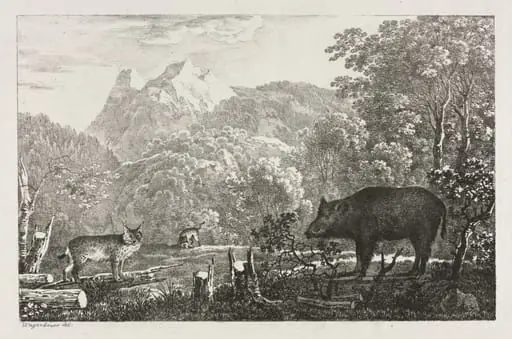 Wild Boar, Wildcat and Lynx
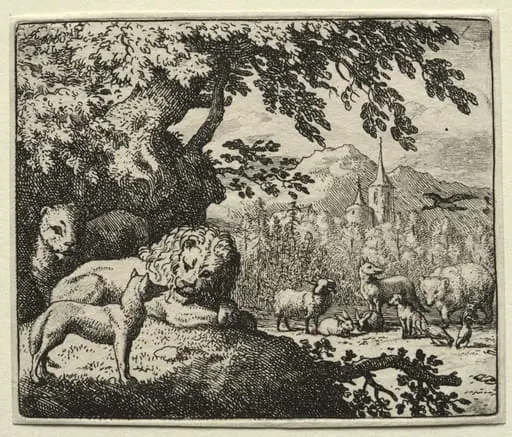 Reynard the Fox: Reynard Continues His Story
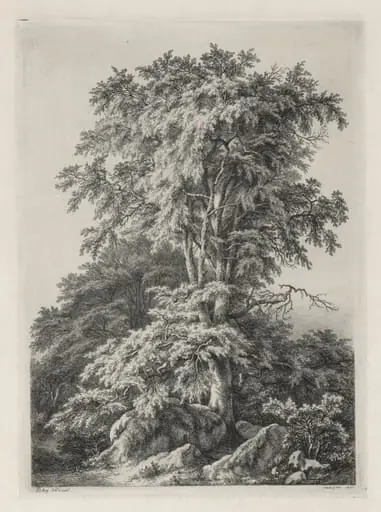 Studies Drawn and Engraved after Nature: The Beach, Fontainebleau (Études dessinées et Gravées D'après nature: Le hêtre, Fontainebleau)
 A Horse Frightened by a Lion
 Reynard the Fox: The Freeing of the Wolf and the Bear
 Reynard the Fox: Reynard Tells of Hidden Treasure
 Ram and Two Sheep
 The Bear Distracted with Talk of Honey
 A Subiaco (Near Subiaco)
 Heroic Landscape: The Satyr Playing the Flute