Artwork
Crucified Man
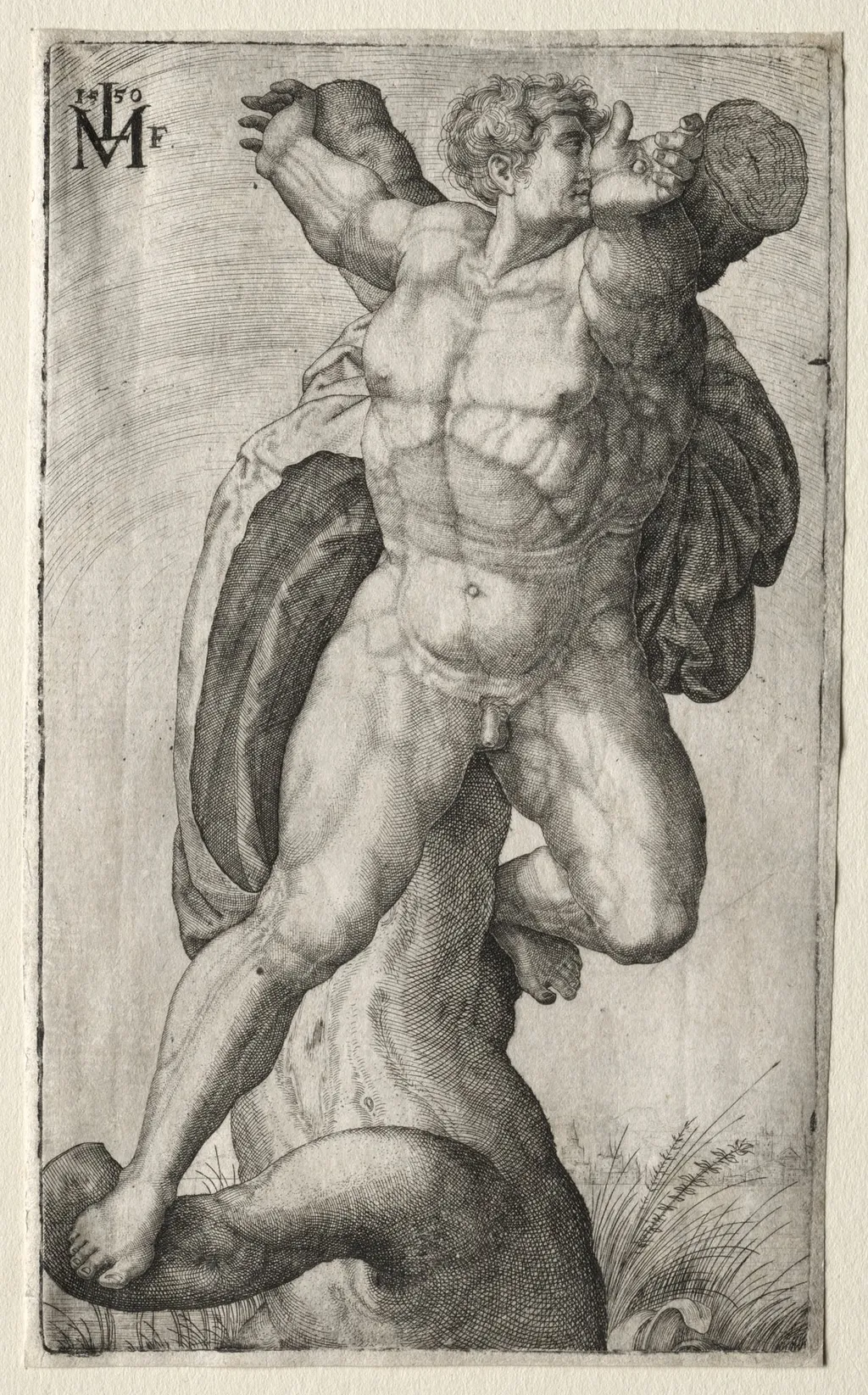
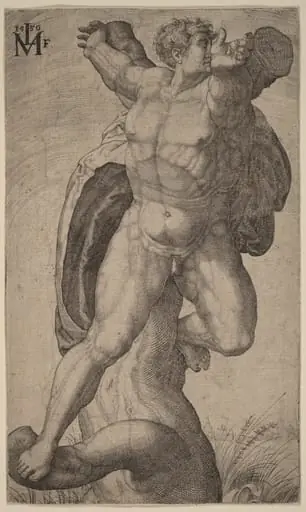
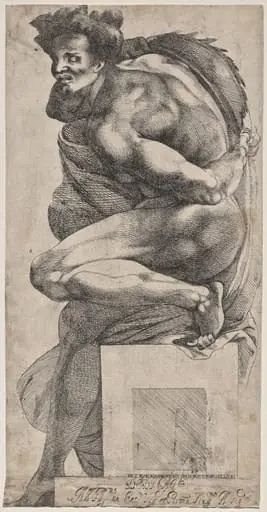
Crucified Man is a print by the Renaissance artist Melchior Lorck. It dates from 1550 and is held in the collection of the Cleveland Museum of Art.
About this work
It’s a study of a figure from Michelangelo’s Sistine Chapel, but Lorck missed the mark on depth and scale.
This print shows a man nailed to a cross, his body twisted and muscles tight. It’s a study of a figure from Michelangelo’s Sistine Chapel, but Lorck missed the mark on depth and scale. His lines are sharp, but the foreshortening feels off—like the head’s too small for the rest.
Lorck was Danish but worked in Germany. Artists there in 1550 often copied Italian prints, not life. They relied on outlines instead of real models.
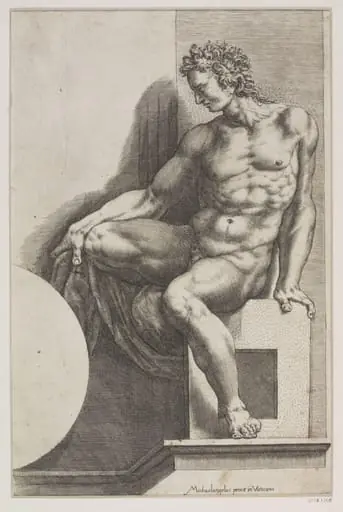
See how Lorck’s style compares to another printmaker. Look up Melchior Lorck (Danish, 1526/27–after 1588).
Overview
Crucified Man is a print by Danish artist Melchior Lorck, based on the figure of Haman from Michelangelo’s Sistine Chapel ceiling. The work showcases Lorck’s attempt to replicate Michelangelo’s style, with varying degrees of success.
Subject & Meaning
The print depicts Haman, an Old Testament figure, in a state of crucifixion, emphasizing intense physical tension through twisted pose and tensed muscles. The subject’s origin in Michelangelo’s work influences Lorck’s interpretation.
Technique & Style
Lorck carefully rendered musculature and outlines, but struggled with foreshortening and body proportions, particularly the head-to-body scale. Sharp lines characterize the piece, yet the perspective feels off, reflecting the challenges of reproducing Italian masters without direct anatomical study or live modeling.
History & Provenance
Created around 1550, this print reflects the practices of non-Italian artists at the time, who often relied on existing prints or drawings rather than live models or direct anatomical study. Lorck, active in Germany, exemplifies this approach.
Context
Lorck’s work contrasts with the more accurate anatomical renderings of Italian artists, who had greater access to live models and dissections. This print highlights the stylistic and technical divisions between Italian and Northern European artistic practices in the 16th century.
Legacy
While not a flawless reproduction, Crucified Man provides insight into the dissemination and interpretation of Michelangelo’s influence across Europe during the Renaissance. It also serves as a benchmark for evaluating the technical prowess of Northern European artists of the time.
Own this work as a print
Artist & collection
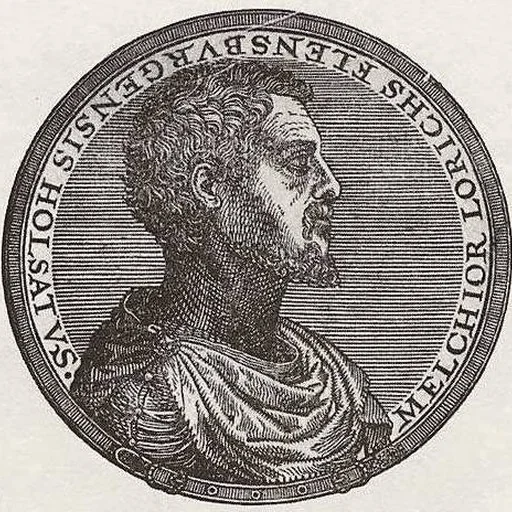
Artist
Melchior Lorck (also Lorch, Lorichs and Lorich; 1526/27 – 1583) was a Renaissance painter, draughtsman, and printmaker of Danish-German origin.

![The Farnese Hercules, three-quarter view turned to left [plate 3], by François Perrier](https://artifactworldgallery.com/img/francois-perrier--the-farnese-hercules-three-quarter-view-turned-to-left-plate--b0564bebaad016fa-w320.webp)
![The Farnese Hercules, front view [plate 2], by François Perrier](https://artifactworldgallery.com/img/francois-perrier--the-farnese-hercules-front-view-plate-2--cedb2cb031c3391b-w320.webp)