Artwork
The Scapegoat
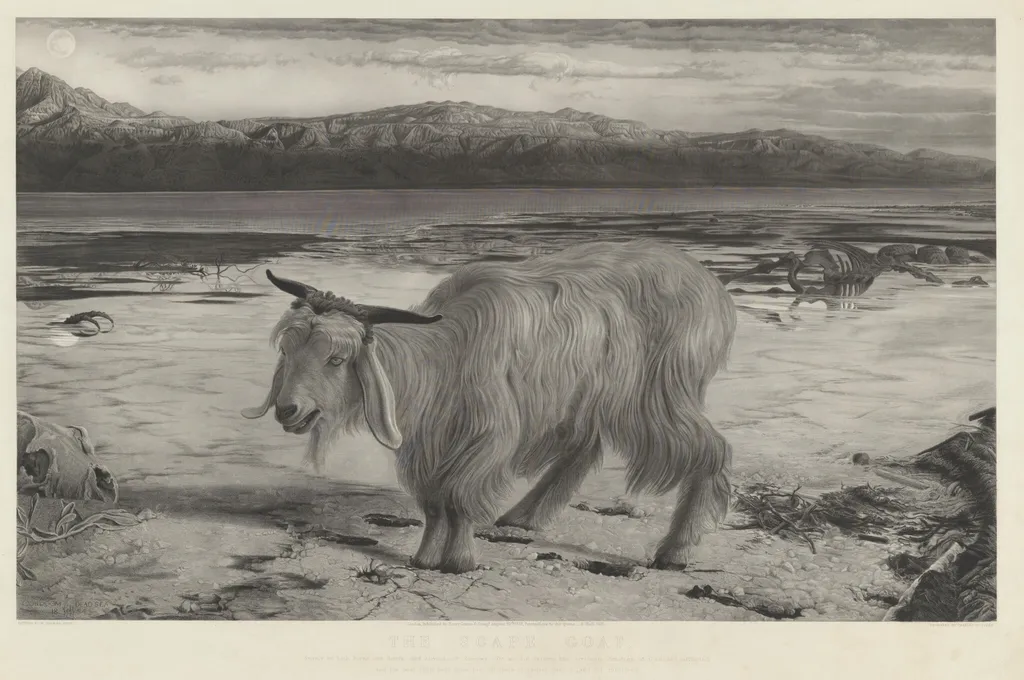
The Scapegoat is an ink print by the Impressionist artist Charles Mottram. It dates from 1861 and is held in the collection of the National Gallery of Art.
About this work
Overview
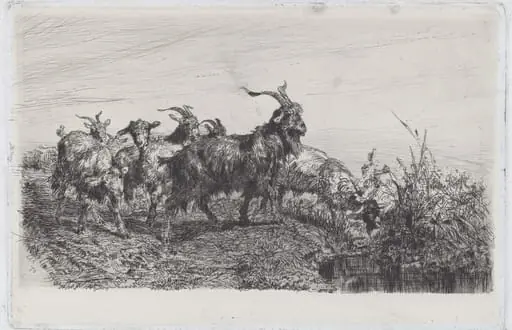
Created in 1861, *The Scapegoat* is a print that merges etching, engraving, and mezzotint on wove paper. The composition centers on a solitary goat perched on a craggy shore, with distant mountains and a cloudy sky forming a subdued backdrop. The animal’s textured coat and curved horns dominate the visual field, while the surrounding landscape recedes into softer tones.
Subject & Meaning
The work presents a single goat as the focal point, isolated against a stark, rocky terrain that hints at a body of water nearby. The animal’s posture and detailed fur suggest a contemplative stillness, inviting viewers to consider themes of solitude and perhaps the biblical notion of a scapegoat bearing collective burdens, though no explicit narrative is provided.
Technique & Style
Mottram combined three intaglio methods: etching for fine line work, engraving for precise edges, and mezzotint to achieve rich, velvety shadows. This layered approach allows the goat’s fur to appear tactile, while the background is rendered with broader, less defined tones, creating a clear visual hierarchy that emphasizes the central figure.
History & Provenance
British engraver Charles Henry Mottram, active in the mid‑19th century, produced the print primarily as a reproductive work, translating painted subjects into print form. Though details of his early life remain vague, Mottram’s reputation rested on his ability to render complex images for a wider audience, and *The Scapegoat* exemplifies his skill in merging multiple intaglio techniques.
Artist & collection
Artist
Charles Henry Mottram (9 April 1807 – 30 August 1876 London) was a British engraver, mainly in the medium of steel engraving.