Artwork
Court lady singing and playing the vina
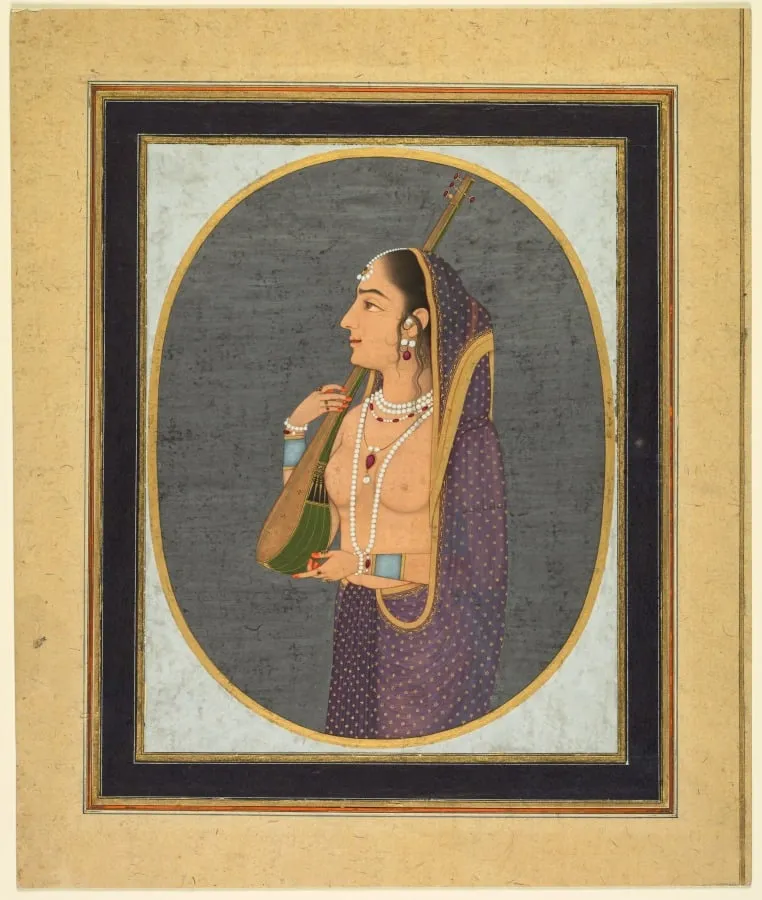
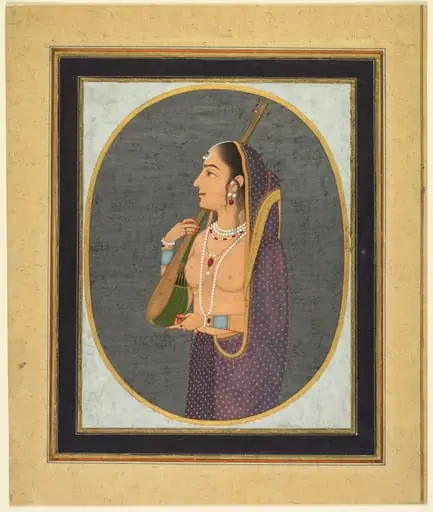
Court lady singing and playing the vina is an unspecified painting by the Mughal Painting artist Muhammad Rizavi Hindi. It dates from 1760 and is held in the collection of the Cleveland Museum of Art. This small painting depicts a court lady engaged in musical performance, seated cross-legged with a vina resting across her lap.
About this work
Overview
Created in the Mughal court context, the work reflects the integration of music, poetry, and visual art as refined elements of elite culture.
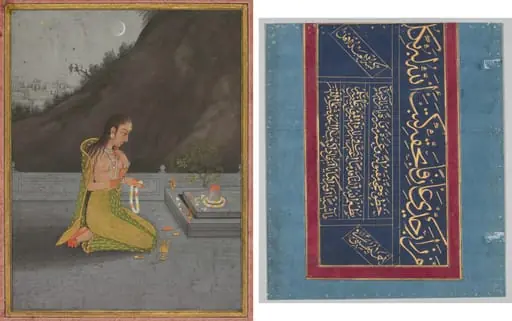
This small painting depicts a court lady engaged in musical performance, seated cross-legged with a vina resting across her lap. Her hennaed fingers pluck its strings while her lips part in song, capturing a moment of quiet concentration. Created in the Mughal court context, the work reflects the integration of music, poetry, and visual art as refined elements of elite culture. The reverse bears Persian verses that deepen its emotional and spiritual resonance.
Subject & Meaning
The woman’s performance is not merely entertainment but an expression of cultivated grace. The vina, with its gourd resonator, symbolizes classical Indian musical tradition. The Persian poetry on the reverse, drawn from Jami’s mystical writings, frames her act as a metaphor for spiritual yearning—love as intoxication, devotion as a journey requiring courage and guidance. The scene thus merges earthly artistry with metaphysical aspiration.
Technique & Style
Rendered in fine brushwork typical of Mughal miniature painting, the figure is rendered with delicate precision: the gold trim of her robe, the subtle modeling of her face, and the intricate detailing of her hennaed fingers. The composition is intimate, focusing on the figure against a plain background to emphasize her presence. Colors are restrained yet rich, with attention to texture and line rather than spatial depth.
History & Provenance
The painting originated in a Mughal atelier, likely during the late 16th or early 17th century, when courtly arts flourished under imperial patronage. Its inclusion of Persian poetry suggests it was part of a literary or poetic album, common among nobility. The verso inscription indicates it was valued not only as an image but as a vessel for textual contemplation, reflecting the era’s fusion of visual and literary culture.
Context
In Mughal courts, music, poetry, and visual art were interwoven into daily life, serving both pleasure and intellectual expression. The vina, associated with divine and courtly traditions, was often played by women of the harem, whose performances were private yet culturally significant. The pairing of this image with mystical verse reveals how aesthetic experiences were framed within Sufi-inspired ideals of longing and transcendence.
Legacy
This painting exemplifies how Mughal art preserved and adapted regional Indian traditions within a Persianate literary framework. Its survival with the original inscription offers rare insight into the layered meanings embedded in courtly imagery. It stands as a quiet testament to the role of women as cultural mediators, whose artistry carried spiritual and emotional weight beyond mere performance.
Artist & collection