Artwork
Populația cafenelelor (I); Populația cafenelelor (II) (legenda portretelor de la planșa nr. I)
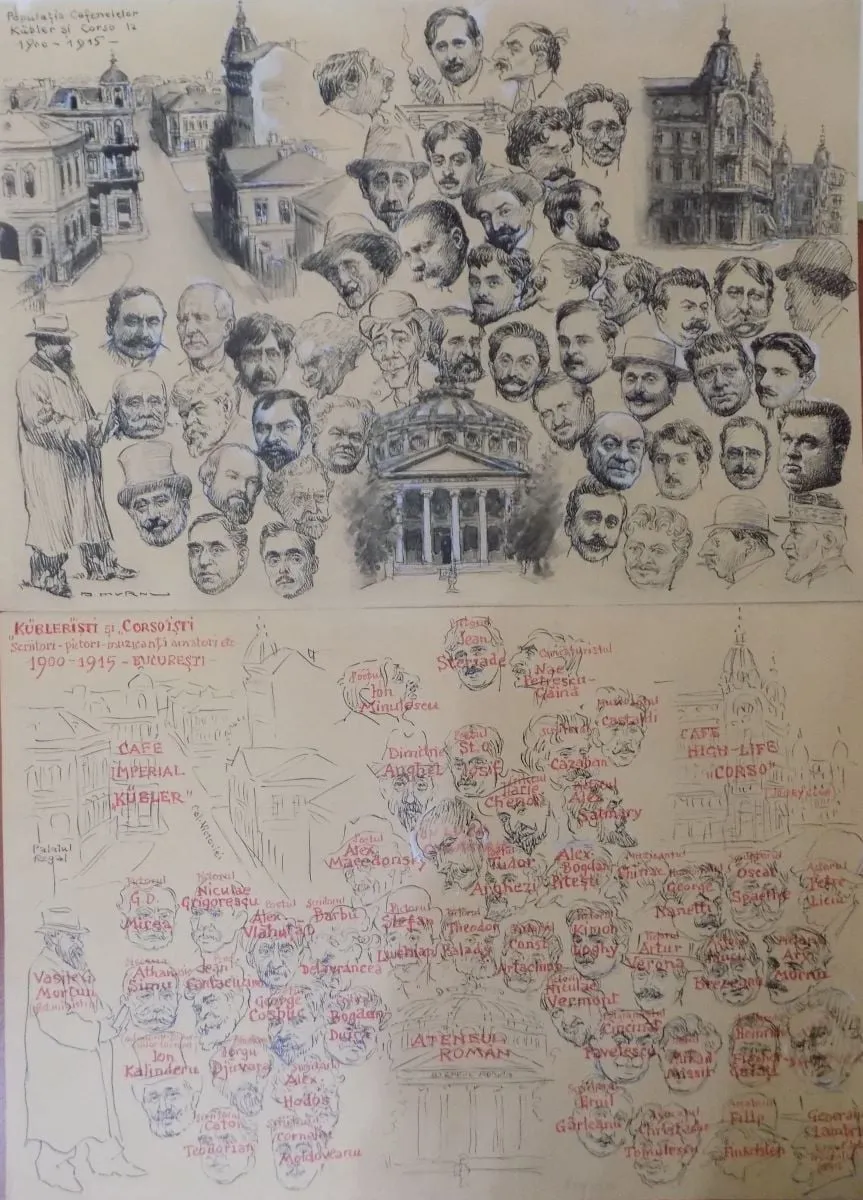
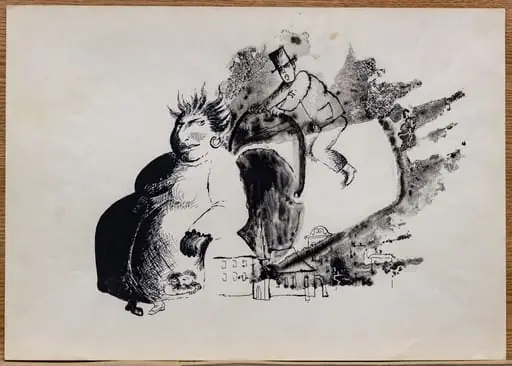
Populația cafenelelor (I); Populația cafenelelor (II) (legenda portretelor de la planșa nr. I) is a drawing by Aristomene Murnu-Gheorghiades. It dates from 1850 and is held in the collection of the Bucharest Municipality Museum.
About this work
Overview
Created around 1850 by Aristomene Murnu-Gheorghiades, this pair of drawings forms a visual catalog of Bucharest’s café-going public.
Created around 1850 by Aristomene Murnu-Gheorghiades, this pair of drawings forms a visual catalog of Bucharest’s café-going public. Rendered in ink, the work combines portraiture and cartography to map social life through individual identities. Each face is labeled with a name, and locations are marked with café names, transforming the image into a sociological record rather than a conventional portrait.
Subject & Meaning
The drawings depict the male patrons of Bucharest’s mid-19th-century cafés, portraying them not as individuals but as members of a social ecosystem. The upper register presents a dense grid of faces, suggesting a collective identity shaped by public space. The lower section maps these individuals to specific venues, implying that social affiliation was tied to location. The color-coded names may indicate factional or class distinctions within the café culture.
Technique & Style
The artist employs fine pen lines and meticulous cross-hatching to render hundreds of small, expressive faces. Background architecture is suggested with minimal strokes, allowing the human figures to dominate. The bottom half functions as a schematic map, with café names and clustered portraits arranged spatially without geographic accuracy. The use of red and blue ink for names introduces a subtle system of categorization, enhancing the work’s documentary tone.
History & Provenance
The drawings have been held since their creation by the Museum of Ethnography, where they were likely acquired as part of a broader effort to document urban social customs. Their survival suggests they were valued early on as ethnographic material rather than fine art. No record of prior ownership or exhibition exists prior to their institutional acquisition, indicating they may have been privately produced for scholarly or personal use.
Context
In mid-19th-century Bucharest, cafés served as hubs for intellectual exchange, political discussion, and social networking among the urban elite. This work captures a moment when public space was becoming a stage for identity formation. The detailed labeling of patrons reflects a growing interest in documenting social structures, paralleling contemporary European ethnographic projects that sought to classify and understand urban populations.
Legacy
Though not widely known outside Romania, the drawings offer a rare visual archive of everyday urban life before photography became common. Their blend of portraiture and mapping anticipates later sociological visualizations. The work remains a key reference for scholars studying the emergence of public culture in Southeastern Europe, valued for its precision and unembellished observation of social patterns.
Artist & collection
Artist
Aristomene Murnu-Gheorghiades made drawings and sculptures tied to Romanian life around 1914.