Artwork
Vorentwurf Seidenbild
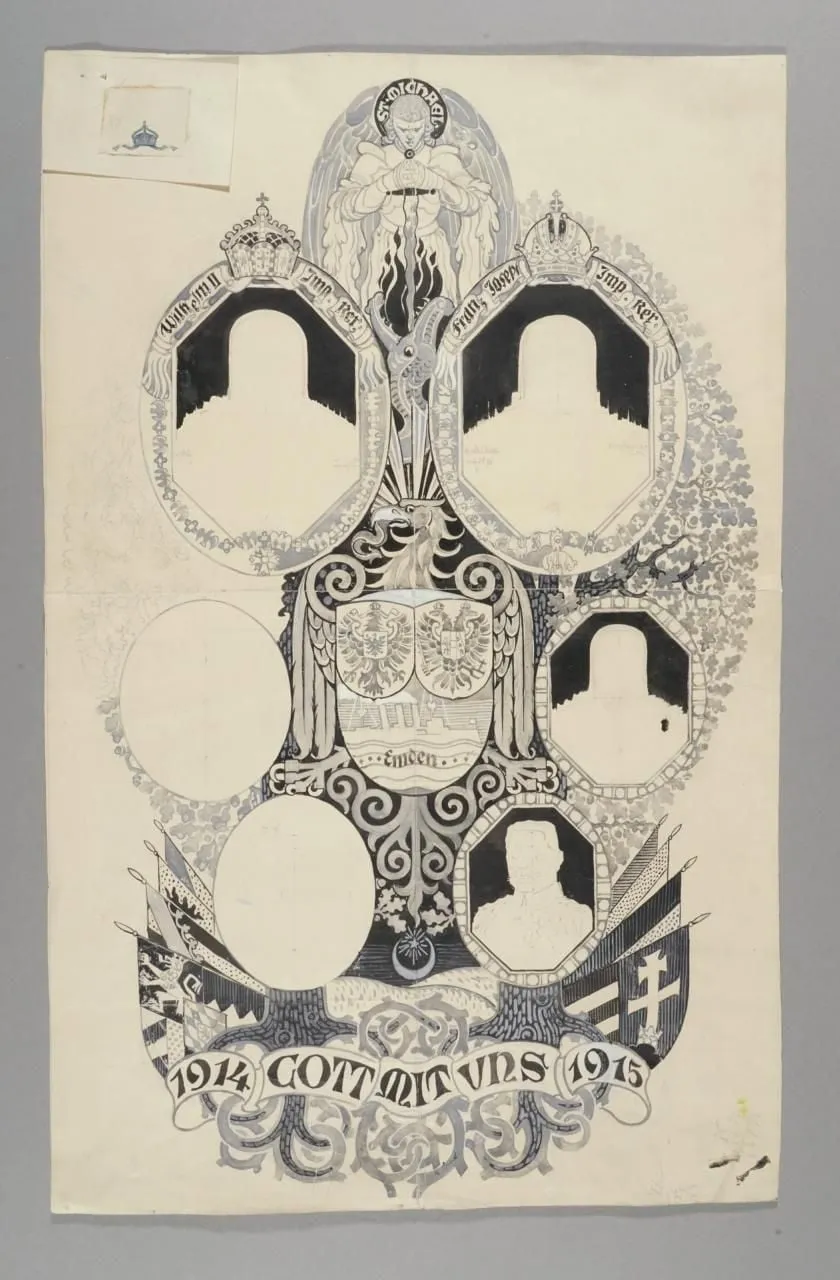
Vorentwurf Seidenbild is a drawing by Unknown. It dates from 1915 and is held in the collection of the Archaeology and Museum Baselland. This preparatory drawing, dated 1914–1915, appears to be a design proposal for a silk textile or heraldic panel.
About this work
Below, a shield with swirls and a crown is flanked by two circles—one with a ship, the other with a face.
This drawing looks like a fancy coat of arms. At the top, two arches frame empty spaces, and a flame sits between them. Below, a shield with swirls and a crown is flanked by two circles—one with a ship, the other with a face. The bottom banner reads "1914 COTTNIVS 1915."
The face in the circle looks like a portrait, but it’s blurry. The ship in the other circle is simple, with no details. The whole thing feels like a sketch for something bigger.
If you like this style, check out cross-hatching next.
Overview
This preparatory drawing, dated 1914–1915, appears to be a design proposal for a silk textile or heraldic panel. Its composition resembles a stylized coat of arms, with symmetrical elements framing central motifs. The inclusion of dates and the Latinized name 'Cottnivs' suggests a personal or familial commission, possibly intended for decorative or commemorative use.
Subject & Meaning
The imagery combines symbolic elements: a central flame between arched openings, a crowned shield with swirling patterns, and two circular emblems—one containing a rudimentary ship, the other a blurred human face. These may represent travel, identity, or legacy, though their precise meaning remains ambiguous. The lack of detail implies the work was a conceptual sketch rather than a finished emblem.
Technique & Style
Executed with loose, linear strokes, the drawing employs minimal shading and unrefined contours. The ship and face are rendered with schematic simplicity, while the shield’s swirls suggest decorative intent. The overall aesthetic leans toward heraldic convention but lacks the precision of formal armorial art, indicating an early or experimental stage in the design process.
History & Provenance
The inscription '1914 COTTNIVS 1915' anchors the work to a specific timeframe and possibly a named individual, though no known artist or collection is definitively linked to it. Its survival as a standalone sheet suggests it was retained as a draft, perhaps by the designer or a patron, rather than being transferred to a final medium.
Context
Created during the early years of World War I, the drawing reflects a period when personal and familial symbolism was often expressed through decorative arts. Heraldic motifs remained popular in applied design, even as modernist trends emerged. This piece sits at the intersection of traditional iconography and informal, hand-drawn experimentation.
Legacy
As an unexecuted design, the drawing offers insight into the iterative process behind textile or heraldic commissions of the era. It stands as a quiet artifact of private symbolism, preserving the tentative forms of ideas that never reached their intended medium. Its value lies in its openness to interpretation and its glimpse into a moment of creative planning.
Artist & collection
 Domestic Scene
 Giacomo and Cardinal Marco, investing Andrea, Abbot of San Zeno, with his Benefice
 The Nymph of Fontainebleau
 Portrait of a Woman
 Madonna and Child with Saints in the Enclosed Garden
 Venus and Minerva
 Family Group of Four on Sofa
 Wall painting from Room H of the Villa of P. Fannius Synistor at Boscoreale
 Night
Night Upright Arabesque with Masks, Cupids and Nereids
 Bookplate: Leonard Smelt, Esq.
 Untitled
 Venise sauvée (Venice Preserved)
 Shiva Ravananugrahamurti; woman holding a flywhisk; rearing yali
 Coat of Arms with Two Eagles
 Fourth Knot
 The Nativity
 The Visiting
 History of the Corcoran Gallery of Art
 Ornament Panel with a Bird Cage