Artwork
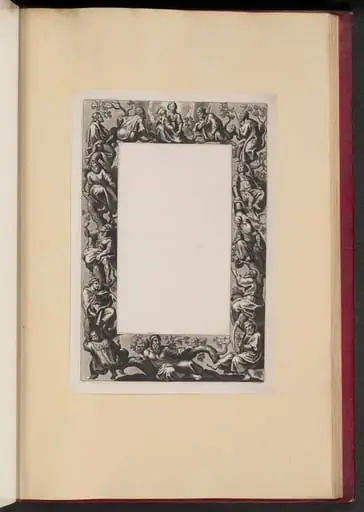
Border Illustration with God the Father, Two Saints, and a Serpent
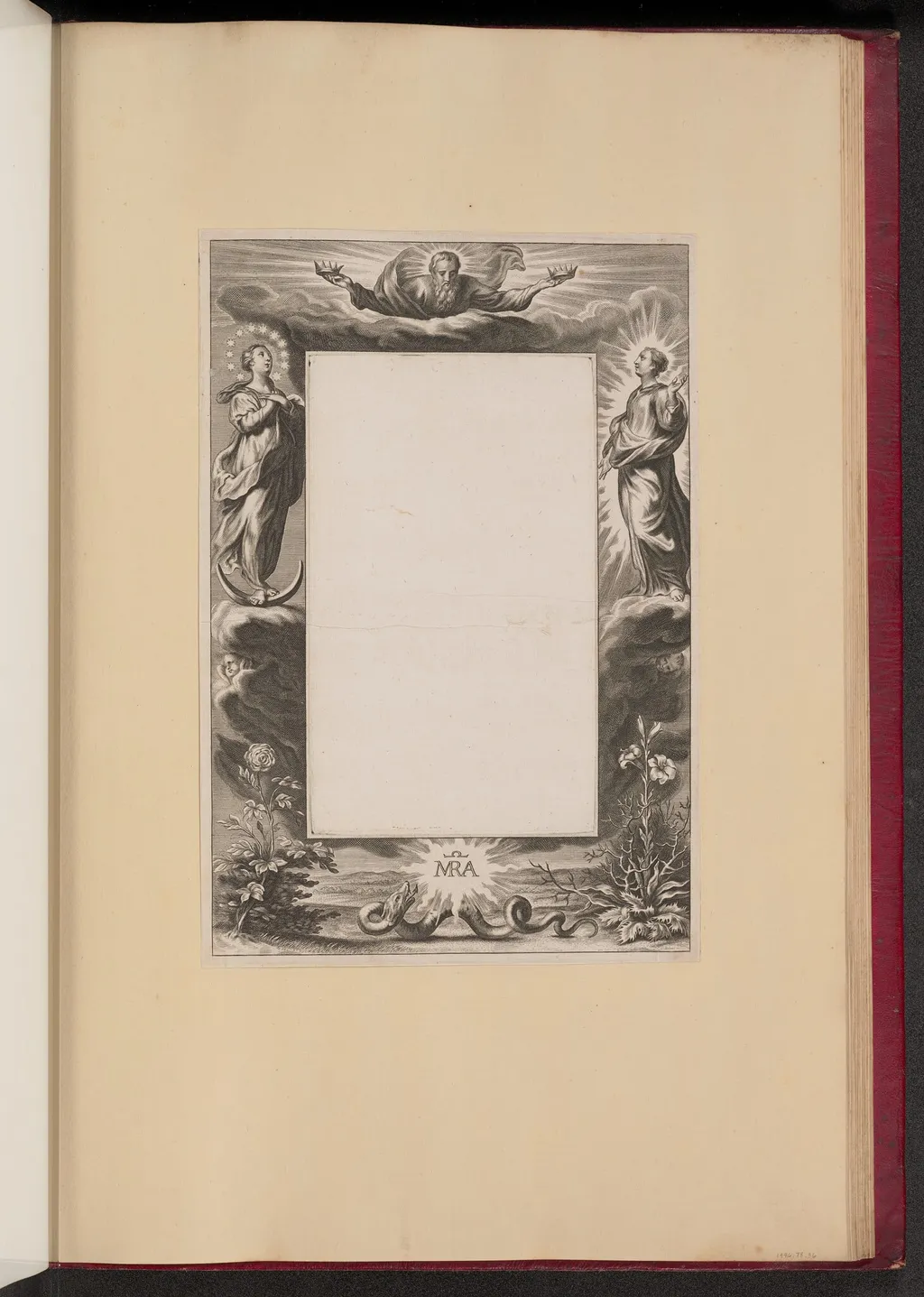
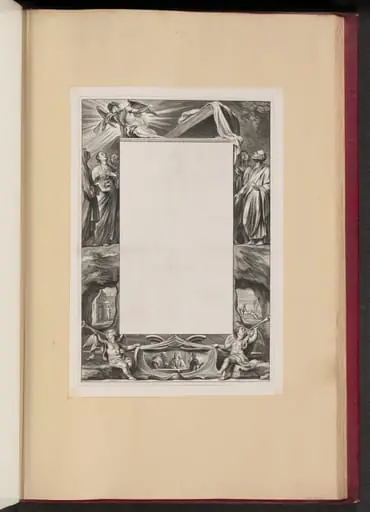
Border Illustration with God the Father, Two Saints, and a Serpent is an ink print by the Baroque artist Netherlandish 17th Century. It dates from 1613 and is held in the collection of the National Gallery of Art.
About this work
Overview
The design was intended as a decorative border, leaving room for later inscription or imagery, a common practice in printed religious materials of the period.
This engraving on laid paper, produced as a proof before the addition of lettering, presents a symmetrical composition centered on an empty space. Four figures frame the void: a celestial figure above, two saints flanking the sides, and a serpent emerging from a sunburst below. The design was intended as a decorative border, leaving room for later inscription or imagery, a common practice in printed religious materials of the period.
Subject & Meaning
The figures represent divine and sacred elements: God the Father, depicted in celestial robes, blesses from above. The two saints, holding a rose and a lily, symbolize purity and devotion, common attributes in Christian iconography. The serpent, coiled from a sunburst, evokes the biblical fall of man, contrasting divine grace with earthly temptation. Together, they form a visual theology meant to frame sacred text or imagery.
Technique & Style
Executed in fine-line engraving, the work demonstrates precise control over incised lines to suggest texture and volume. The figures are rendered with restrained detail, emphasizing clarity over ornamentation. The serpent’s coils and the sunburst’s radiating lines are carefully etched to guide the viewer’s eye toward the central void. The use of laid paper and the proof state suggest an early stage in the print’s production cycle.
History & Provenance
As a proof before letters, this impression likely served as a working stage for a printer or publisher, allowing review of the design before final inscription. Such proofs were often retained by artists or workshops for reference or sale. Its survival indicates it was valued beyond its utilitarian purpose, possibly collected for its symbolic composition or as an example of devotional printmaking techniques.
Context
In the late medieval and early Renaissance periods, printed borders with religious iconography were widely used in books, broadsheets, and altarpiece designs. The combination of divine figures, saints, and symbolic animals like the serpent reflected a visual language familiar to contemporary viewers. These borders functioned as both decoration and instruction, reinforcing theological narratives in an era of rising literacy and print culture.
Legacy
This engraving exemplifies how religious symbolism was standardized in print media to convey doctrine visually. Its preserved proof state offers insight into the production process of devotional prints, revealing how artists and publishers planned compositions for integration with text. Though anonymous, it contributes to understanding the role of print in shaping religious experience during the transition to the early modern era.
Artist & collection

Artist
This artist was born in the Netherlands in the early 1600s and made drawings and engravings.