Artwork
Shore of Inland Waterway with a Ketch, Two Smaller Boats, and Fisherman
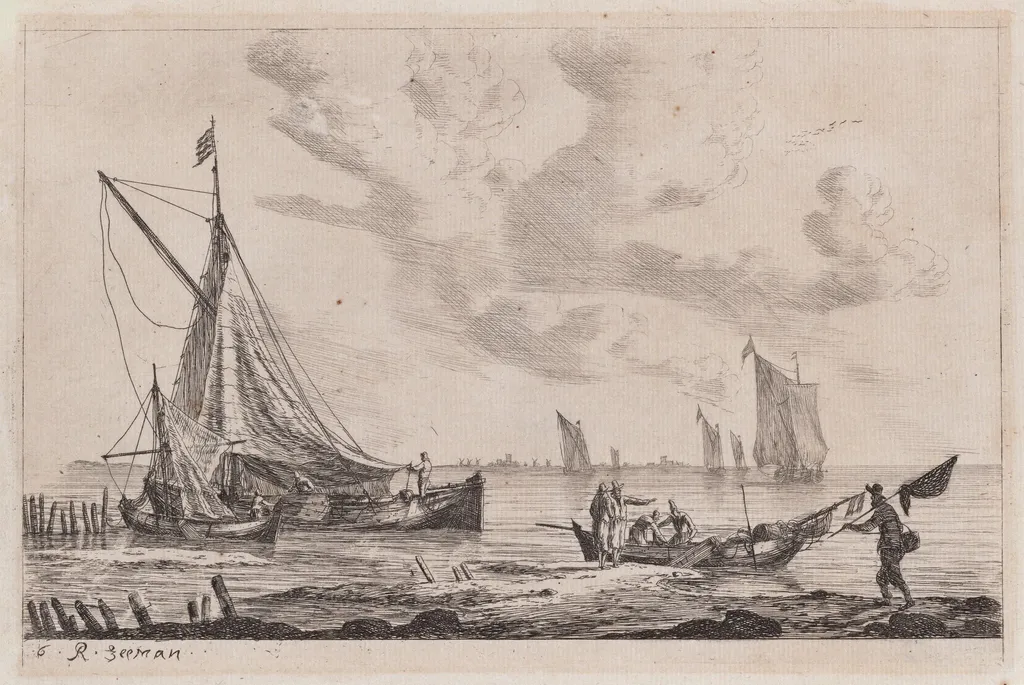
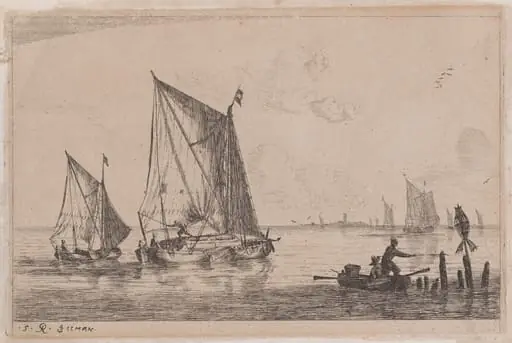
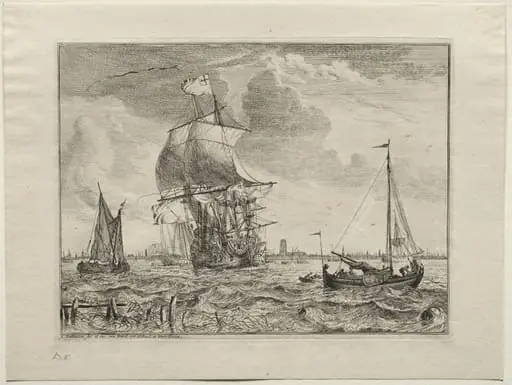
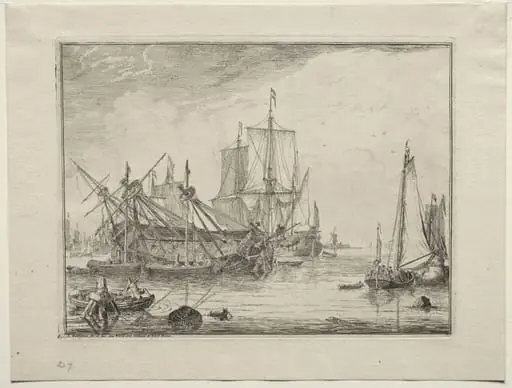
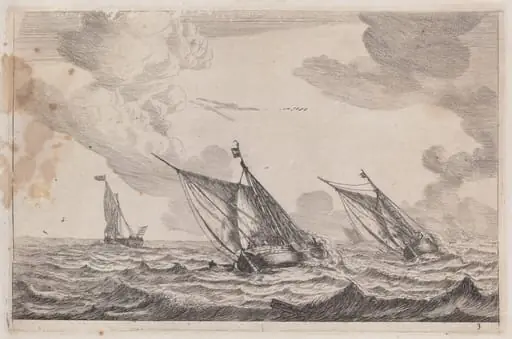
Shore of Inland Waterway with a Ketch, Two Smaller Boats, and Fisherman is an ink print by the Baroque artist Nooms, called Zeeman, Reinier. It dates from 1656 and is held in the collection of the National Gallery of Art. Created circa 1656, this etching on laid paper presents a tranquil stretch of inland waterway populated by a three‑boat ensemble.
About this work
Overview
Created circa 1656, this etching on laid paper presents a tranquil stretch of inland waterway populated by a three‑boat ensemble. A sizable ketch with its masts upright anchors near the bank, while two smaller vessels drift closer to the dock, one bearing a solitary fisherman at its prow. The scene is framed by a low, cloudy sky and a shoreline marked by wooden pilings.
Subject & Meaning
The composition records everyday maritime activity rather than an idealised narrative, emphasizing the functional relationship between vessels and the laborer who tends them. By juxtaposing the larger trading ketch with the modest fishing boat, the image reflects the layered economy of 17th‑century Dutch waterways, where commerce and subsistence co‑existed along the same banks.
Technique & Style
The artist’s characteristic precision renders structural details of rigging and hulls, while the subtle tonal gradations suggest atmospheric conditions.
Executed with delicate, intersecting lines, the etching captures the ripple of water and the billowing of sails through fine cross‑hatching. The artist’s characteristic precision renders structural details of rigging and hulls, while the subtle tonal gradations suggest atmospheric conditions. Such meticulous line work was typical of Reinier Nooms, whose prints served both aesthetic and documentary purposes.
History & Provenance
Attributed to Reinier Nooms, known by the nickname Zeeman, the work belongs to a series of maritime prints he produced from the mid‑1650s onward. Nooms’ etchings were widely circulated among collectors and fellow artists, functioning as visual references for shipbuilding and coastal topography. The print’s later ownership record is sparse, but it remains catalogued in several European print collections.
Context
During the Dutch Golden Age, the expansion of trade routes and inland navigation prompted a surge in visual documentation of ships and ports. Nooms, a former seaman turned artist, contributed to this trend by rendering vessels with technical accuracy. His prints complemented contemporary maps and ship manuals, offering a realistic glimpse into the bustling waterways that underpinned the Republic’s prosperity.
Own this work as a print
Artist & collection

Artist
Reinier Nooms (c. 1623 – 1664), also known as Zeeman or Seeman (Dutch for "sailor"), was a Dutch maritime painter known for his highly detailed paintings and etchings of ships. From the 1650s, Nooms started producing…