Artwork
Two "Overlanders" or Houseboats
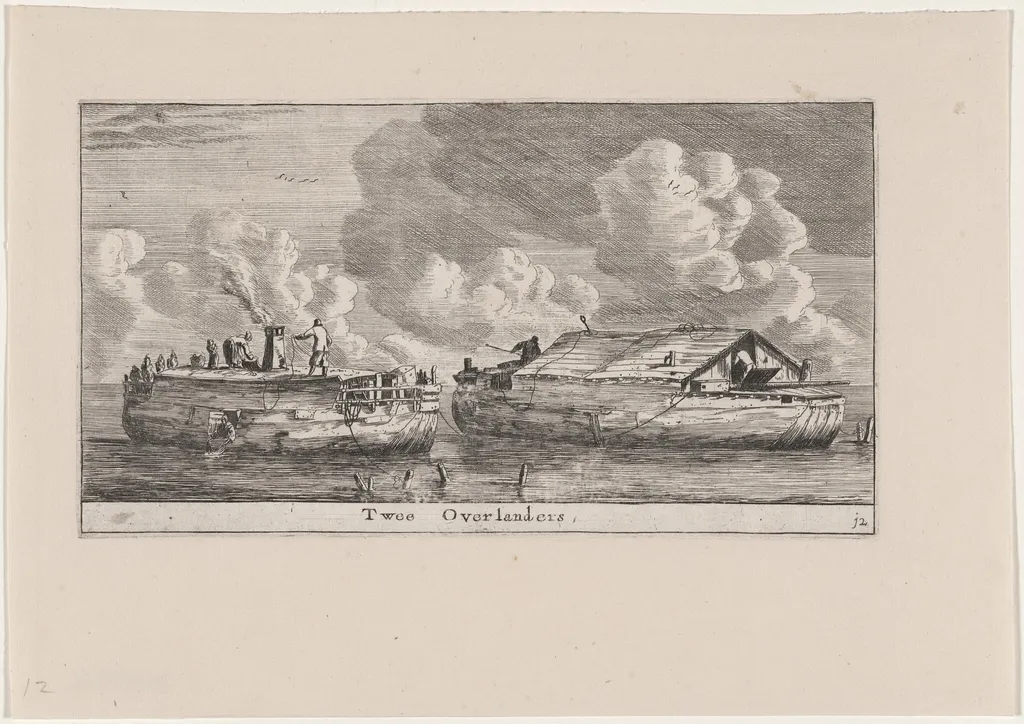
Two "Overlanders" or Houseboats is an ink print by the Baroque artist Nooms, called Zeeman, Reinier. It dates from 1653 and is held in the collection of the National Gallery of Art.
About this work
The sky above is bright but cloudy, and the river reflects the boats’ shapes.
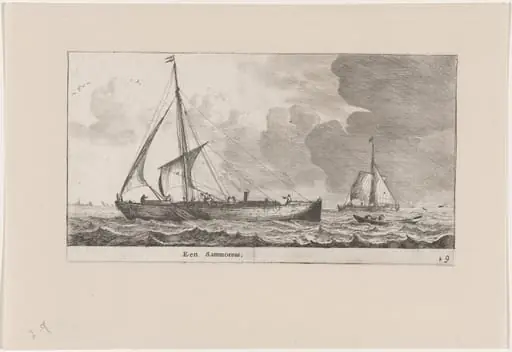
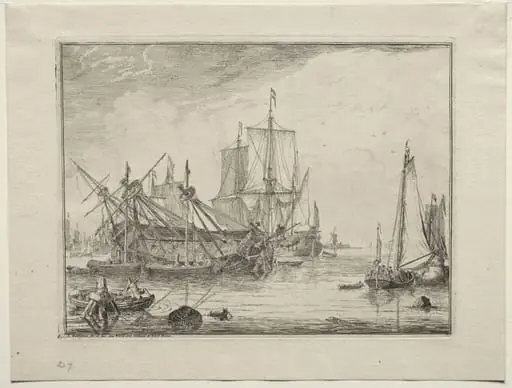
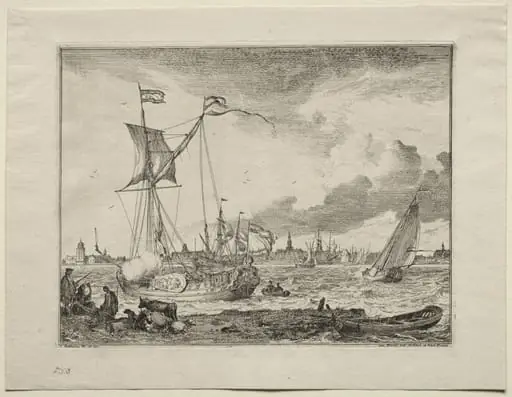
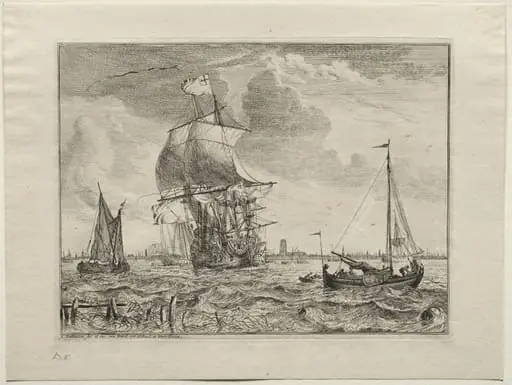
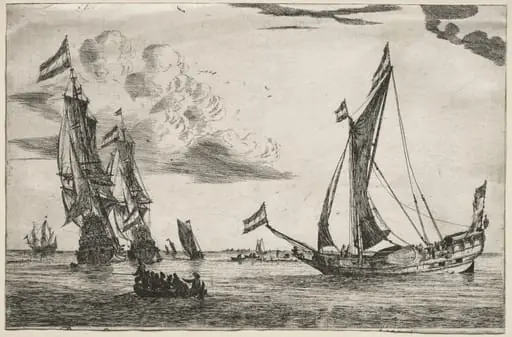
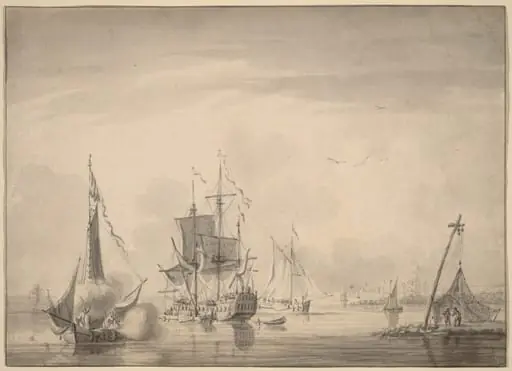
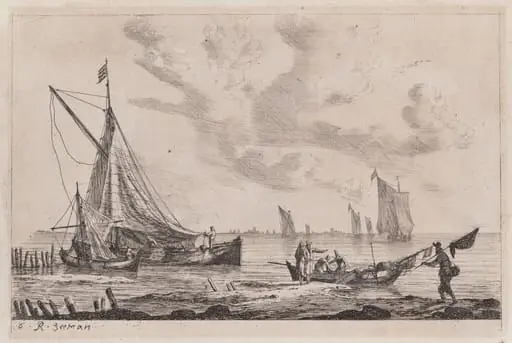
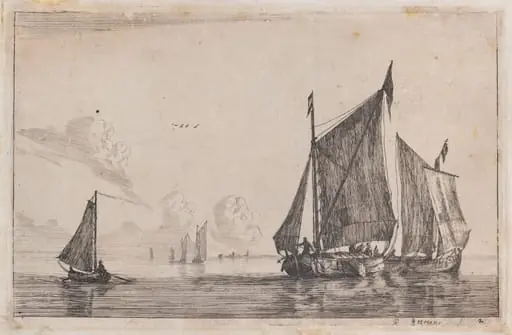
This etching shows two flat-bottomed boats floating on a wide river. The boats sit low in the water, loaded with barrels and wooden crates. The sky above is bright but cloudy, and the river reflects the boats’ shapes.
Reinier Nooms etched this scene around 1654. Boats like these carried goods along Dutch rivers and canals. The drypoint lines catch light and shadow on the wood and water.
Look up etching with drypoint.
Overview
Reinier Nooms, known as Zeeman, created this etching with drypoint around 1653–1654 as part of a focused series documenting Dutch river traffic. The work captures two heavily laden houseboats drifting on a broad waterway, rendered with meticulous attention to architectural detail and surface texture. Nooms, primarily active in the 1650s, used printmaking to record the working vessels of the Dutch waterways, contributing to a broader visual archive of maritime life.
Subject & Meaning
The two flat-bottomed boats depicted are functional transport vessels, commonly used to carry barrels and crates along inland waterways. Their low draft and sturdy construction reflect practical design for navigating shallow Dutch rivers and canals. The scene avoids romanticism, presenting the boats as working tools of commerce, their cargo and form speaking to the economic rhythms of the Dutch Republic’s domestic trade networks.
Technique & Style
Nooms combined etching with drypoint to achieve fine gradations of light and texture. The drypoint’s burr creates soft, velvety lines that enhance the grain of wooden hulls and the ripples of water, while etched contours define structural details. The composition emphasizes horizontal planes—water, hulls, sky—reinforcing calm movement and spatial depth. The technique prioritizes observational accuracy over dramatic effect, aligning with contemporary printmaking ideals.
History & Provenance
Created during Nooms’s most productive period, this print was likely made for collectors and fellow artists who valued precise maritime documentation. Though no specific early ownership records are documented, such works circulated among Dutch elites and maritime professionals. The print’s survival in multiple institutional collections suggests its enduring role as a reference for ship form and riverine activity in the mid-seventeenth century.
Context
In the 1650s, the Dutch Republic’s economy relied heavily on inland water transport. Houseboats like those depicted were essential for moving goods between towns, especially where roads were poor or nonexistent. Nooms’s focus on these vessels reflects a broader cultural interest in documenting the infrastructure of daily commerce, distinct from grand naval battles or exotic ports often depicted by contemporaries.
Legacy
Nooms’s etchings, including this one, became valuable sources for later artists and cartographers seeking accurate depictions of Dutch rivercraft. His methodical approach influenced the development of topographical printmaking in the Netherlands. While not widely celebrated in his lifetime as a fine artist, his works remain key records of maritime material culture, valued for their documentary clarity rather than stylistic innovation.
Artist & collection

Artist
Reinier Nooms (c. 1623 – 1664), also known as Zeeman or Seeman (Dutch for "sailor"), was a Dutch maritime painter known for his highly detailed paintings and etchings of ships. From the 1650s, Nooms started producing…