Artwork
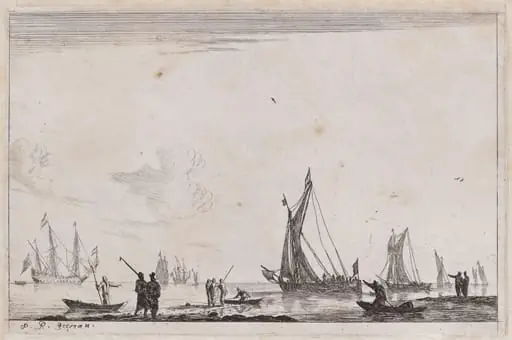
View of Inland Waterway with Fishermen
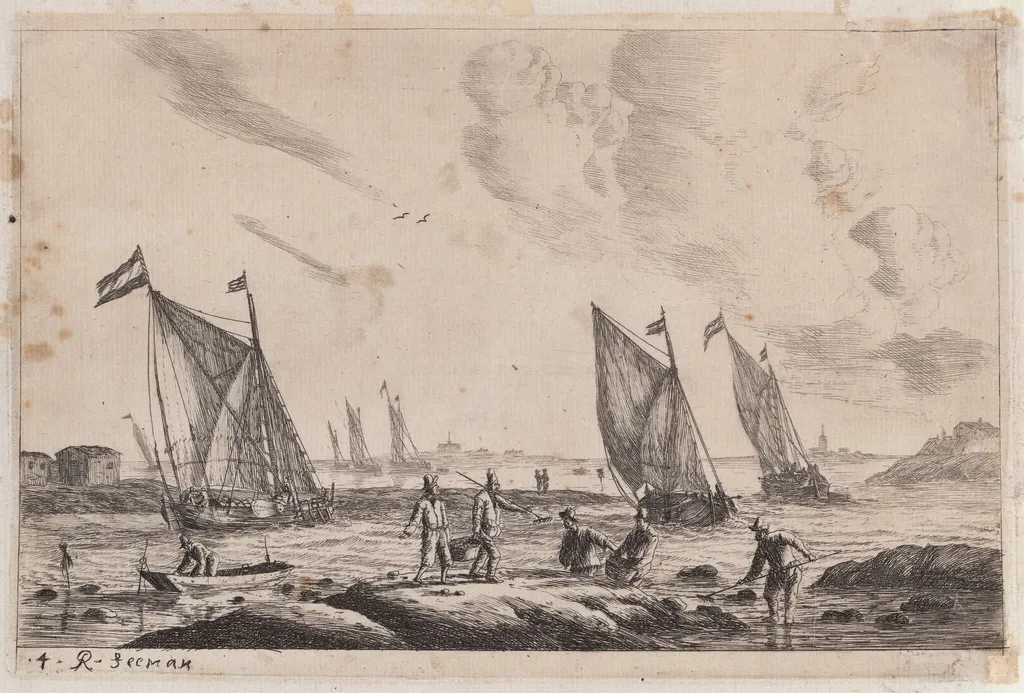
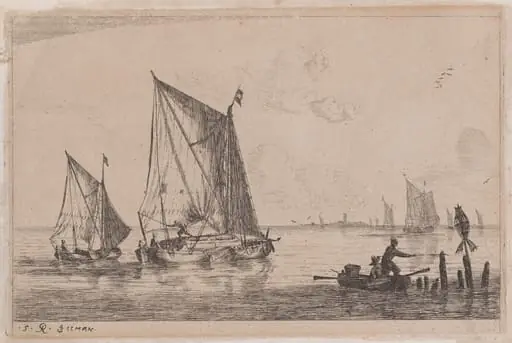
View of Inland Waterway with Fishermen is an ink print by the Baroque artist Nooms, called Zeeman, Reinier. It dates from 1656 and is held in the collection of the National Gallery of Art. Reinier Nooms, known as Zeeman, created this etching around 1656, capturing a quiet yet active inland waterway in the Netherlands.
About this work
Overview
Reinier Nooms, known as Zeeman, created this etching around 1656, capturing a quiet yet active inland waterway in the Netherlands.
Reinier Nooms, known as Zeeman, created this etching around 1656, capturing a quiet yet active inland waterway in the Netherlands. As a specialist in maritime scenes, he focused on the daily rhythms of waterborne life rather than grand naval events. The work exemplifies his precision in rendering vessels and landscapes, using fine, controlled lines to convey both movement and stillness within a single composition.
Subject & Meaning
The scene depicts fishermen and boatmen engaged in routine labor along a narrow channel, with three large sailboats navigating the center and smaller craft near the shore. The presence of nets, poles, and drifting boats suggests a working environment, not a ceremonial or idealized setting. Buildings and a distant tower hint at nearby habitation, grounding the scene in a real, inhabited landscape rather than a fantasy.
Technique & Style
Nooms employed fine, incised lines typical of etching to render the texture of water, fabric, and wood with remarkable clarity. The sails are rendered with dynamic curves, suggesting wind pressure, while the water’s surface is suggested through delicate, undulating strokes. The composition balances detail with openness, avoiding clutter despite the number of figures and vessels, creating a sense of spatial depth and atmospheric light.
History & Provenance
Created in the mid-1650s, this print belongs to a series of topographical etchings Nooms produced during a period of heightened interest in Dutch waterways. His works were circulated among collectors and artists, valued for their accuracy and observational rigor. Though no specific early ownership is documented, the print’s survival in multiple institutional collections indicates its enduring role as a reference for maritime depiction.
Context
In 17th-century Holland, inland waterways were vital for trade, transport, and subsistence fishing. Nooms’s focus on these scenes reflects a broader cultural interest in documenting everyday life and local geography. Unlike grand historical paintings, his etchings offered a quiet, unembellished record of the Dutch landscape, aligning with the period’s preference for realism and empirical observation.
Legacy
Nooms’s etchings, including this one, became standard references for later artists studying maritime composition and topography. His ability to capture the subtleties of light on water and the structure of vessels influenced generations of printmakers. Though not widely celebrated in his lifetime as a painter, his prints ensured his lasting contribution to Dutch visual culture through their precision and quiet authenticity.
Own this work as a print
Artist & collection

Artist
Reinier Nooms (c. 1623 – 1664), also known as Zeeman or Seeman (Dutch for "sailor"), was a Dutch maritime painter known for his highly detailed paintings and etchings of ships. From the 1650s, Nooms started producing…