Artwork
When Life Was Awakening in the Depths of Obscure Matter
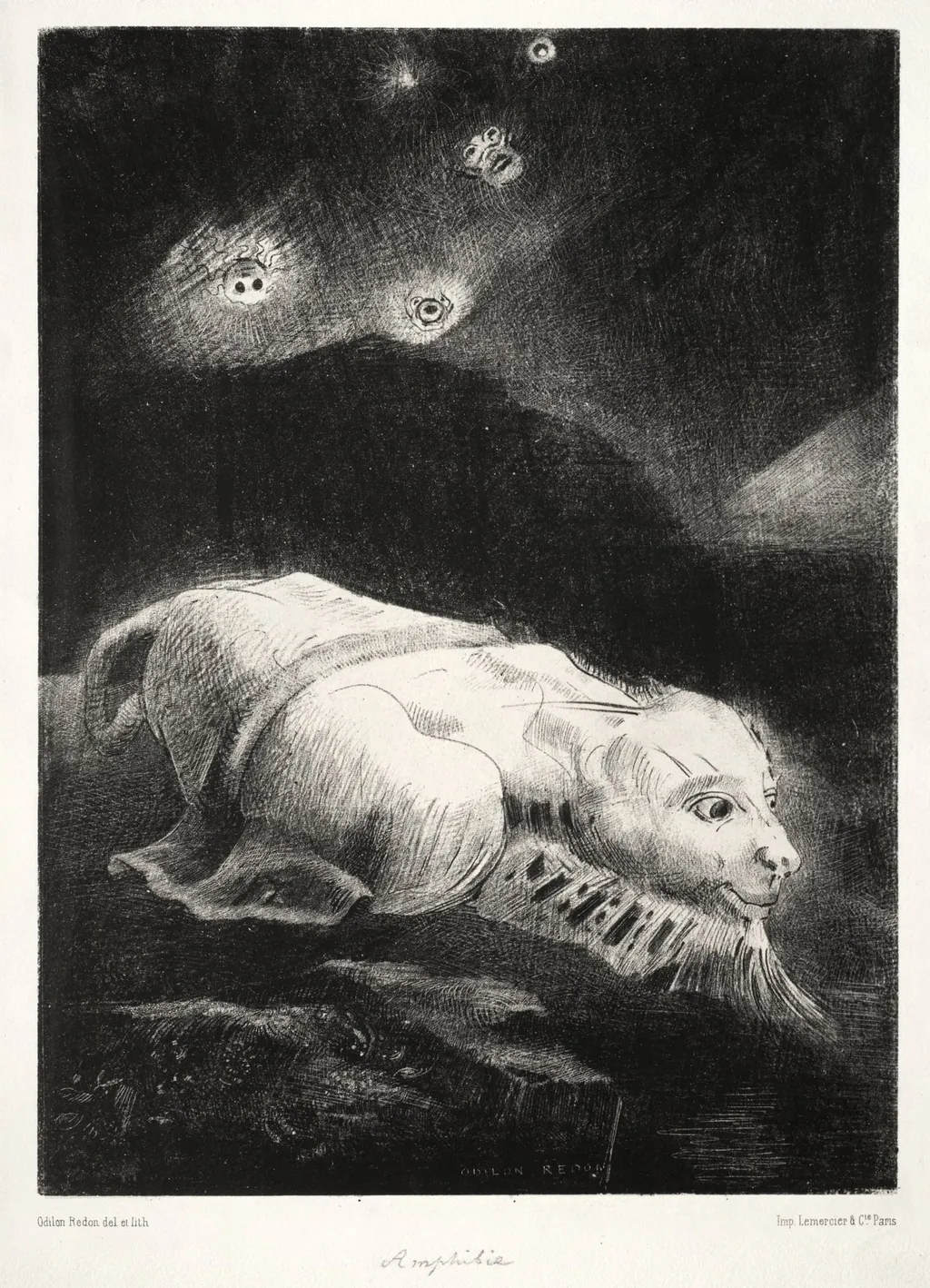
When Life Was Awakening in the Depths of Obscure Matter is a print by the Impressionist artist Odilon Redon. It dates from 1883 and is held in the collection of the Cleveland Museum of Art.
About this work
Overview
Executed during his formative years as a Symbolist, the piece reflects his shift from traditional representation toward evocative, inner-world imagery.
Created in 1883, this lithograph is part of Odilon Redon’s series of black-and-white works known as the *noirs*. Executed during his formative years as a Symbolist, the piece reflects his shift from traditional representation toward evocative, inner-world imagery. Redon used charcoal and lithographic stone to achieve deep blacks and subtle gradations, establishing a visual language rooted in mystery and psychological suggestion rather than literal depiction.
Subject & Meaning
The image depicts a hybrid, amphibious creature with a bearded, lion-like head and a sinuous, elongated body, suspended in an indeterminate void. Surrounded by faint, glowing orbs, the form suggests an emergent life force rising from primordial darkness. Redon avoids clear narrative, instead inviting contemplation of subconscious realms—where biological forms dissolve into dream logic, echoing Symbolist interests in the unseen and the metaphysical.
Technique & Style
Redon employed lithography to exploit the medium’s capacity for rich tonal depth. By layering charcoal and ink, he built dense shadows that isolate the creature and luminous spheres in stark relief. The absence of horizon or scale enhances the sense of infinite space. The creature’s fluid contours and the orbs’ soft radiance create a tension between solidity and ethereality, characteristic of his early style and his rejection of naturalism.
History & Provenance
The work emerged during Redon’s transition from obscurity to critical attention, shortly before Joris-Karl Huysmans praised his *noirs* in the 1884 novel *À rebours*. This literary endorsement helped anchor Redon within the Symbolist circle. Though the exact provenance of this specific print is not widely documented, it belongs to a body of work that was circulated among avant-garde collectors and writers in Paris during the 1880s.
Context
In the 1880s, French art was moving away from Realism and Impressionism toward introspective, poetic expression. Symbolists like Redon sought to convey emotion and idea through metaphor, often drawing from mythology, dreams, and the occult. This piece aligns with broader cultural interests in the unconscious, spiritualism, and the limits of perception, reflecting a generation’s disillusionment with materialist science.
Legacy
Redon’s *noirs*, including this work, influenced later movements such as Surrealism through their embrace of the irrational and the dreamlike. His mastery of tone and ambiguity paved the way for artists exploring inner states over external reality. Though less known than his later color pastels, these early lithographs remain foundational to understanding his evolution and the Symbolist project’s enduring resonance in modern art.
Artist & collection
Artist
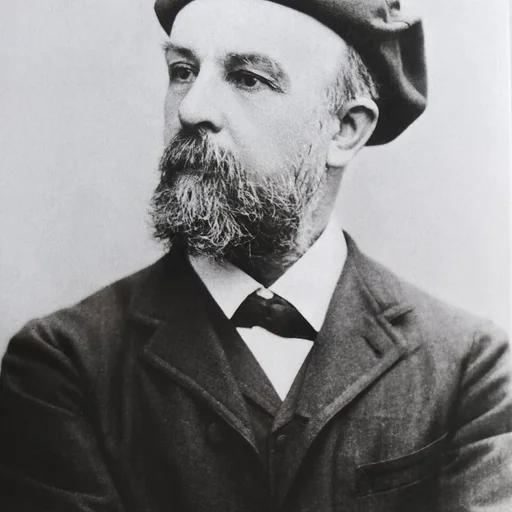
Born Bertrand-Jean Redon on 20 April 1840 in Bordeaux, the artist adopted the name Odilon from his mother, Marie-Odile.

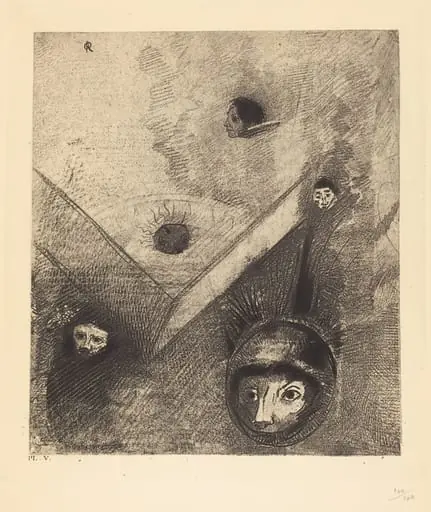 Sur le fond de nos nuits dieu de son doigt savant dessine un cauchemar multiforme et sans treve (On backdrop of our nights God with His knowing finger traces a multiform implacable nightmare)
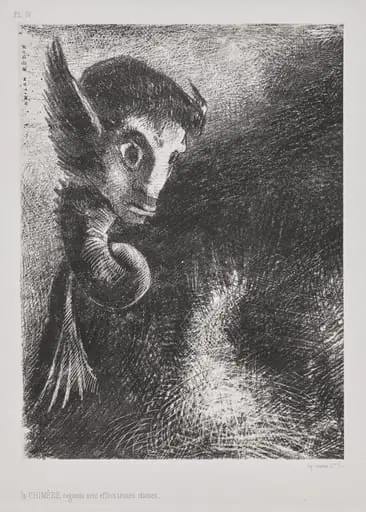 The Chimera Gazed at All Things with Fear
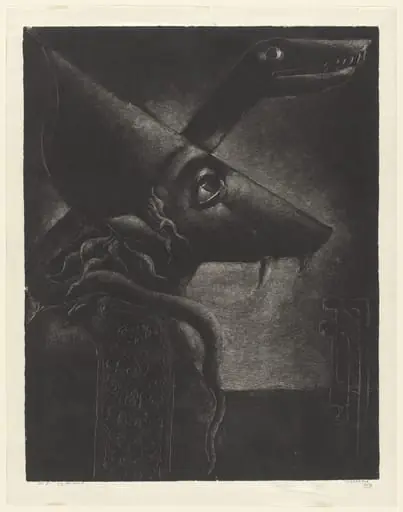 Untitled
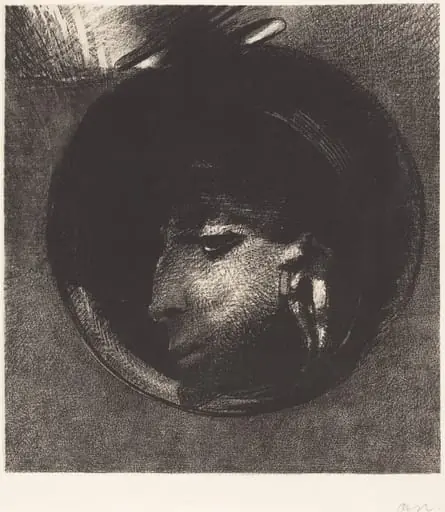 Cellule Auriculaire
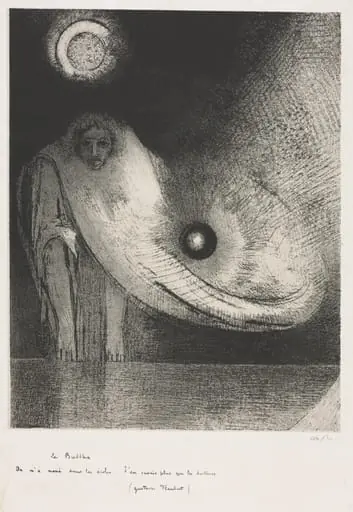 The Buddha
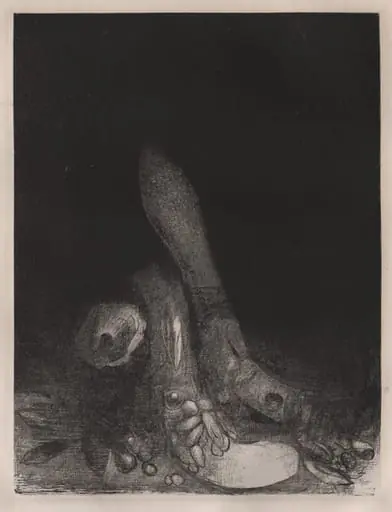 Flowers Fall and the Head of a Python Appears
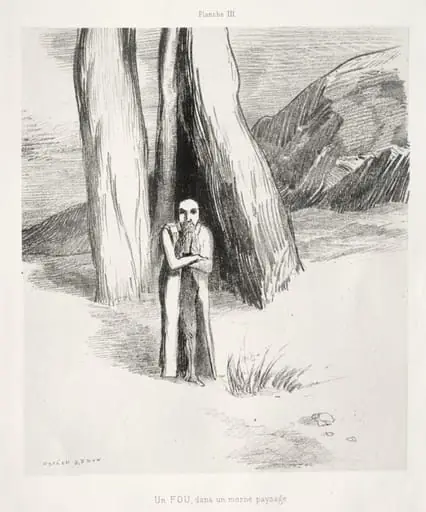 A Madman in a Dismal Landscape
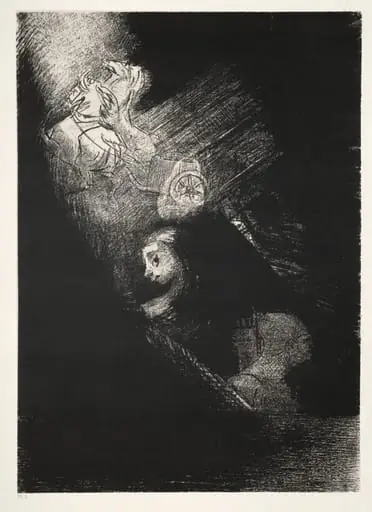 First a Pool of Water, Then a Prostitute, the Corner of a Temple, a Soldier's Face, a Chariot with Two White, Rearing Horses
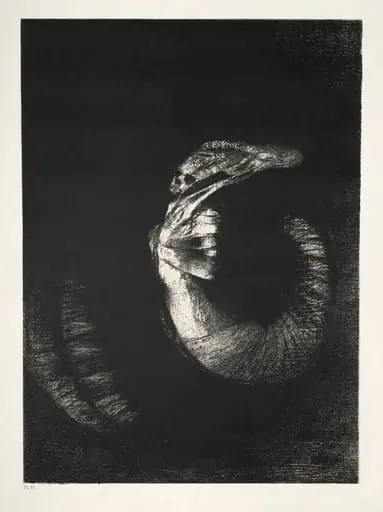 It Is a Skull Wreathed with Roses. It Dominates a Woman's Torso of Pearly Whiteness
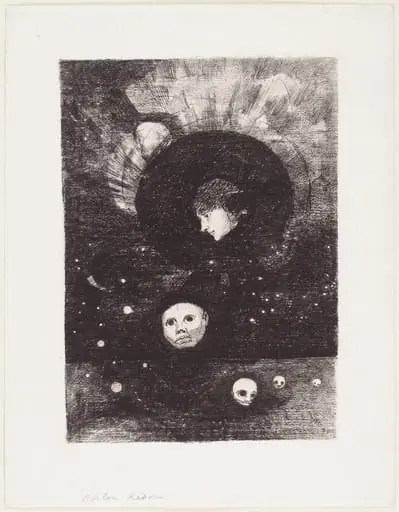 Untitled
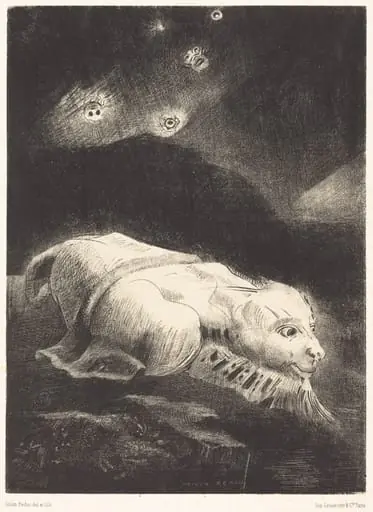 Quand s'eveillait la Vie au Fon de la matiere obscure (When life was awakening in the depths of obscure matter)
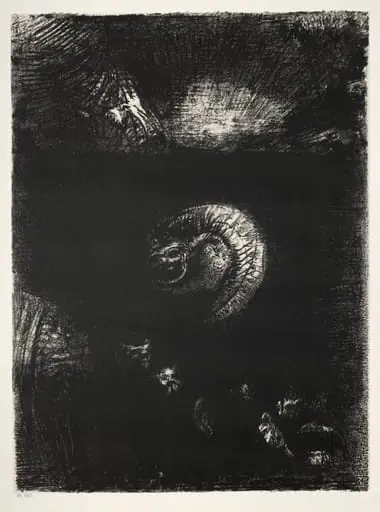 And All Manner of Frightful Creatures Arise