Artwork
Obsesia timpului
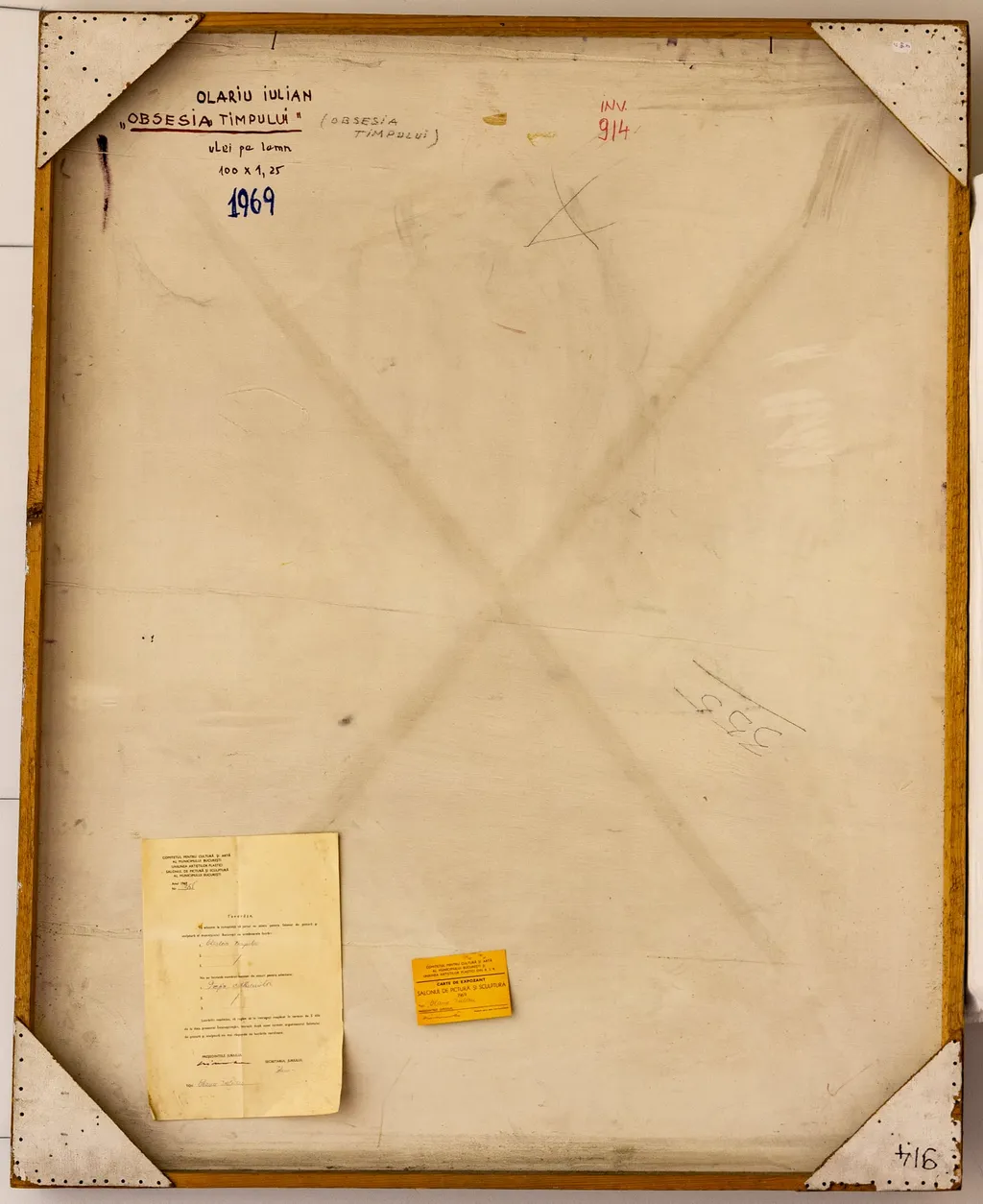
Obsesia timpului is an unspecified painting by Olariu Iulian. It dates from 1969 and is held in the collection of the Gavrila Simion Eco-Museum Research Institute Tulcea.
About this work
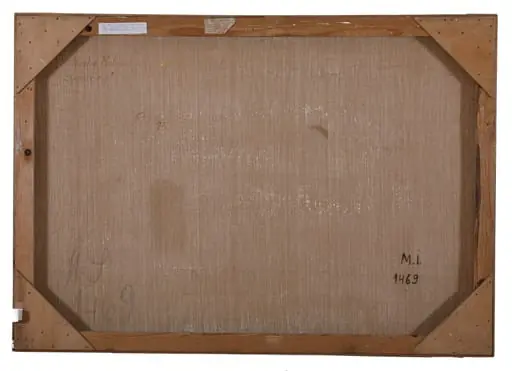
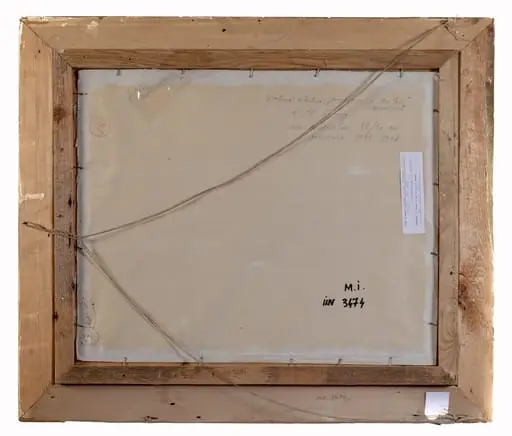
Inside the frame’s edge, there’s a handwritten label in Romanian with the title *Obsesia timpului* and the year 1969.
This is an empty canvas stretched over a wooden frame. The surface is blank, smooth, and pale—just a few faint pencil marks and smudges. Inside the frame’s edge, there’s a handwritten label in Romanian with the title *Obsesia timpului* and the year 1969.
The canvas looks unused, almost like it was never finished. The frame holds two small papers: one official-looking document and a yellow card with more text.
If you’re curious about blank canvases, check out the technique: impasto.
Overview
Obsesia timpului, created by Olariu Iulian in 1969, is a conceptual artwork housed at the Museum of Ethnography. At its core, it presents a seemingly blank, pale canvas on a wooden frame, accompanied by handwritten and printed annotations.
Subject & Meaning
The artwork's subject appears to be the absence of visual content, potentially exploring themes of emptiness, the passage of time (as hinted by the title, translating to 'Obsession with Time'), and the nature of artistic creation. The faint pencil marks and smudges suggest a preliminary stage, questioning the threshold between preparation and completion.
Technique & Style
Contrary to the suggested technique of impasto (which implies thick, heavy brushwork), the canvas exhibits a smooth, pale surface with only faint pencil markings, indicating a minimalist or conceptual approach rather than a textured, expressive one.
History & Provenance
Created in 1969 by Olariu Iulian, the piece is now part of the Museum of Ethnography's collection. Additional context is provided by a handwritten label on the frame (title and year) and two enclosed papers: an official document and a yellow card with unspecified text, which may offer insights into the artwork's history or intent.
Context
Given its conceptual nature and the contrast between its blank appearance and the title's depth, Obsesia timpului might be situated within late 20th-century movements that challenged traditional notions of art, emphasizing idea over visual spectacle. The ethnography museum setting adds a layer of intrigue, suggesting intersections between cultural study and contemporary art practices.
Legacy
The legacy of Obsesia timpului is not broadly detailed in available information. However, as a piece that subverts expectations (especially with the misleading impasto reference), it could influence or reflect a continuum of minimalist and conceptual artworks that provoke reflection on the essence of art and time.
Artist & collection
Artist
Iulian Olariu painted bold prints and oils in Romania during the 1960s and 1980s.
Museum
Gavrila Simion Eco-Museum Research Institute Tulcea
Continue through works from the same source collection.
 Natură statică cu cești de cafea
 Case pe mal
 Flori galbene
 Cană cu flori
 Pasăre
 Primăvara
 Casa conspiratorului Ticovschi
 Seara în oraș
 Tablou, ulei pe pânză, „Omagiu de ziua femeii”. În centrul tabloului este reprezentat un coș cu flori de toarta căruia este legat un mărțișor. În partea de sus un portativ cu note pe care stau trei rândunele și inscripția ”De ziua femeii”. În partea stângă jos semnătura autorului G.V. Mihăilă, datat 1979. Oferit Elenei Ceaușescu de autor, 1979
 Portret
 Peisaj citadin
 Natură statică - pensoane și culori