Artwork
Sketch for a Baptism of Christ
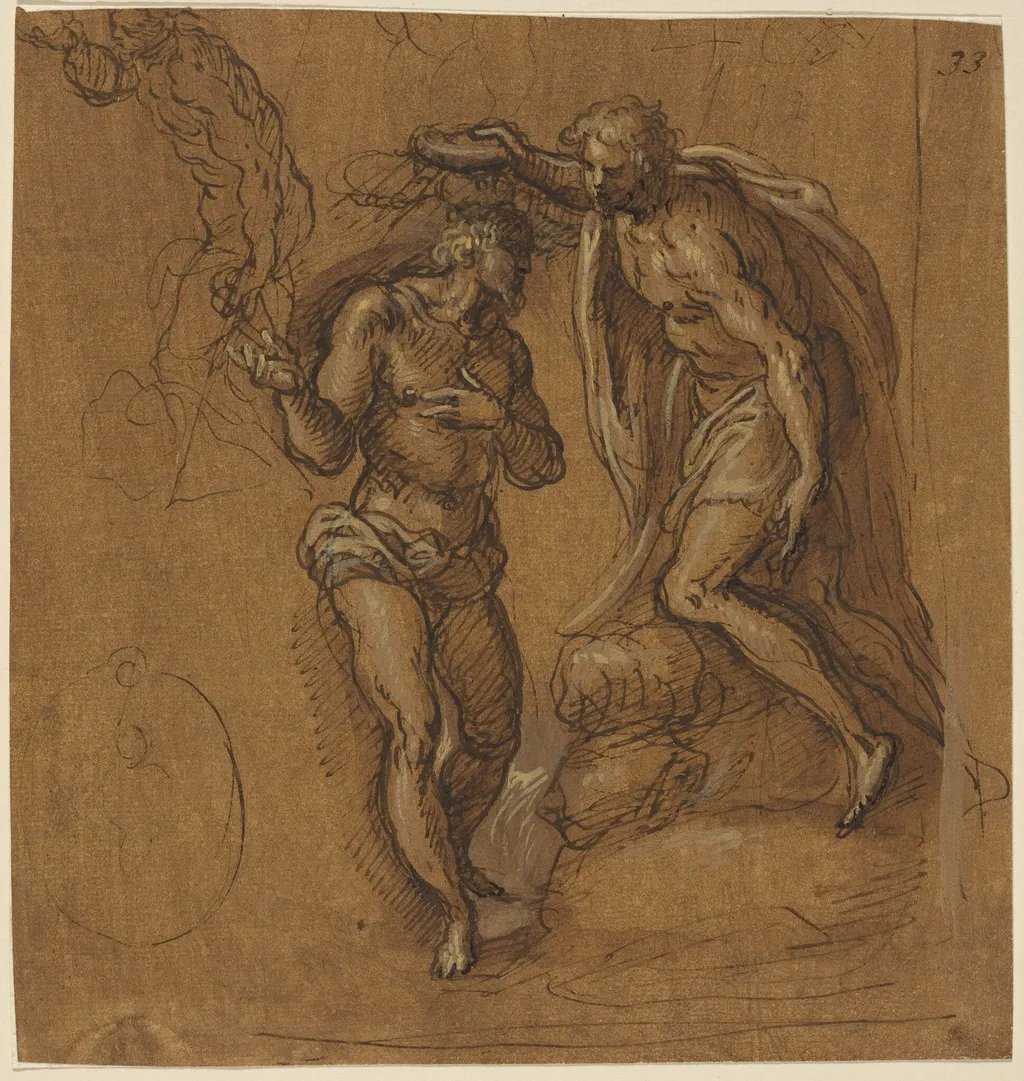
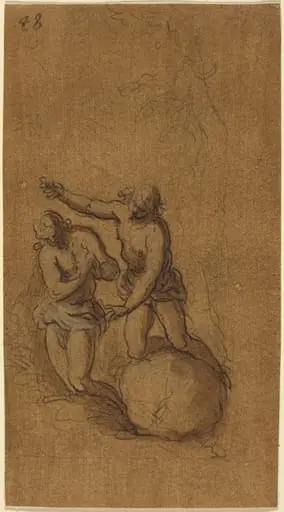
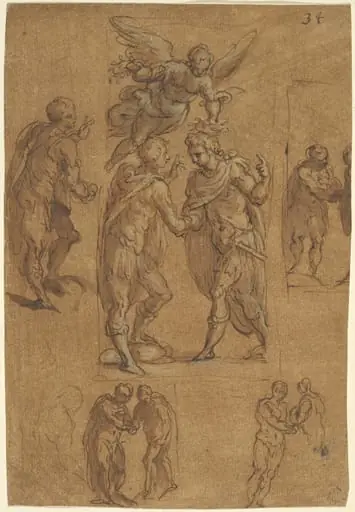
Sketch for a Baptism of Christ is an ink drawing by the Renaissance artist Jacopo Palma il Giovane. It dates from 1588 and is held in the collection of the National Gallery of Art.
About this work
Overview
Created in 1588 by the Venetian painter Palma il Giovane, this drawing serves as a preparatory study for a larger composition of the Baptism of Christ. Executed on laid paper that has been treated with a brown wash, the work combines pen work with brown ink and a further wash, possibly highlighted with touches of white.
Subject & Meaning
The composition presents two figures engaged in the baptismal scene: a standing figure draped with a cloth over his shoulder, likely representing John the Baptist, and a kneeling figure reaching upward, identified as Christ. The gestural interaction captures the moment of spiritual initiation without elaborating narrative details.
Technique & Style
Palma il Giovane employed a rapid, ink-washed approach, layering brown ink and wash to model volume. The drawing relies on loose, expressive lines and varied shading, creating a sense of movement while remaining intentionally unfinished. Subtle cross‑hatching builds form, and the possible addition of white highlights suggests an early attempt to define light.
History & Provenance
The sketch was produced as a study for an intended painted altarpiece, a common practice among late‑Renaissance artists to resolve composition and figure placement. Its survival on paper indicates it was retained, perhaps by the workshop, rather than discarded after the final work was completed.
Context
In the late sixteenth century, Venetian artists like Palma il Giovane frequently revisited biblical themes such as Christ’s baptism, aligning with Counter‑Reformation demands for clear, didactic imagery. The study reflects the period’s emphasis on dynamic figure interaction and dramatic chiaroscuro, hallmarks of the Venetian Mannerist style.
Legacy
Although the drawing itself was never intended for public display, it offers insight into Palma il Giovane’s preparatory methods and the broader workshop practices of the era. Scholars use such studies to trace the evolution from initial sketch to finished altarpiece, illuminating the artist’s creative process.
Artist & collection


![Nude Man Seen from Behind [verso], by Jacopo Palma il Giovane](https://artifactworldgallery.com/img/jacopo-palma-il-giovane--nude-man-seen-from-behind-verso--2de266ff199c839b-w320.webp)
![The Fall of the Rebel Angels [recto], by Parmigianino](https://artifactworldgallery.com/img/parmigianino--the-fall-of-the-rebel-angels-recto--e9b082b33c001c66-w320.webp)