Artwork
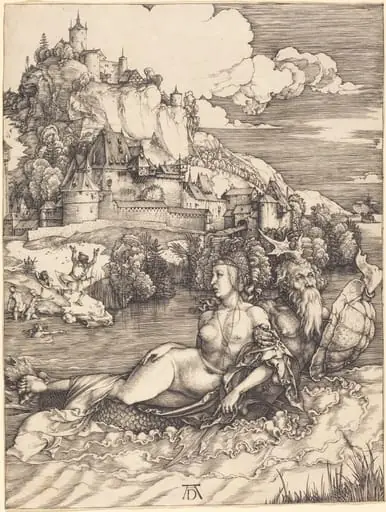
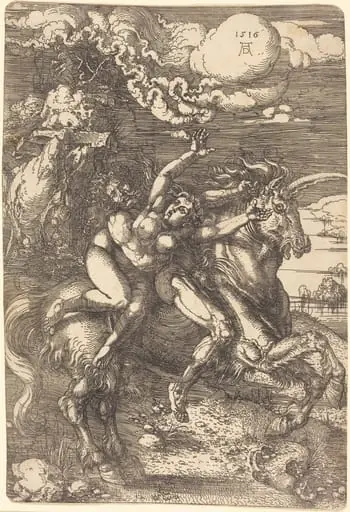
The Rape of Europa
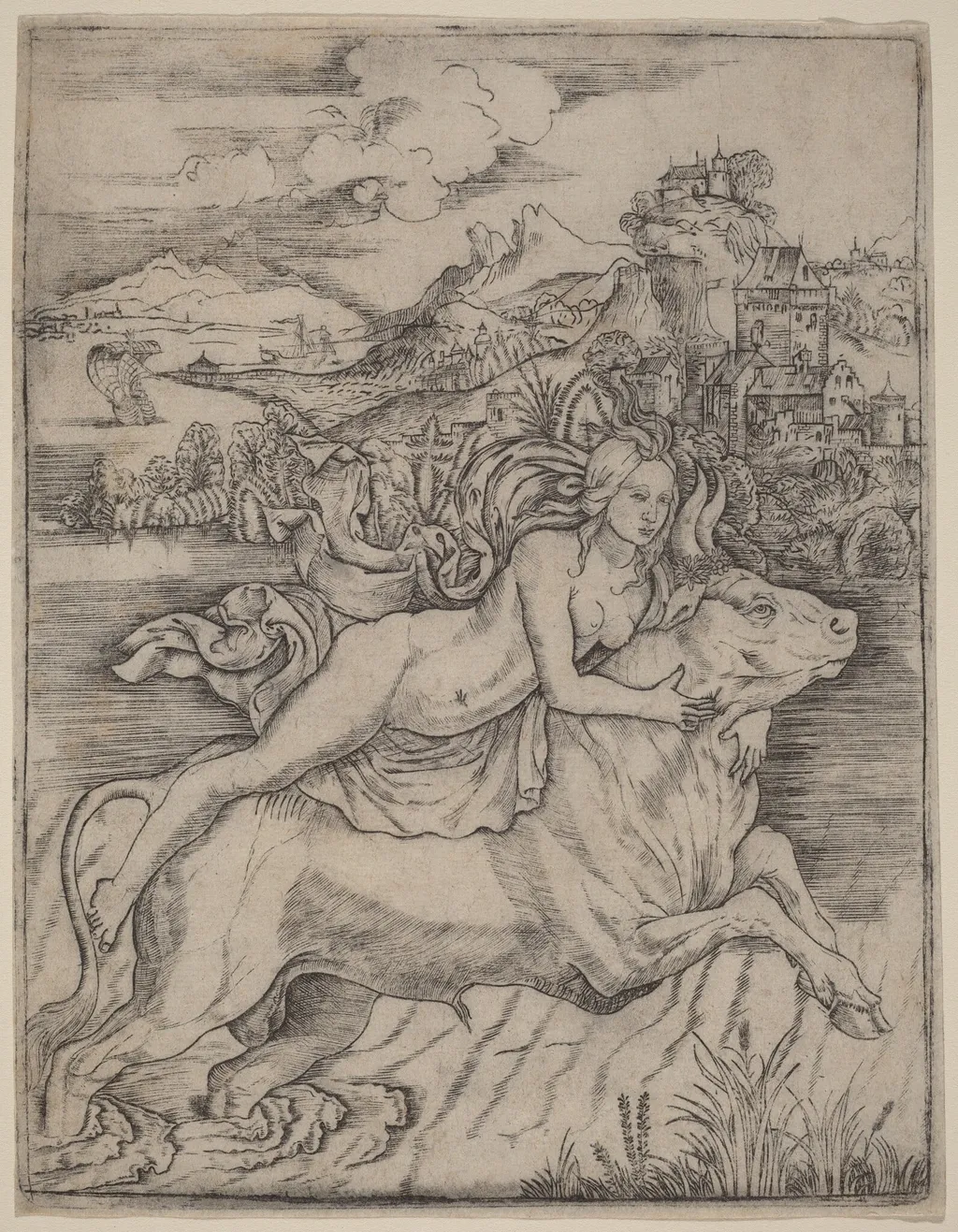
The Rape of Europa is an ink print by the Renaissance artist Giovanni Battista Palumba. It dates from 1502 and is held in the collection of the National Gallery of Art.
About this work
Overview
Created in 1502, this engraving by Giovanni Battista Palumba depicts the mythological abduction of Europa by Zeus in the form of a bull.
Created in 1502, this engraving by Giovanni Battista Palumba depicts the mythological abduction of Europa by Zeus in the form of a bull. Executed in fine linear technique, the work belongs to the early 16th-century Italian print tradition. Its composition captures a moment of suspended motion, with Europa airborne and the landscape receding behind her, suggesting both narrative tension and spatial depth through controlled line work.
Subject & Meaning
The scene illustrates the myth in which Zeus, disguised as a gentle bull, carries Europa across the sea to Crete. Her composed expression contrasts with the bull’s dynamic form, emphasizing the duality of divine power and human vulnerability. The inclusion of a distant shore implies the journey’s destination, grounding the supernatural event in a recognizable terrestrial setting, a common feature in Renaissance mythological prints.
Technique & Style
Palumba employed delicate cross-hatching and fine parallel lines to render texture and movement. The waves and clouds are built from layered strokes that suggest fluidity, while Europa’s flowing garments and hair are rendered with rhythmic, curved lines. The bull’s muscular form is defined with subtle tonal shifts, avoiding heavy shading to maintain the clarity and precision characteristic of early Renaissance engraving.
History & Provenance
The engraving is one of Palumba’s few surviving works, attributed to him based on stylistic comparison and early print catalogues. It was likely produced for a small, educated audience familiar with classical myths. No early ownership records are documented, but its technical quality suggests it was circulated among collectors and artists in northern Italy during the early 1500s.
Context
This print emerged during a period when Italian artists were re-engaging with classical mythology through visual media. Engravings like this served as both artistic studies and portable images of myth, circulating beyond painted altarpieces. Palumba’s work reflects the influence of northern European engraving techniques, adapted to Italian subject matter and compositional ideals.
Legacy
Though Palumba’s output was limited, this engraving exemplifies the transition from late Gothic to High Renaissance printmaking in Italy. Its restrained elegance and narrative clarity influenced later artists exploring mythological themes in graphic form. It remains a key example of how early printmakers translated complex stories into intimate, finely detailed compositions.
Artist & collection