Artwork
The Reconciliation of Jacob and Laban
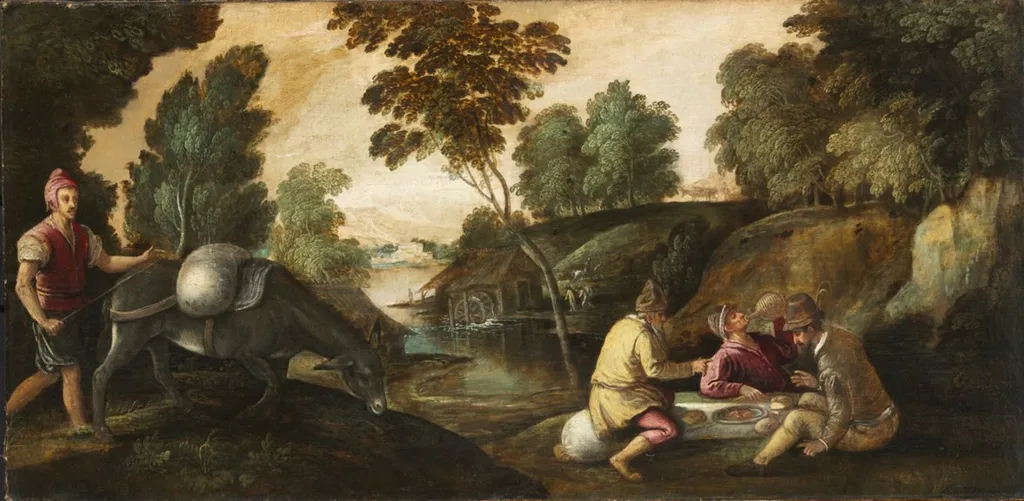
The Reconciliation of Jacob and Laban is an oil painting by the Mannerist artist Paolo Fiammingo. It dates from 1590 and is held in the collection of the Museum of Fine Arts, Budapest.
About this work
Overview
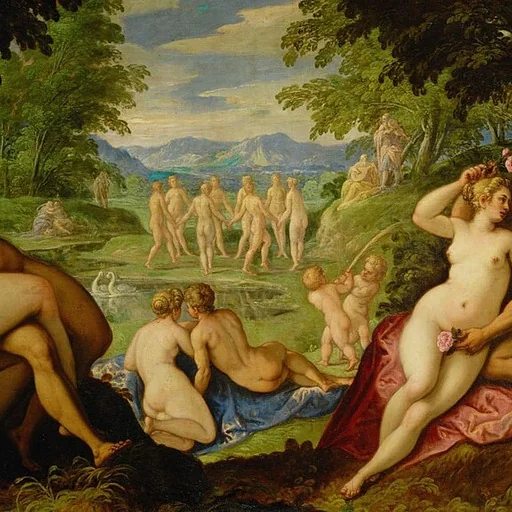
Created in 1590 by the Flemish painter Paolo Fiammingo, this oil on canvas portrays the biblical moment when Jacob and Laban reconcile. The composition centers on four male figures gathered around a table laden with food and drink, while a donkey bearing a sack stands to the left. A modest house, trees, and a calm body of water form the background, lending the scene a tranquil atmosphere.
Subject & Meaning
The work visualizes the scriptural episode in which Jacob, after years of service, meets his former employer Laban to settle debts and restore peace.
The work visualizes the scriptural episode in which Jacob, after years of service, meets his former employer Laban to settle debts and restore peace. The kneeling figure suggests humility or supplication, while the others’ relaxed postures convey a negotiated harmony. The inclusion of everyday items—tableware, a donkey, a sack—grounds the biblical narrative in a relatable, domestic setting, emphasizing themes of forgiveness and renewed fellowship.
Technique & Style
Fiammingo employs a Mannerist vocabulary marked by elongated forms and complex spatial arrangements, echoing the influence of Tintoretto, Veronese, and Bassano. A vivid palette of saturated reds, blues, and earth tones creates depth, while subtle chiaroscuro models the figures and highlights the table’s objects. The atmospheric perspective, achieved through muted blues in the distant water and foliage, enhances the sense of space and serenity.
History & Provenance
The painting entered the collection of the Museum of Fine Arts in Budapest, where it remains on display. Its acquisition date and prior ownership are not extensively documented, but the work has been identified as part of Fiammingo’s output during his Venetian period, when he produced numerous mythological, allegorical, and religious compositions for private patrons.
Context
Executed during the late 16th‑century Venetian Mannerist phase, the canvas reflects the city’s artistic climate, which favored dramatic narrative scenes rendered with vivid coloration and dynamic composition. Fiammingo, a Flemish expatriate, adapted the local style while retaining a Northern attention to detail, situating the biblical story within a familiar, contemporary milieu for his patrons.
Artist & collection
Artist
Pauwels Franck, known in Italy as Paolo Fiammingo and Paolo Franceschi (c. 1540–1596), was a Flemish painter, who, after training in Antwerp, was active in Venice for most of his life. He is mainly known for his…