Artwork
Two Pigs in a Sty
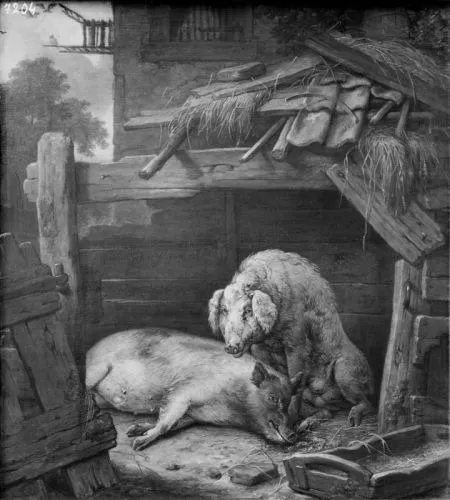
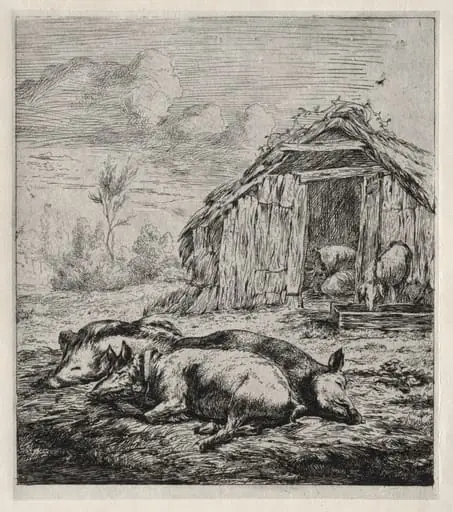
Two Pigs in a Sty is an oil painting by the Dutch Golden Age artist Paulus Potter. It dates from 1650 and is held in the collection of the Royal Museums of Fine Arts of Belgium.
About this work
Overview
The work belongs to a small but significant group of animal-focused paintings by the Dutch artist, who specialized in depicting livestock with quiet realism.
Painted around 1650 by Paulus Potter, this oil on canvas depicts two pigs resting in a modest wooden sty. The work belongs to a small but significant group of animal-focused paintings by the Dutch artist, who specialized in depicting livestock with quiet realism. Despite his short life, Potter produced around a hundred works, many centered on farm animals observed in natural settings. The painting is now part of the Royal Museums of Fine Arts of Belgium’s collection.
Subject & Meaning
The painting presents two pigs in a state of quiet repose—one curled, the other resting its head on the ground—within a humble, cluttered enclosure. There is no narrative or symbolic intent beyond the observation of ordinary rural life. The scene emphasizes the dignity of everyday creatures, reflecting a broader Dutch interest in the dignity of the mundane. The pigs’ stillness and the worn surroundings suggest a world untouched by human drama.
Technique & Style
Potter employed chiaroscuro to model the pigs’ forms, using subtle shifts in light and shadow to convey volume and texture. The rough grain of the wooden pen and the dampness of the mud are rendered with restrained brushwork, avoiding ornamentation. The low viewpoint places the viewer at ground level, enhancing the sense of intimacy and immersion. Light falls naturally across the pigs’ coarse fur and the weathered timber, grounding the scene in tactile reality.
History & Provenance
Created during the height of the Dutch Golden Age, the painting was made by Potter, who died of tuberculosis at age 28. His career was brief but influential, particularly in elevating animal subjects to serious artistic focus. The work entered the collection of the Royal Museums of Fine Arts of Belgium in the 19th century, where it has remained since, preserved as part of a broader survey of Flemish and Dutch 17th-century art.
Context
In 17th-century Netherlands, domestic and farm animals were increasingly depicted not as symbols but as subjects worthy of close study. Potter’s work aligned with a cultural shift toward empirical observation and the celebration of ordinary life. Unlike grand historical or religious scenes, his paintings captured the quiet rhythms of rural existence, resonating with a society that valued realism and material detail.
Legacy
Though Potter’s output was limited by his early death, his approach influenced later animal painters and contributed to the legitimacy of genre scenes in Dutch art. His focus on texture, light, and the physical presence of animals set a precedent for naturalistic observation. *Two Pigs in a Sty* remains a quiet testament to his ability to find substance and presence in the simplest of subjects.
Artist & collection
Artist
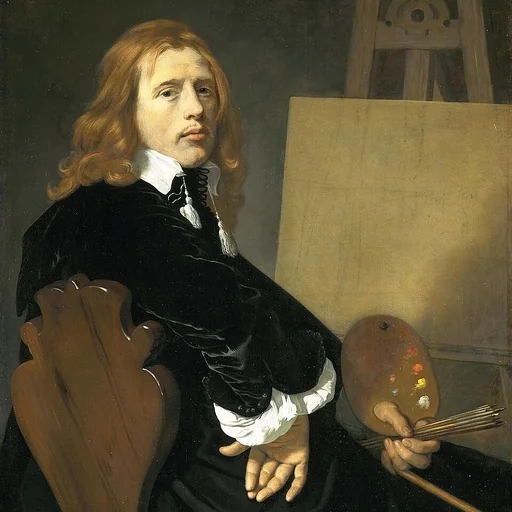
Paulus Potter (Dutch pronunciation: ; 20 November 1625 (baptised) – 17 January 1654 (buried)) was a Dutch painter who specialized in landscapes featuring animals, often from a low vantage point.

Museum
Royal Museums of Fine Arts of Belgium
Continue through works from the same source collection.