Artwork
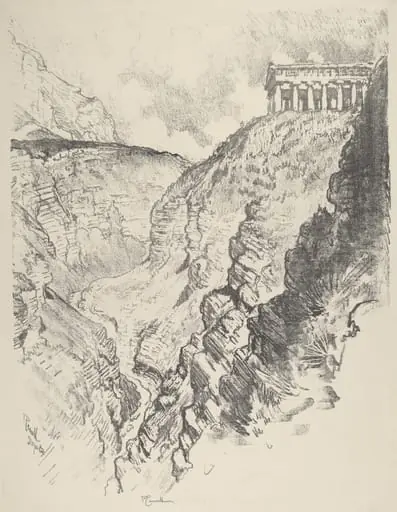
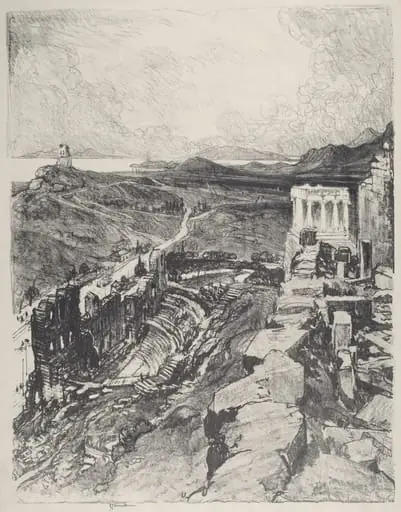
Aetna Over Taormina
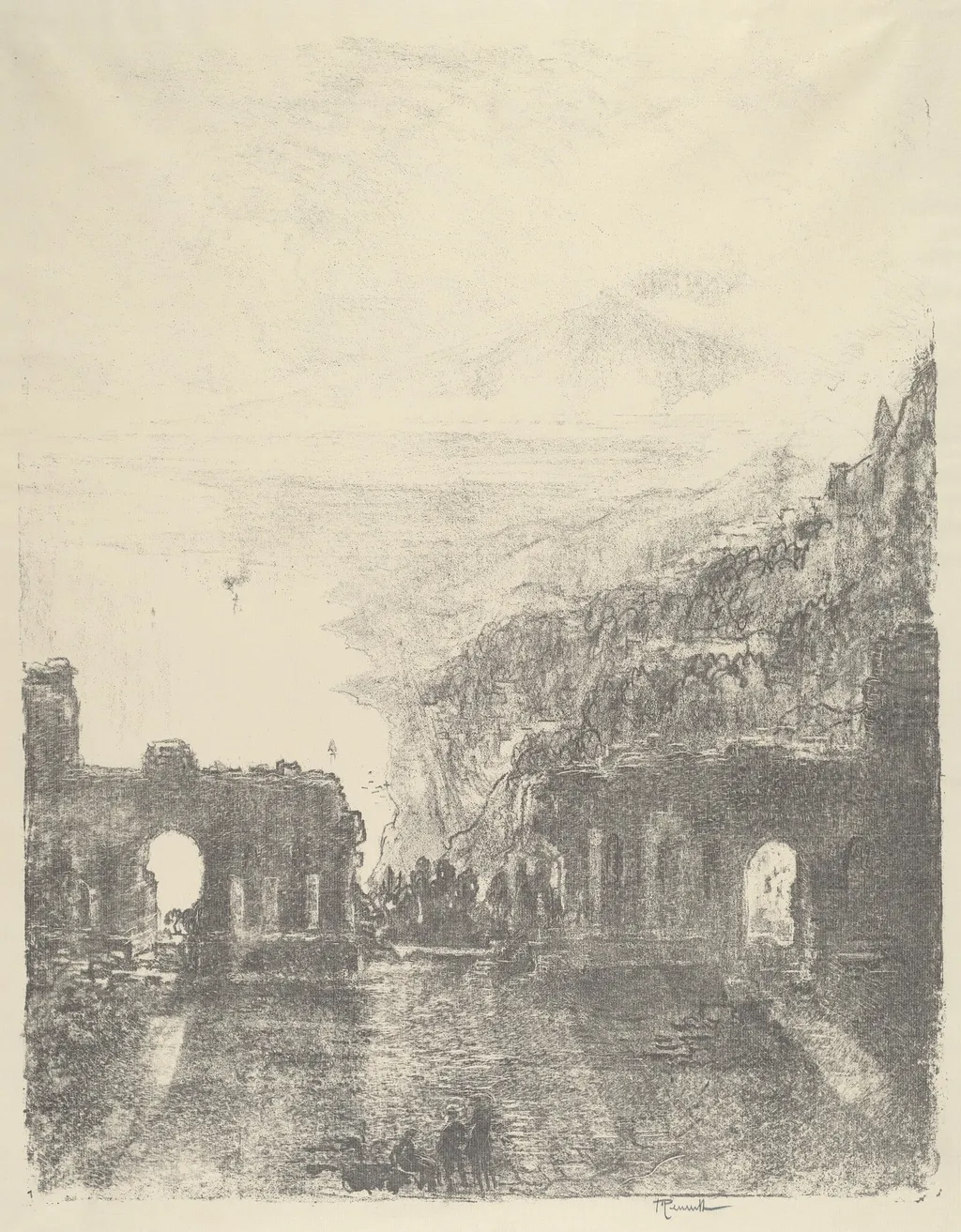
Aetna Over Taormina is an ink print by Joseph Pennell. It dates from 1913 and is held in the collection of the National Gallery of Art.
About this work
Overview
The absence of human figures emphasizes solitude and the enduring scale of the land.
Joseph Pennell’s 1913 lithograph *Aetna Over Taormina* captures a quiet, atmospheric view of Sicily’s landscape, focusing on the presence of Mount Etna rising behind the ancient town. Executed in lithography, the work reflects Pennell’s interest in architectural ruins and natural forms, rendered with minimal detail and a restrained tonal range. The absence of human figures emphasizes solitude and the enduring scale of the land.
Subject & Meaning
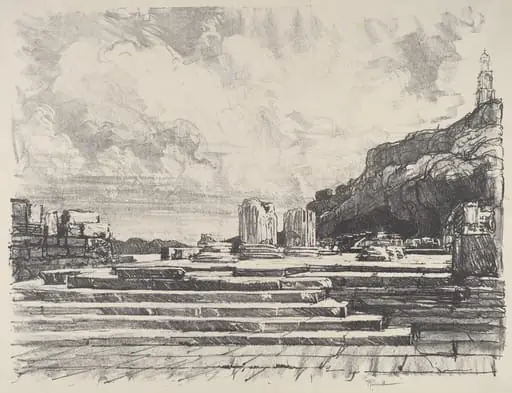
The composition centers on a crumbling stone archway, its two vacant openings framing the distant bulk of Mount Etna. The ruin suggests the passage of time and the layering of human history over the natural world. The mountain, veiled in atmospheric haze, appears both distant and dominant, evoking a sense of quiet awe rather than dramatic threat. The scene invites contemplation of impermanence and geological time.
Technique & Style
Pennell employed lithographic crayon to create loose, rapid lines that suggest form without defining it. The haze around Etna is achieved through soft, smudged tones, while the archway’s texture is rendered with sparse, angular strokes. The limited palette and emphasis on negative space reflect Whistler’s influence, prioritizing mood over detail. The print’s economy of line conveys immediacy, as if drawn on-site in a single observation.
History & Provenance
Pennell created this work during his extended travels in southern Italy, where he documented landscapes and ruins for both artistic and journalistic purposes. As an American artist based in Europe, he often published his prints alongside writings by his wife, Elizabeth Robins. *Aetna Over Taormina* was likely produced for inclusion in one of their collaborative publications, reflecting a broader interest in European topography among early 20th-century American printmakers.
Context
In the early 1900s, lithography experienced a revival among artists seeking alternatives to traditional etching. Pennell’s work aligned with a trend favoring direct, expressive mark-making over polished finish. His focus on ruins and volcanic terrain resonated with contemporary interests in archaeology and natural forces, positioning him within a transatlantic movement that valued the emotional weight of place over literal representation.
Legacy
Pennell’s lithographs, including this one, contributed to the recognition of printmaking as a legitimate medium for personal expression rather than mere reproduction. His ability to convey atmosphere through minimal means influenced later generations of American landscape printmakers. While not widely exhibited today, his works remain in institutional collections as examples of early modernist sensibility in print.
Artist & collection
Artist
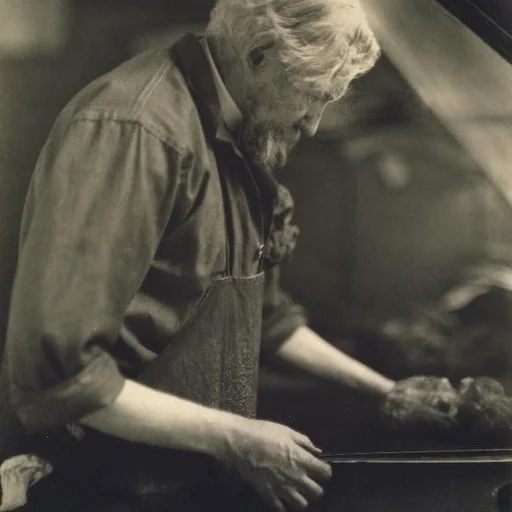
Joseph Pennell (July 4, 1857 – April 23, 1926) was an American draftsman, etcher, lithographer, and illustrator for books and magazines.