Artwork
Building the Freidrich-Strasse Station
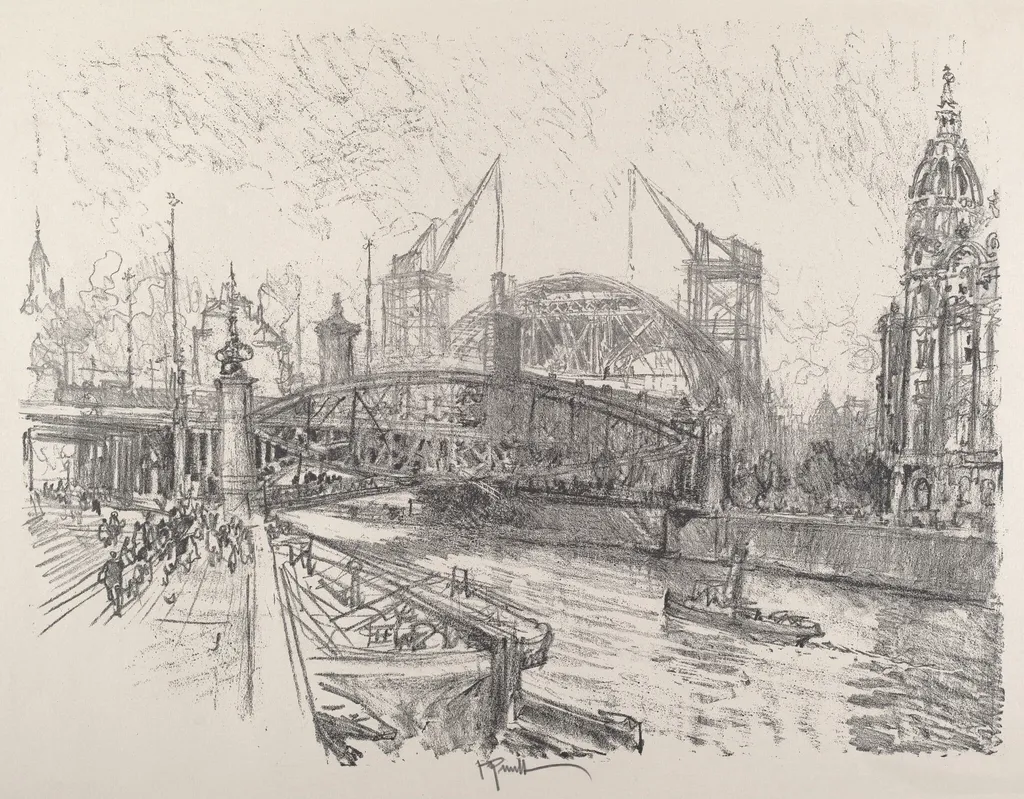
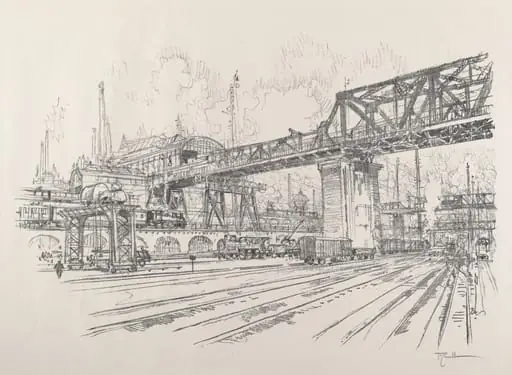
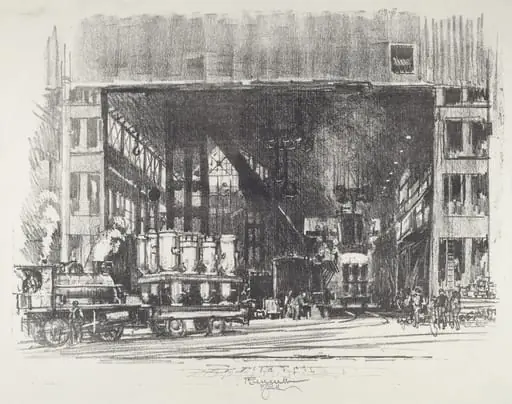
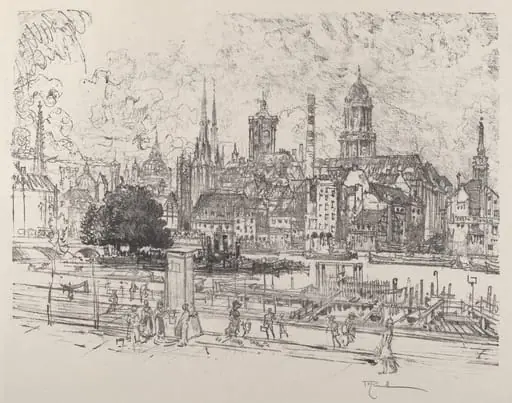
Building the Freidrich-Strasse Station is an ink print by Joseph Pennell. It dates from 1921 and is held in the collection of the National Gallery of Art.
About this work
Overview
Joseph Pennell’s 1921 lithograph, *Building the Friedrich‑Straße Station*, records the erection of a major railway hub in Berlin. The print captures a dense urban environment, centering on the station’s massive structure amid tracks, trains, pedestrians, surrounding buildings and industrial smokestacks.
Subject & Meaning
The composition emphasizes the dynamism of early‑twentieth‑century urban growth, illustrating how transportation infrastructure reshaped city life. By foregrounding workers and commuters, Pennell highlights both the human activity and the architectural ambition that defined the era’s modernization.
Technique & Style
Executed in lithography, the work relies on a limited grayscale palette. Pennell employs strong line work and varied shading to generate depth, rendering the station’s massing and the bustling street scene with a tactile sense of texture and contrast.
History & Provenance
An American artist who spent much of his career in Europe, Pennell was shaped by the teachings of James Lambdin, Thomas Eakins, and the aesthetic influence of James McNeill Whistler. His focus on industrial and architectural subjects aligns with his broader oeuvre of European cityscapes.
Context
Created shortly after World War I, the lithograph reflects postwar reconstruction and the expansion of Berlin’s transit network. It situates Pennell within a tradition of artists documenting the built environment as a marker of progress.
Artist & collection
Artist
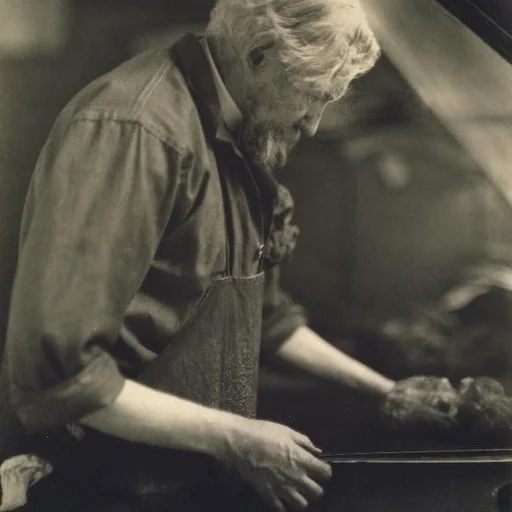
Joseph Pennell (July 4, 1857 – April 23, 1926) was an American draftsman, etcher, lithographer, and illustrator for books and magazines.

![[Large Steamer Ship at Dock, Paris], by Auguste Lepère](https://artifactworldgallery.com/img/auguste-lepere--large-steamer-ship-at-dock-paris--ed31099e42153820-w320.webp)