Artwork
Shot Tower between the Bridges
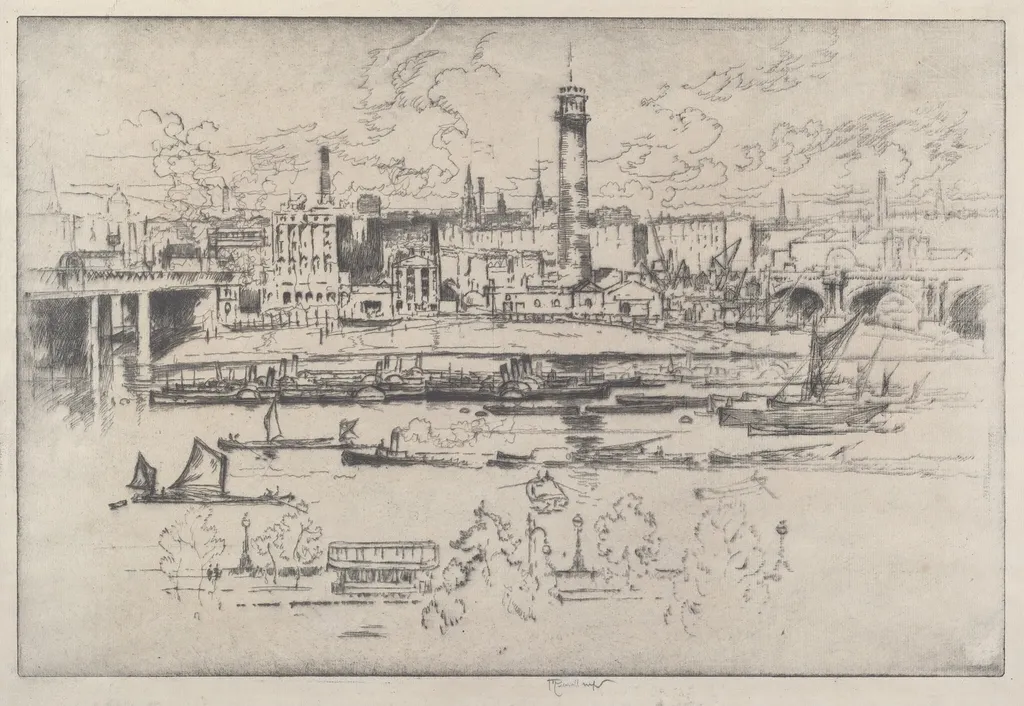
Shot Tower between the Bridges is an ink print by Joseph Pennell. It dates from 1910 and is held in the collection of the National Gallery of Art.
About this work
Overview
Joseph Pennell created this 1910 etching trial proof depicting a riverside industrial landscape in Philadelphia.
Joseph Pennell created this 1910 etching trial proof depicting a riverside industrial landscape in Philadelphia. As an American artist based largely in Europe, Pennell returned to U.S. urban scenes with a focus on architectural and mechanical subjects. This work, one of many in his series on industrial sites, captures the energy of a working waterfront through the precise yet fluid lines characteristic of his etching technique.
Subject & Meaning
The scene centers on a tall shot tower flanked by factories, cranes, and docked vessels along the Schuylkill River. Boats of varying sizes populate the water, suggesting active commerce. The composition juxtaposes human-made structures with natural elements like trees and rippling water, emphasizing the integration of industry into the urban fabric. No figures are present, yet the scene conveys motion and labor through the arrangement of forms and textures.
Technique & Style
Pennell employed etching to achieve a dynamic interplay of line and tone. His loose, confident strokes define the tower’s verticality and the water’s turbulence, while finer details—such as smokestacks and pavilion roofing—add precision. The trial proof status indicates it was an early impression, possibly used to refine the plate before final printing. The absence of heavy ink washes preserves the clarity of the engraved lines, highlighting the artist’s control over texture and depth.
History & Provenance
This trial proof dates from Pennell’s period of intense focus on American industrial sites, following his return from Europe. It was likely produced in his Philadelphia studio around 1910, during a phase when he was documenting the city’s evolving infrastructure. As a trial proof, it was not part of a commercial edition, making it a rare artifact of his working process. Its survival reflects its value to the artist as a study rather than a finished product.
Context
In the early 20th century, American artists increasingly turned to industrial subjects as symbols of modernity. Pennell’s work aligned with broader trends in printmaking that valued realism and social observation. Unlike romanticized landscapes, his etchings embraced the grit of urban expansion. This piece reflects a moment when Philadelphia’s waterfront was a hub of manufacturing, and artists like him sought to record its transformation with documentary precision.
Legacy
Pennell’s etchings, including this trial proof, contributed to the recognition of printmaking as a serious medium for urban documentation. His approach influenced later generations of artists interested in industrial aesthetics and the formal qualities of mechanical environments. Though less widely known than his European contemporaries, his work remains a significant record of early 20th-century American industrial life through the lens of skilled draftsmanship.
Own this work as a print
Artist & collection
Artist
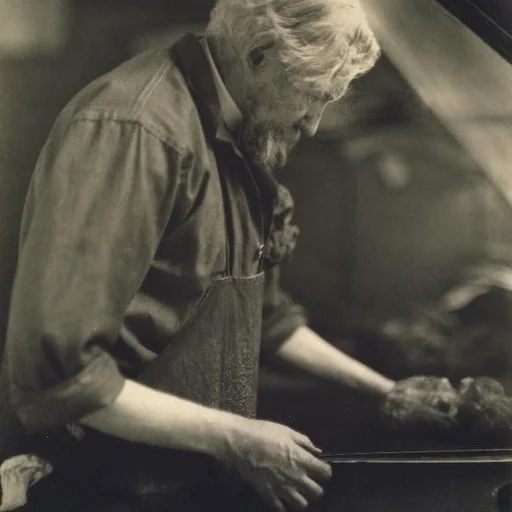
Joseph Pennell (July 4, 1857 – April 23, 1926) was an American draftsman, etcher, lithographer, and illustrator for books and magazines.

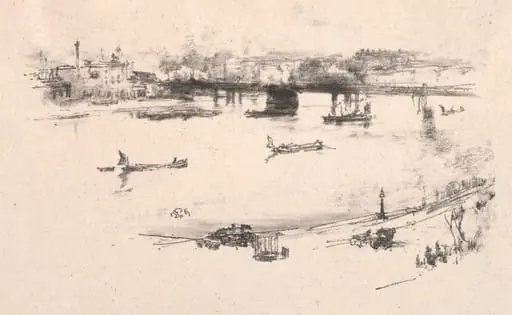 Charing Cross Railway Bridge
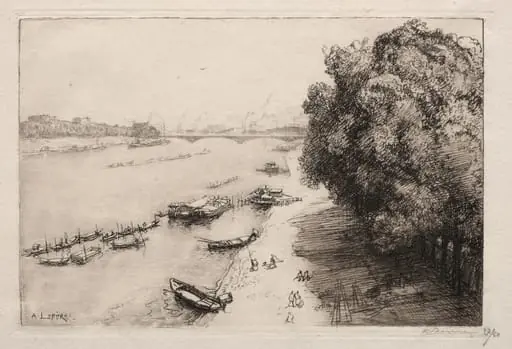 La Seine au Pont Nationale
 Early Morning Battersea
 Battersea Reach
 Arteries of Great Britain: The Tyne
![[Large Steamer Ship at Dock, Paris], by Auguste Lepère](https://artifactworldgallery.com/img/auguste-lepere--large-steamer-ship-at-dock-paris--ed31099e42153820-w320.webp) [Large Steamer Ship at Dock, Paris]
[Large Steamer Ship at Dock, Paris] Fulham
 London Bridge
 The 'Adam and Eve', Old Chelsea
 Building the Freidrich-Strasse Station
 Arteries of Great Britain: The Tyne
 The 'Adam and Eve', Old Chelsea