Artwork
Archangel Michael
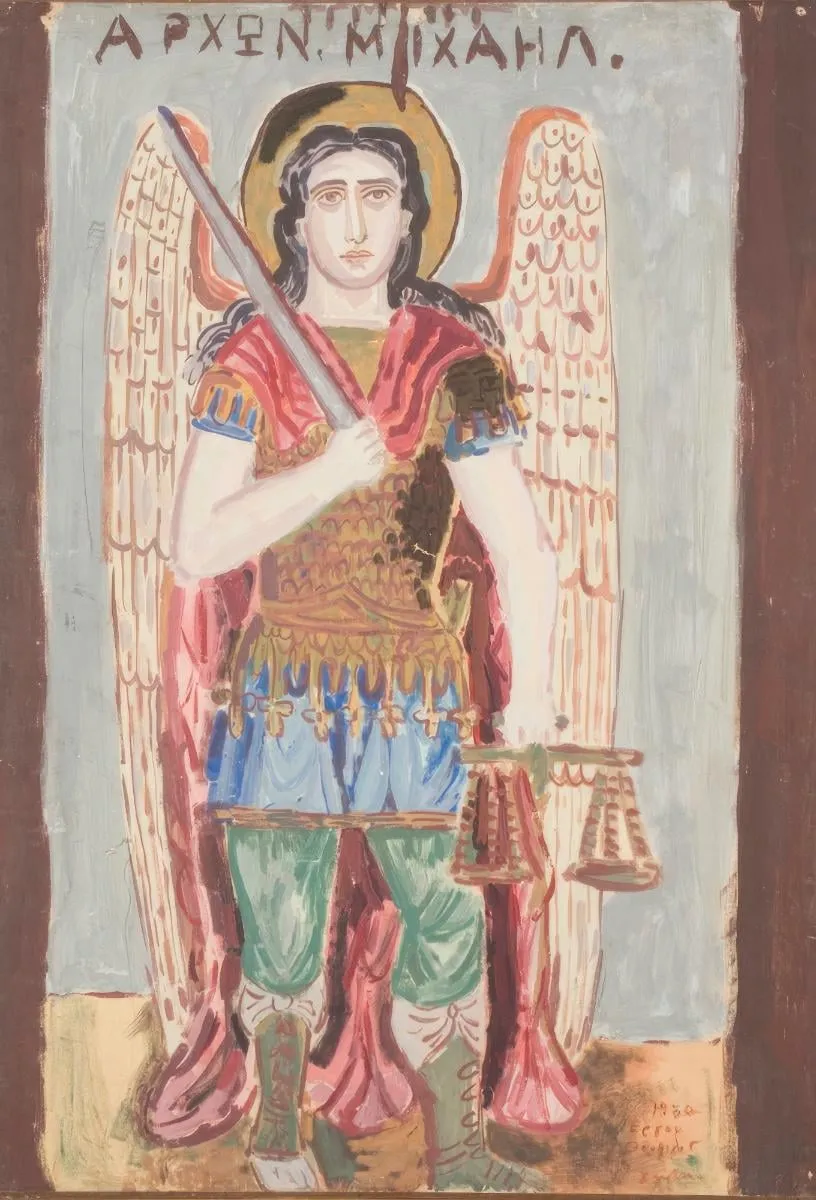
Archangel Michael is an unspecified painting by Pepi Svoronou-Kokkinidou. It dates from 1982 and is held in the collection of the Athens School of Fine Arts.
About this work
Overview
Created around 1982 by Pepi Svoronou-Kokkinidou, this painting depicts the Archangel Michael as a celestial warrior.
Created around 1982 by Pepi Svoronou-Kokkinidou, this painting depicts the Archangel Michael as a celestial warrior. Executed in oil or tempera, the work is part of the Museum of Ethnography’s collection. Its composition follows traditional iconographic conventions while incorporating expressive brushwork. The figure stands centrally against a muted background, emphasizing spiritual presence over narrative detail.
Subject & Meaning
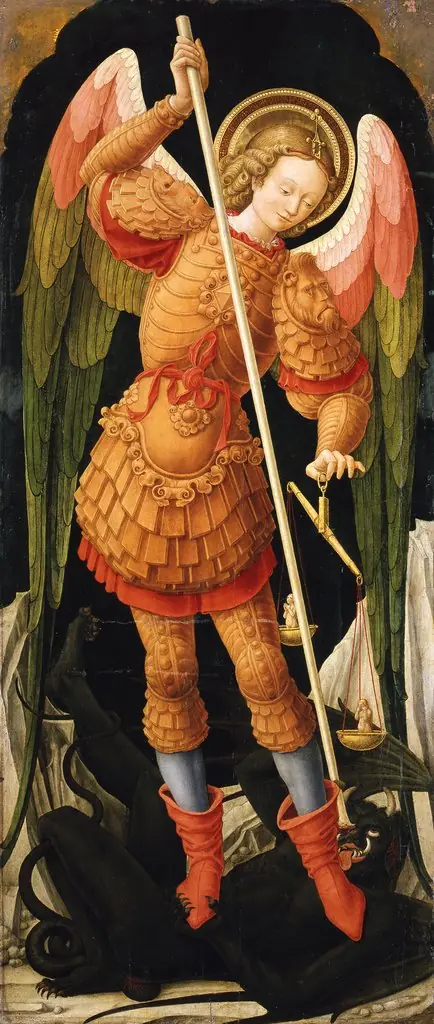
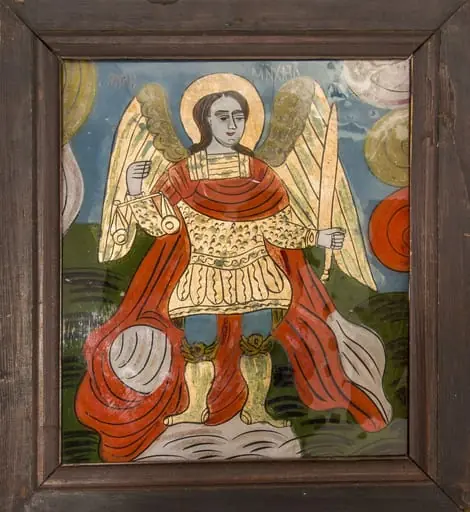
The figure represents Michael, the archangel associated with divine justice and protection. He holds a sword, symbolizing the defeat of evil, and scales, representing the weighing of souls. The Greek inscription above confirms his identity. The red tunic and golden halo signify sanctity and authority, while the absence of a crowd or landscape focuses attention on his role as a moral arbiter in Christian eschatology.
Technique & Style
The artist employs thick, textured brushstrokes, particularly in the fabric and halo, creating a tactile surface that catches light. This impasto technique adds dimensionality to the flat, symbolic space. Colors are applied with deliberate contrast—gold against red, blue against gray—enhancing the figure’s otherworldly presence. The background’s subdued tone isolates the figure, reinforcing its devotional function.
History & Provenance
The painting was completed in the early 1980s and entered the Museum of Ethnography’s collection shortly thereafter. It reflects the artist’s engagement with religious iconography within a modern Greek context. No earlier ownership records are documented, suggesting it was likely commissioned or created for personal or community devotional use before institutional acquisition.
Context
This work emerges from a period of renewed interest in Byzantine and folk religious imagery among Greek artists. While rooted in centuries-old icon traditions, Svoronou-Kokkinidou’s approach introduces personal expression through visible brushwork and color intensity. It bridges liturgical art and contemporary practice, reflecting a cultural moment where spiritual symbols were reinterpreted through individual artistic voice.
Legacy
The painting contributes to a broader dialogue on the evolution of religious imagery in modern Greece. Its presence in an ethnographic museum signals its value as a cultural artifact rather than a purely liturgical object. It offers insight into how traditional iconography continues to inform artistic identity, even when removed from ecclesiastical settings.
Artist & collection
Artist
Pepi Svoronou-Kokkinidou (1934–2011) was an artist, born in Piraeus.
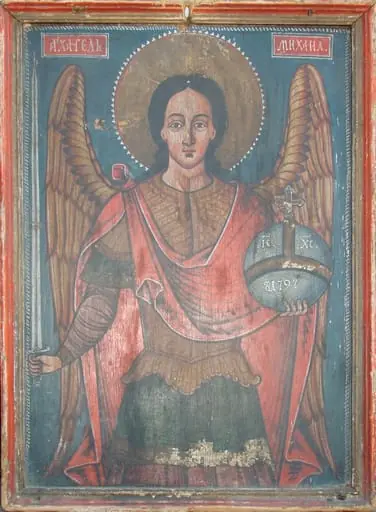 Arhanghelul Mihail
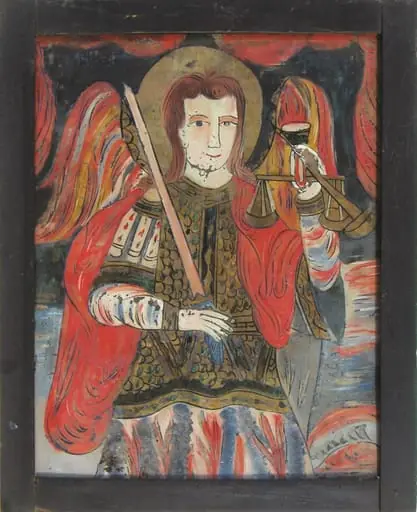 Sf. Arhanghel Mihail
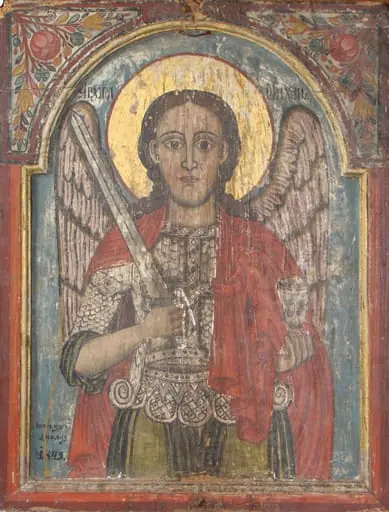
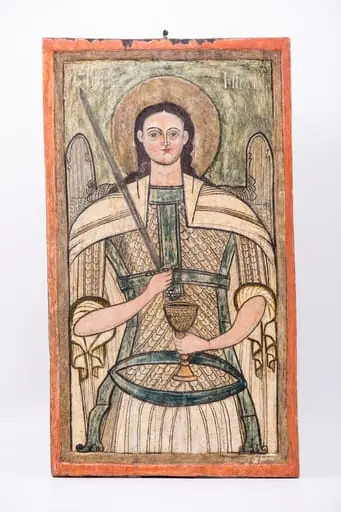 Sfântul Arhanghel Mihail este unul dintre mai-marii voievozi ai oștilor cerești. Sfântul Arhanghel Mihail este numit slujitorul Legii. Este îmbrăcat în haine de oștean militar, cavaler, cu cămașă verde, kaki și olive, vestă de zale, cu solzi aurii, cu tunică și mantie crem-bej. Ține în mâna dreaptă spada de război ridicată, fiind un sfânt luptător și apărător al Creștinismului și în mâna stângă Potirul pictat cu nuanțe de negru-gri-alb. Are aureolă și aripi gri-gălbui. Părul lung negru cade pe umeri. Fondul icoanei este verde-vernil. Icoana are un chenar decorativ geometrizant liniar roșu. Trăsăturile feței sunt foarte fin realizate, cu minuțiozitatea detaliului. Cromatica armonioasă este alcătuită din: roșu-vermillon, cărămiziu, ocru-galben, verde, gri, kaki, olive, alb, bej, negru. Icoana excelează prin cromatica armonioasă și foarte luminoasă și prin desenul riguros și detaliat. Icoana este de iconostas, din Rășinari, Mărginimea Sibiului și este de secol XVIII.
 Angel
Angel Sfântul Arhanghel Mihail
 Arhanghelul Mihail
 Arhanghelul Mihail