Artwork
Jupiter and Antiope
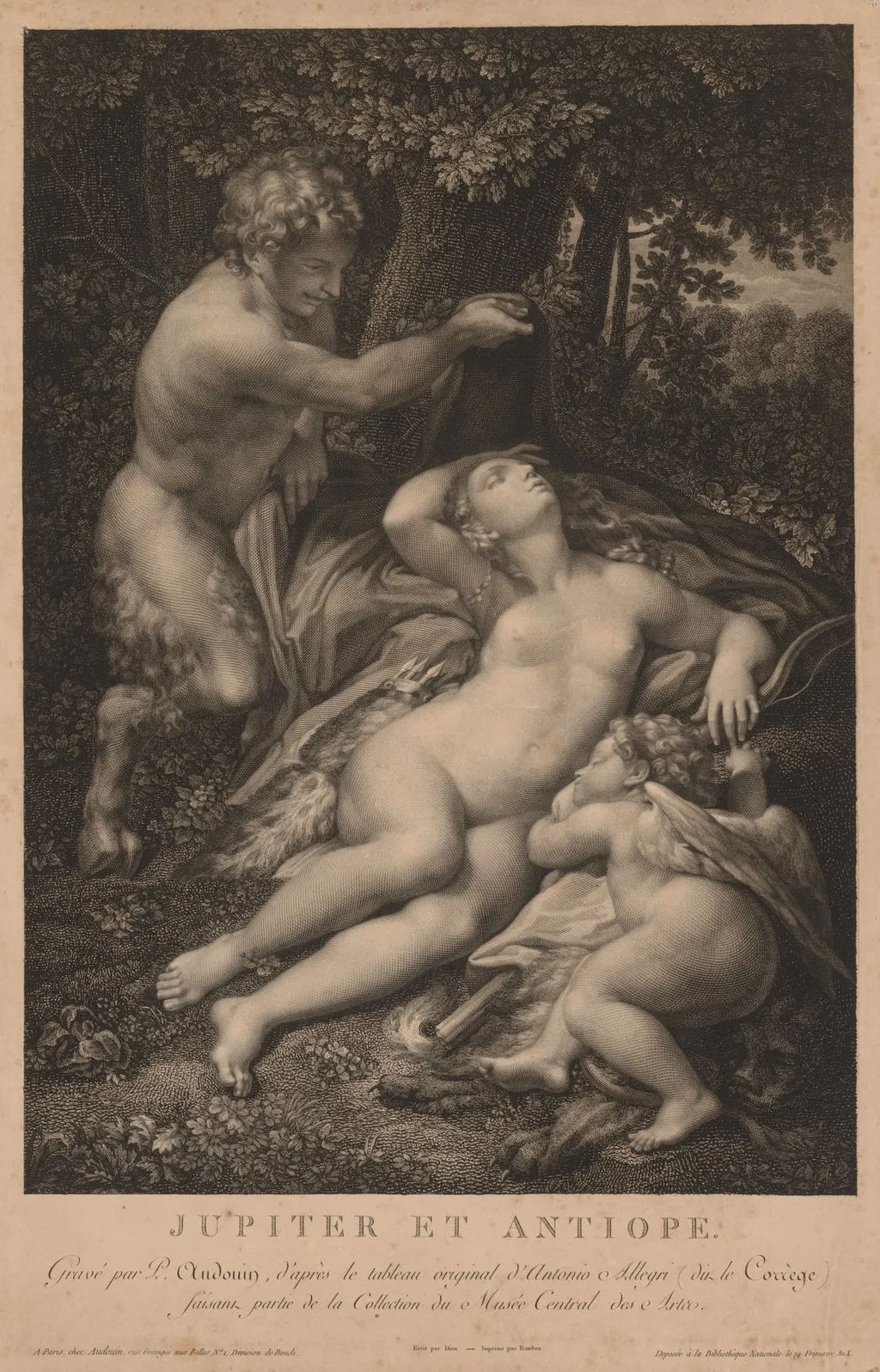
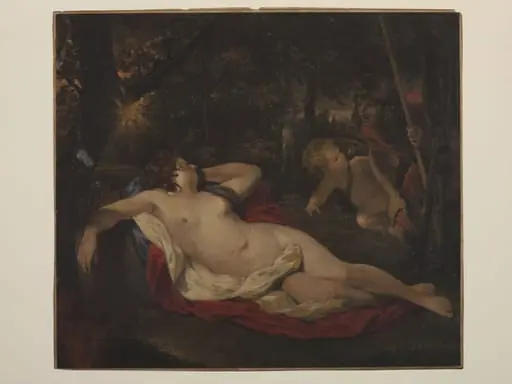
Jupiter and Antiope is a print by the Romanticist artist Pierre Audouin. It dates from 1801 and is held in the collection of the Cleveland Museum of Art.
About this work
Overview
This work exemplifies his skill in adapting classical subjects into the print medium with precision and atmospheric depth.
Pierre Audouin, a French engraver trained under Beauvarlet, created this print around 1801 as part of the series *Le Musée Français*, which reproduced significant paintings for a broader audience. Working in Paris, Audouin specialized in translating painted compositions into detailed intaglio prints. His later association with the Vienna Academy of Arts reflects his recognition beyond France. This work exemplifies his skill in adapting classical subjects into the print medium with precision and atmospheric depth.
Subject & Meaning
The scene illustrates the myth of Jupiter, the king of the gods, approaching Antiope, a Theban princess, in the form of a satyr. The muscular male figure represents Jupiter, while the reclining woman, half-covered by drapery, embodies Antiope. The child at her side, holding a staff, alludes to their son Amphion, born from this union. The moment captures the myth’s ambiguous tension—seduction disguised as divine intervention—rendered with emotional restraint rather than overt drama.
Technique & Style
Audouin employed fine, controlled lines to model form and texture, using hatching and cross-hatching to build gradations of tone. The composition relies on chiaroscuro to define the figures against a dense, shadowed woodland, enhancing the sense of intimacy and mystery. Drapery flows with naturalistic weight, and the figures’ poses are rendered with classical poise, reflecting the influence of Renaissance and Baroque painting traditions adapted to the demands of reproductive engraving.
History & Provenance
The print was produced during the early years of *Le Musée Français*, a multi-volume publication commissioned by the French state to preserve and disseminate major artworks from royal collections. Audouin’s contribution was among hundreds of engravings intended to educate the public and elevate national taste. Though the original painting it reproduces is now lost, Audouin’s version survives as a key record of its composition and visual language.
Context
In post-revolutionary France, there was a concerted effort to reframe cultural heritage through accessible art. *Le Musée Français* served as both a scholarly archive and a tool of civic education. Classical mythology remained a favored subject, offering moral and aesthetic lessons without overt political connotations. Audouin’s work aligned with this agenda, translating grand historical paintings into a format suitable for domestic display and study.
Legacy
Audouin’s engraving contributed to the broader circulation of classical imagery in early 19th-century Europe. While not widely celebrated as an original artist, his technical precision helped preserve the visual language of now-lost paintings. His prints remain valuable for art historians studying the transmission of imagery across media and the role of reproductive engraving in shaping public perception of art during the Napoleonic era.
Artist & collection
Artist
Pierre Audouin (1768–1822) was a French engraver, and pupil of Beauvarlet. Audouin was born in Paris, where he lived and worked his whole life. He was married to Anne Laurent, the daughter of the engraver, Pierre…

![The Goddess Discord [La Discord], by Félix Bracquemond](https://artifactworldgallery.com/img/felix-bracquemond--the-goddess-discord-la-discord--fe619c84d477117f-w320.webp)
![The Amorous Lion [Le lion amoureux], by Félix Bracquemond](https://artifactworldgallery.com/img/felix-bracquemond--the-amorous-lion-le-lion-amoureux--5d353e25984ceddb-w320.webp)