Artwork
Lolotte and Werther
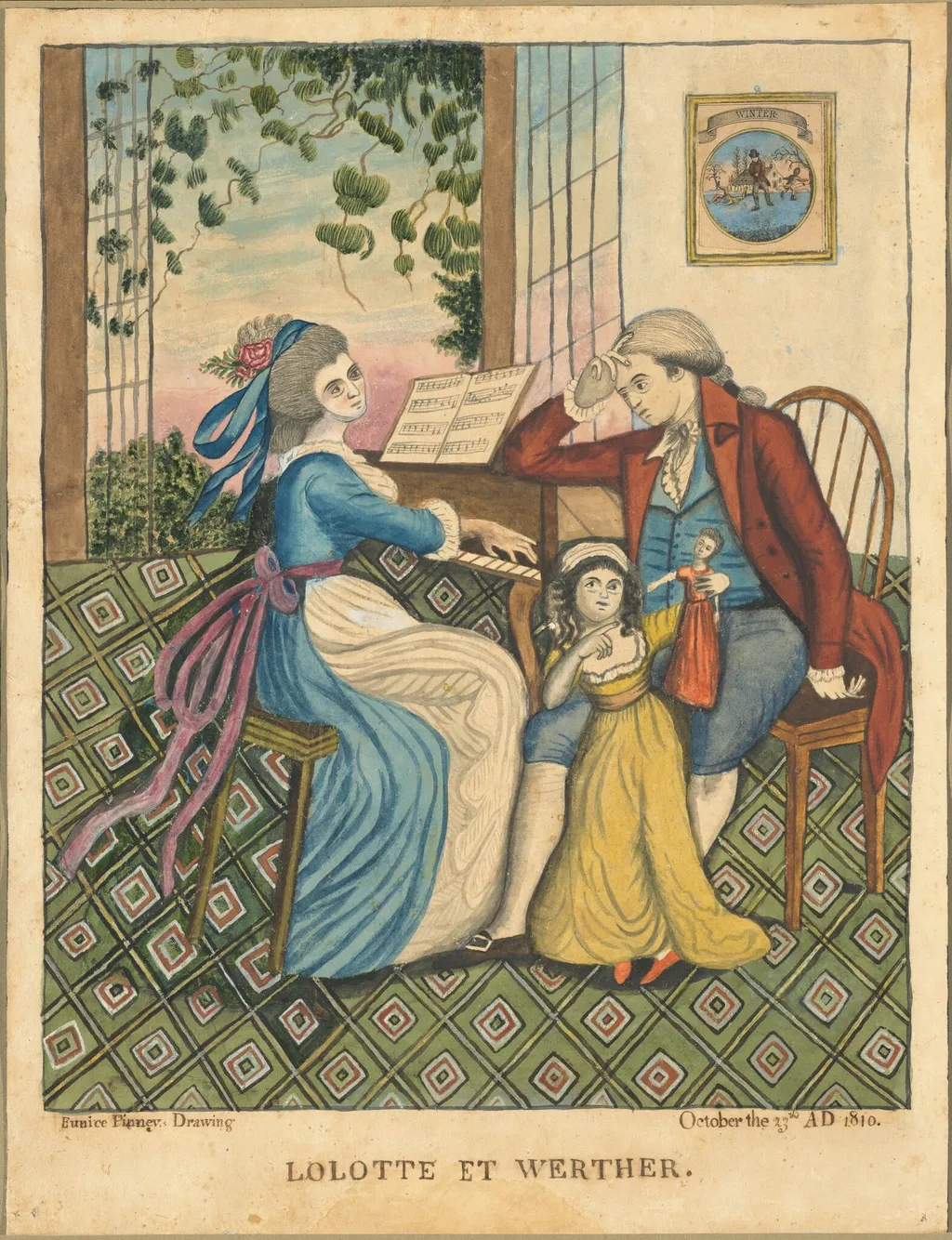
Lolotte and Werther is a watercolor drawing by the Romanticist artist Eunice Pinney. It dates from 1810 and is held in the collection of the National Gallery of Art.
About this work
Overview
“Lolotte and Werder” is a work attributed to Eunice Pinney, dated to 1810. The piece combines a watercolor drawing with an inserted engraving titled “Winter,” which is mounted in a simulated frame on the surface. The composition presents two figures, identified as Lolotte and Werther, set within a narrative scene derived from a literary source.
Subject & Meaning
The two central figures reference the characters Lolotte and Werther from a novel popular in the early nineteenth century, suggesting a visual interpretation of a specific episode in the story. Their gestures and surrounding details hint at the emotional tone of the literary moment, inviting viewers to connect the image with the text’s themes of love and melancholy.
Technique & Style
Pinney’s primary medium is watercolor, applied with a delicate hand that renders the figures and background in soft washes. The added engraving, an original print named “Winter,” is affixed to the watercolor and framed in a faux border, creating a layered effect that juxtaposes the fluidity of watercolor with the linear precision of printmaking.
History & Provenance
The work is recorded as an 1810 creation by Eunice Pinney, an American artist known for her drawings and prints. The engraving “Winter” is an authentic contemporary piece, not a later reproduction, and its inclusion suggests the artist’s intent to merge two distinct media within a single composition.
Context
During the early 1800s, American women artists like Pinney often worked in watercolor and print, mediums accessible for domestic practice. Incorporating an engraved image into a watercolor reflects a broader interest in mixed-media experimentation and the circulation of literary themes through visual art.
Artist & collection


 Woman and Boy with Provisions
 Annette and Lubin
 La lecon interrompue
 The Prodigal Son Revelling with Harlotsy
 Gaikokujin ifuku shitate no zu|Picture of a Foreigner Making Clothes
 Harpsichord Recital at Count Rumford's, Concord, New Hampshire
 歌川芳員画 『外国人衣服仕立之図』|Foreign Family with Wife Making Clothes (Gaikokujin ifuku shitate no zu)
 The Sargent Family
 La jarretière
 Seated Woman Sketching a Design for Embroidery and Children Winding Yarn
 The Prodigal Son Taking Leave of His Father
 Four children of the Ackland family