Artwork
The Well
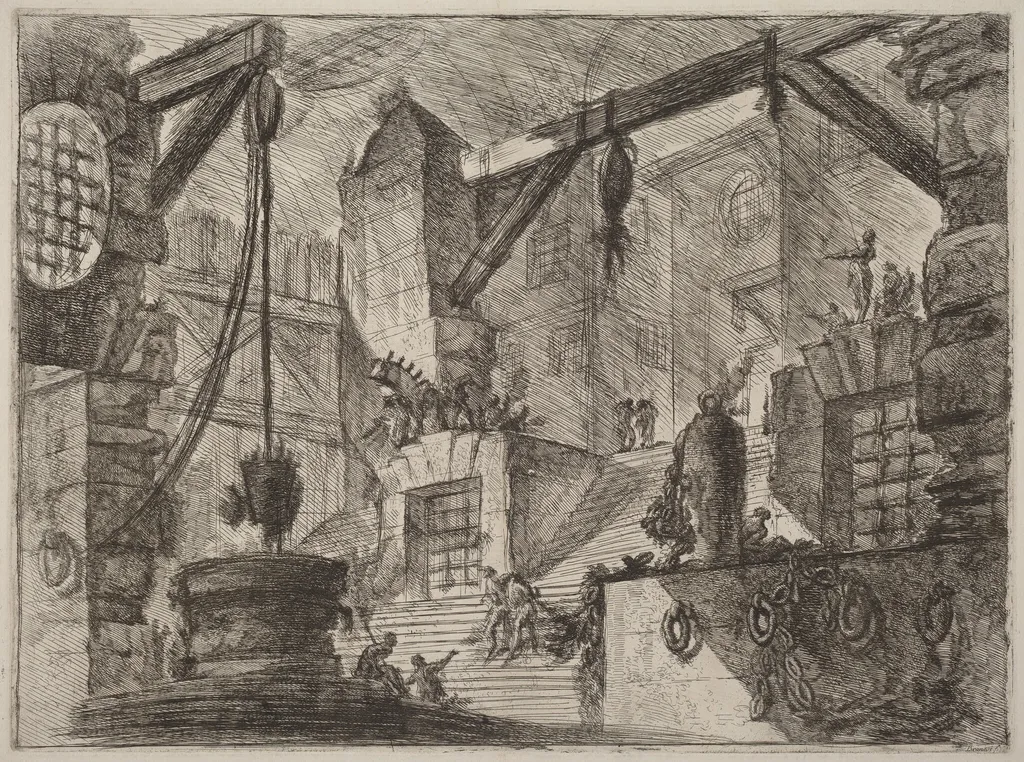
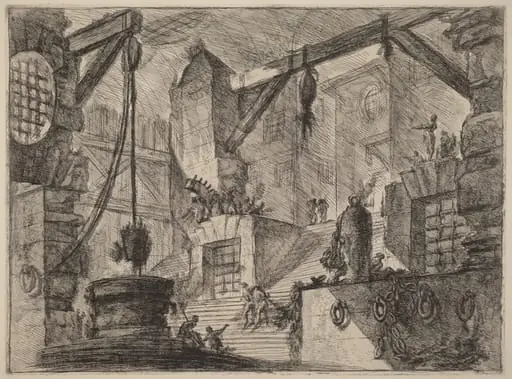
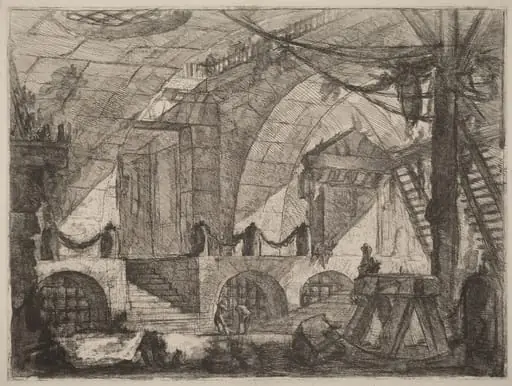
The Well is an ink print by the Romanticist artist Giovanni Battista Piranesi. It dates from 1754 and is held in the collection of the National Gallery of Art.
About this work
Overview
Created in 1754, *The Well* is a complex print by Giovanni Battista Piranesi that combines multiple intaglio techniques—etching, engraving, scratching, burnishing, and lavis—to construct a dense, atmospheric architectural scene. Unlike conventional prints of the period, it layers textures and tones to evoke depth and decay, reflecting Piranesi’s interest in pushing the boundaries of printmaking as a medium for spatial exploration.
Subject & Meaning
The composition conveys neither narrative nor idealized antiquity, but rather the weight of time and human effort within a decaying built environment.
The scene depicts a labyrinthine staircase choked with figures, debris, and architectural fragments, suggesting a collapsed or abandoned structure. The presence of a well at the base, alongside laborers and dangling ropes, implies a site of utility amid ruin. The composition conveys neither narrative nor idealized antiquity, but rather the weight of time and human effort within a decaying built environment.
Technique & Style
Piranesi built the image through successive stages of incision and surface manipulation. Etching provided fine lines, engraving added precision, while scratching and burnishing created areas of deep shadow and smooth, reflective surfaces. Lavis washes introduced tonal gradations, enhancing the illusion of volume. The result is a tactile, almost sculptural surface where light and mass feel physically present.
History & Provenance
Produced during Piranesi’s early years in Rome, *The Well* emerged from his engagement with ancient ruins and his growing reputation as a printmaker. It was likely part of a series exploring architectural decay, circulated among collectors and scholars interested in antiquity. The print’s technical ambition set it apart from contemporaneous topographical views, establishing Piranesi as an innovator in the field.
Context
In mid-18th-century Rome, antiquarian interest in classical ruins was widespread, but few artists treated them with such visceral intensity. Piranesi’s work diverged from idealized reconstructions, instead emphasizing entropy and human interaction with decay. His prints responded to Enlightenment debates on heritage and the passage of time, offering a more ambiguous, emotionally charged vision of the past.
Legacy
The technical complexity and psychological depth of *The Well* influenced later artists exploring architectural alienation, including 19th-century Romantic printmakers and 20th-century surrealists. Its layered surfaces and oppressive spatial dynamics became a model for depicting psychological and physical disorientation through print, cementing Piranesi’s role in expanding the expressive potential of the medium.
Artist & collection

Artist
Giovanni Battista (or Giambattista) Piranesi (Italian pronunciation: ; also known as simply Piranesi; 4 October 1720 – 9 November 1778) was an Italian classical archaeologist, architect, and artist, famous for his…

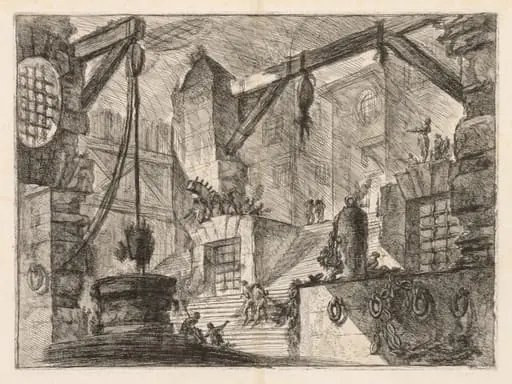 The Prisons: Colonnaded Interior with a Broad Stair
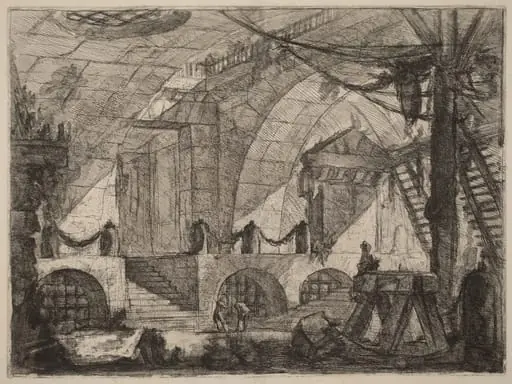 The Sawhorse
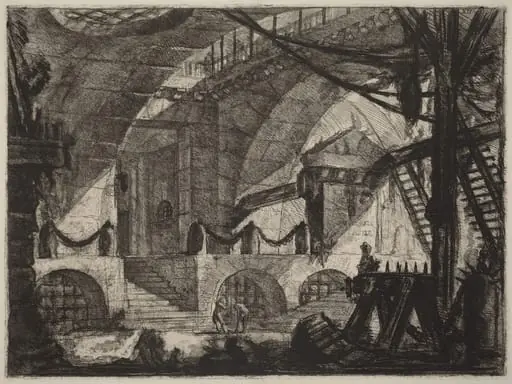 The Sawhorse
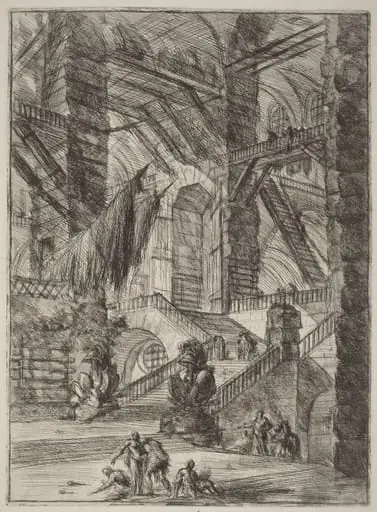 The Staircase with Trophies
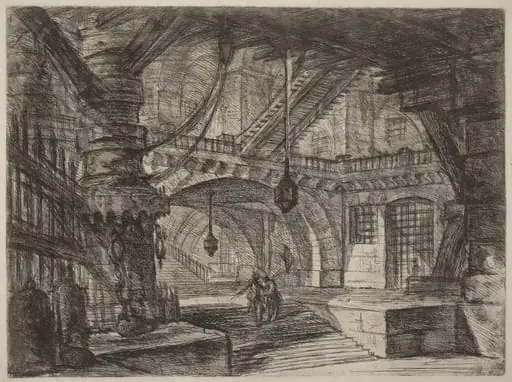 The Pier with Chains
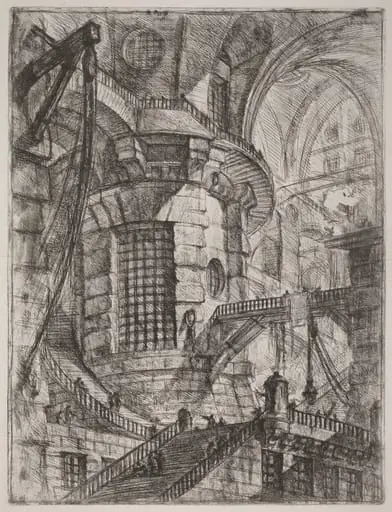 The Round Tower
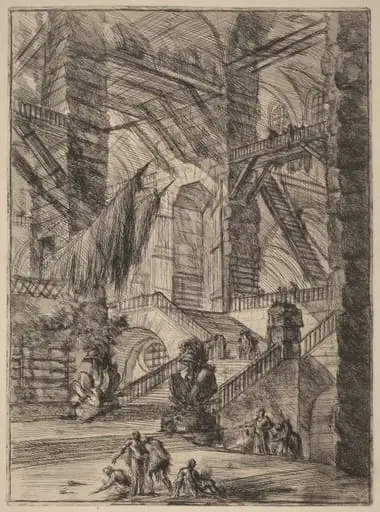 The Staircase with Trophies
 The Prisons: A Perspective of Arches with a Smoking Fire in the Center
 The Prisons: An Arched Chamber with Posts and Chains
 The Arch with a Shell Ornament
 The Well
 The Sawhorse