Artwork
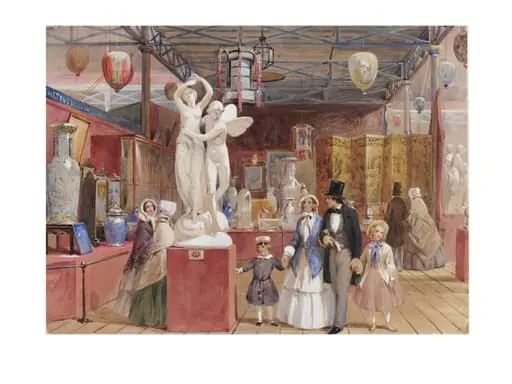
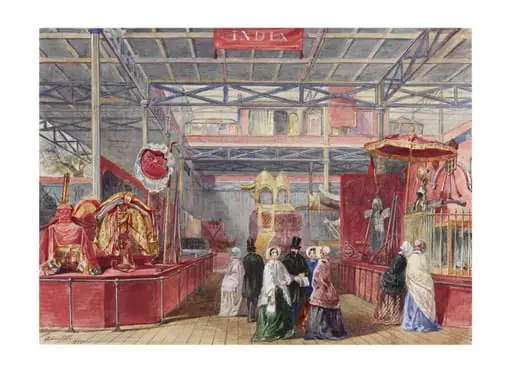
Queen Victoria, Prince Albert and Three of Their Children at the Indian Pavilion of the Great Exhibition
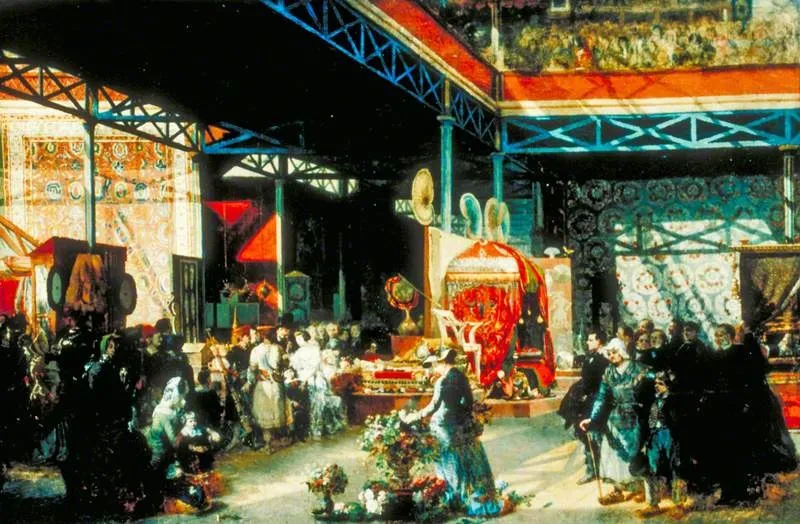
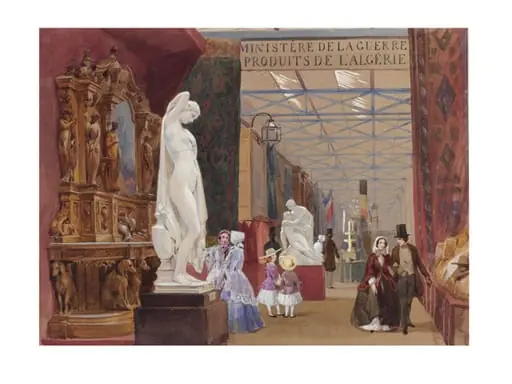
Queen Victoria, Prince Albert and Three of Their Children at the Indian Pavilion of the Great Exhibition is an oil painting by the Orientalist artist Prosper Lafaye. It dates from 1866 and is held in the collection of the Victoria and Albert Museum.
About this work
Overview
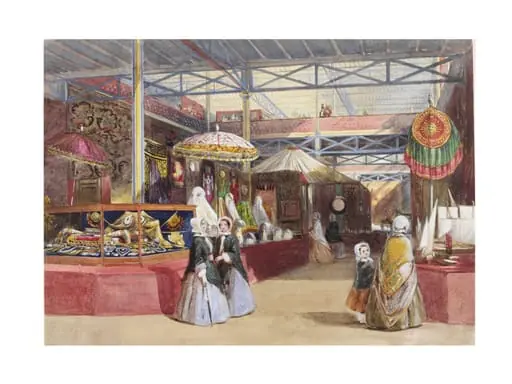
In 1866 Prosper Lafaye, a French painter associated with the court of Louis‑Philippe, produced an oil canvas that records a royal visit to the Indian Pavilion during the Great Exhibition. The work captures Queen Victoria, Prince Albert and three of their children amid a bustling market scene, and it now belongs to the Victoria and Albert Museum’s collection.
Subject & Meaning
The composition centers on the British royal family observing an Indian market stall, surrounded by attendants in formal dress. The inclusion of the monarchs within an exotic setting reflects contemporary curiosity about the empire’s far‑flung territories and the diplomatic display of cultural exchange at the exhibition.
Technique & Style
Lafaye employs a vivid palette and meticulous brushwork to render intricate textiles, patterned wares and the striped roof of the pavilion. The painting’s detailed surface and lively coloration are characteristic of the Orientalist trend, which favored rich visual narratives of non‑Western environments.
History & Provenance
Created shortly after the 1861–1862 Great Exhibition, the canvas entered the Victoria and Albert Museum’s holdings, where it remains on view. Its provenance traces directly to the artist’s studio and the museum’s acquisition records, confirming its authenticity as a contemporary depiction of the event.
Context
The Great Exhibition (1851) and its subsequent Indian Pavilion served as platforms for showcasing colonial production to a British audience. Lafaye’s work situates the royal family within this milieu, illustrating the intersection of imperial politics, commerce, and the 19th‑century fascination with Oriental motifs.
Artist & collection
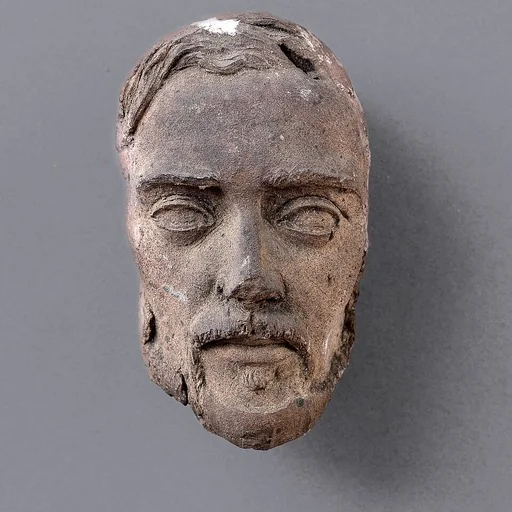
Artist
Prosper Lafaye, originally Lafait (23 September 1806, Mont-Saint-Sulpice - 3 March 1883, Paris) was a French painter at the court of King Louis-Philippe I. He also worked as a designer and was a master stained glass artist.