Artwork
Laundresses before the Wasserturm, Nuremberg
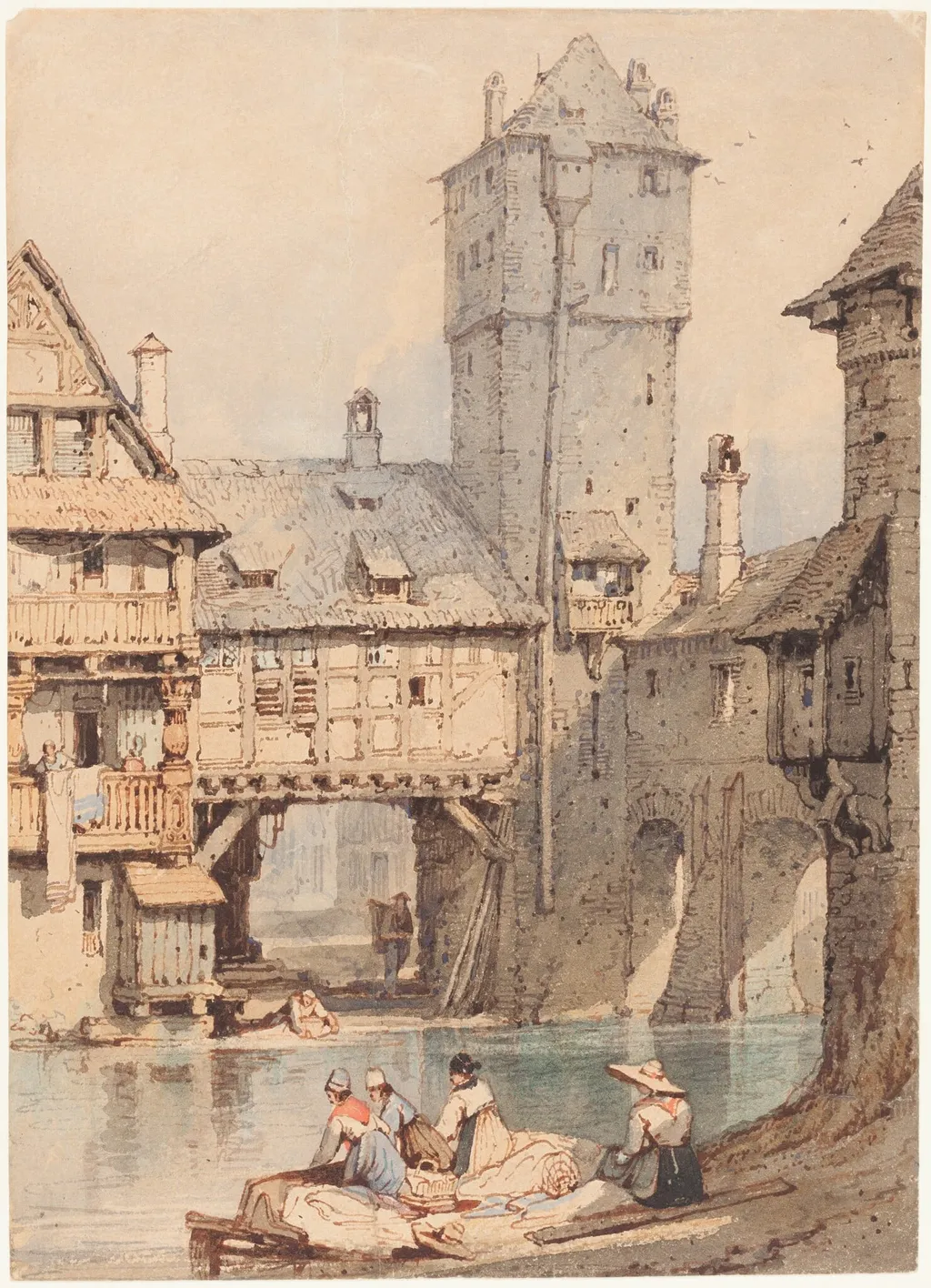
Laundresses before the Wasserturm, Nuremberg is a watercolor drawing by the Romanticist artist Samuel Prout. It dates from 1818 and is held in the collection of the National Gallery of Art.
About this work
Overview
The work captures a quiet moment along the Pegnitz River in Nuremberg, focusing on everyday labor rather than monumental architecture.
Samuel Prout created this watercolor on wove paper in 1818 during a period of travel through southern Germany. The work captures a quiet moment along the Pegnitz River in Nuremberg, focusing on everyday labor rather than monumental architecture. Prout, known for his precise yet atmospheric renderings of European urban landscapes, used the medium to convey texture and light with restraint, avoiding overt drama in favor of observed reality.
Subject & Meaning
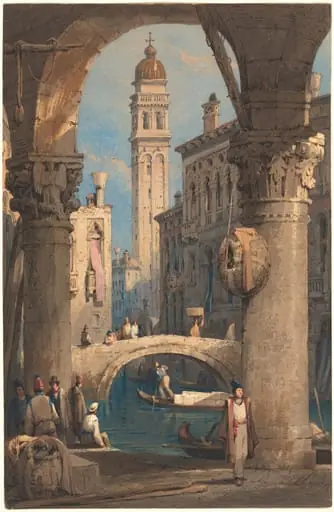
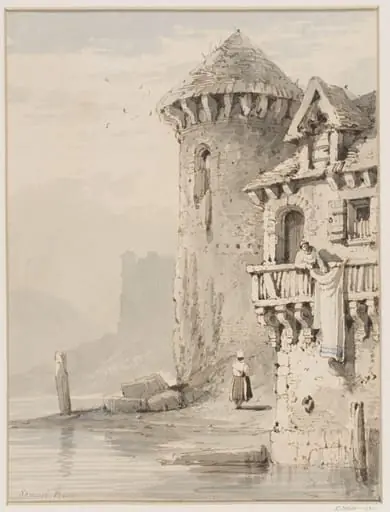
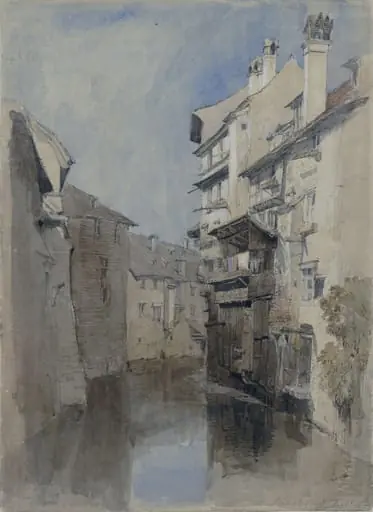
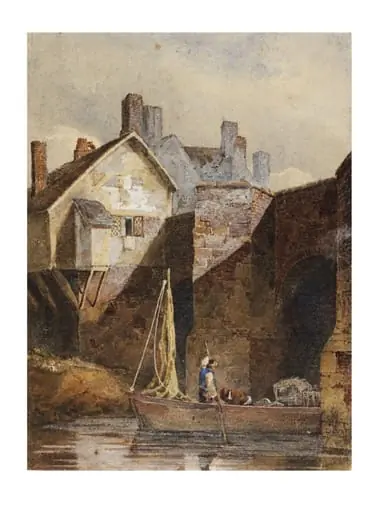
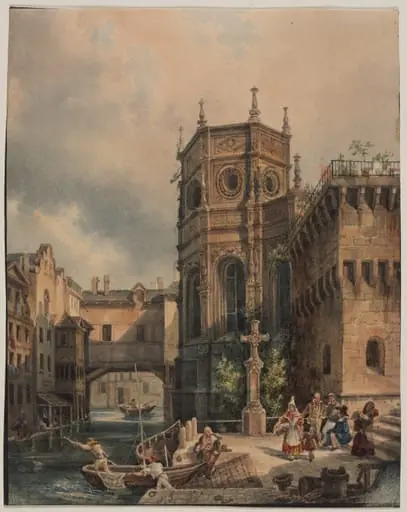
The scene depicts three laundresses engaged in routine tasks beside the river: folding linen, resting on the ground, and leaning against a wooden pole. Their presence highlights domestic labor in a historic cityscape, contrasting the human scale with the enduring stone structures behind them. The Wasserturm, a functional water tower, anchors the composition as a symbol of civic infrastructure, while the half-ruined arch suggests layers of time and use.
Technique & Style
Prout employed thin, layered watercolor washes to suggest the weathered surfaces of stone and wood, using muted earth tones to evoke age and dampness. Delicate glazing creates subtle shifts in light across the water and building facades. The brushwork is controlled but not rigid—soft edges blur the boundary between figures and environment, reinforcing the quiet, unposed nature of the scene.
History & Provenance
Executed during Prout’s early travels in Germany, the work reflects his growing interest in northern European architecture beyond the more familiar Italian subjects of his contemporaries. It was likely made as a study for later, more finished compositions. The paper was laid down for preservation, indicating early recognition of its value. The piece entered institutional collections before the mid-19th century, though its exact provenance prior to that remains undocumented.
Context
In early 19th-century Nuremberg, the Wasserturm was one of several medieval towers repurposed for municipal water storage, essential for fire prevention. Laundresses, often working in groups near rivers, were a common sight in European towns where domestic water access was limited. Prout’s focus on such scenes aligned with a broader European interest in vernacular life, distinct from the grand historical narratives favored in academic painting.
Legacy
This work exemplifies Prout’s role in elevating topographical watercolor to a respected art form in Britain. His attention to architectural detail and everyday life influenced later generations of landscape artists, particularly those interested in the poetic potential of urban decay and routine. Though not widely exhibited in his lifetime, such studies contributed to his reputation and eventual royal appointment.
Artist & collection

Artist
Samuel Prout (; 17 September 1783 – 10 February 1852) was a British watercolourist, and one of the masters of watercolour architectural painting, who largely invented the genre of the grand steet scene in British…