Artwork
Duomo D'Ossola, Piedmont
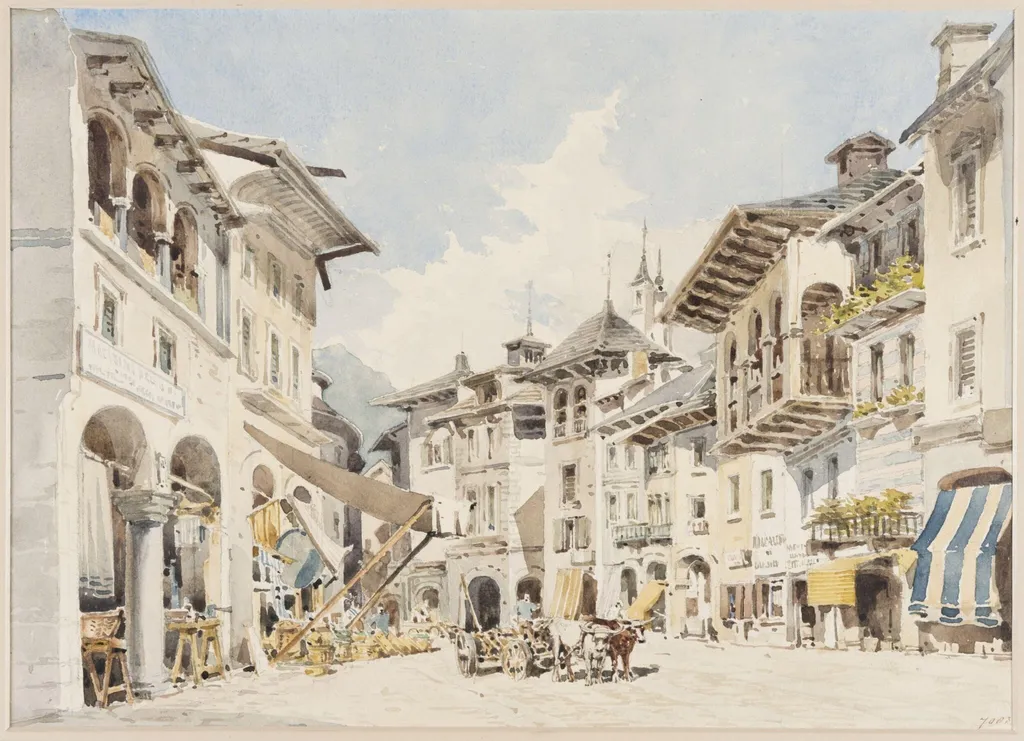
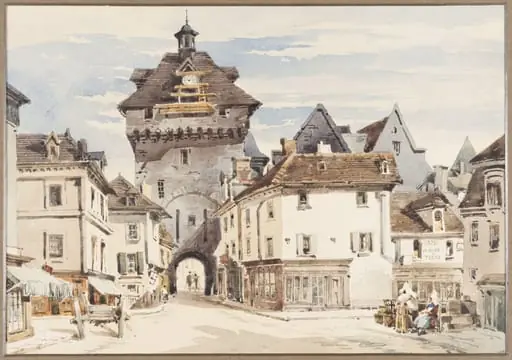
Duomo D'Ossola, Piedmont is a watercolor work on paper by Charles Claude Pyne. It dates from 1850 and is held in the collection of the Victoria and Albert Museum.
About this work
Overview
Charles Claude Pyne’s watercolour captures a quiet street in Domodossola, a town in Piedmont, Italy. The scene centers on a narrow road lined with modest stone buildings, their facades softened by time and weather. A single cart, drawn by two cows, moves slowly along the cobbled path, suggesting daily rural life. The composition is grounded in horizontal lines, reinforcing stillness and order.
Subject & Meaning
The absence of dramatic figures or events emphasizes the quiet dignity of ordinary moments in a mountain town.
The painting presents an unidealized view of provincial Italian life, free from grandeur or spectacle. Baskets arranged on trestle tables outside building alcoves hint at local commerce or domestic routines. The presence of pedestrians and livestock conveys routine activity, not performance. The absence of dramatic figures or events emphasizes the quiet dignity of ordinary moments in a mountain town.
Technique & Style
Pyne employs transparent watercolour washes to suggest light and texture with restraint. Buildings are rendered in muted earth tones, while the sky is lightly glazed with pale blue and cloud wisps. Details like awnings and balconies are suggested rather than overdefined, allowing the medium’s fluidity to enhance the sense of atmosphere. The brushwork is deliberate but unobtrusive, supporting the scene’s calm tone.
History & Provenance
The work dates from the early 19th century, likely created during Pyne’s travels in northern Italy. It was probably made as a personal record or for private collectors interested in regional topography. No public record of its early ownership exists, but its preservation suggests it was valued for its documentary quality rather than artistic novelty at the time.
Context
During the early 1800s, British artists often traveled through the Alps, documenting landscapes and towns for scholarly or aesthetic interest. Domodossola, situated near the Swiss border, was a common waypoint. Pyne’s focus on everyday detail aligns with a broader trend of topographical watercolours that prioritized accuracy over romanticism, serving as visual records of lesser-known regions.
Legacy
Pyne’s watercolour remains a modest but valuable example of 19th-century topographical art. It contributes to the visual archive of Italian provincial life before industrialization. Though not widely exhibited, it holds significance for regional historians and students of watercolour technique, offering a quiet testament to the rhythms of mountain communities in the pre-modern era.
Own this work as a print
Artist & collection

 Sketches at Home and Abroad: Trento
 Corso Sant'Anastasia, Verona, with the Palace of Prince Maffei
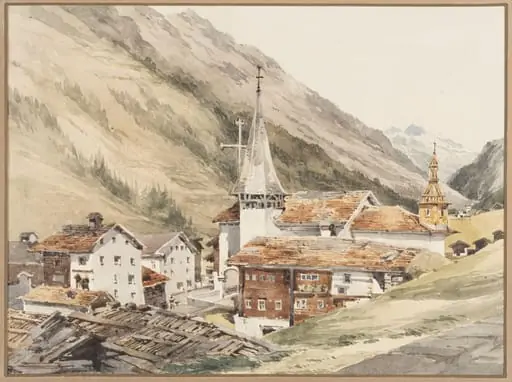
 An Alpine Village
 Picturesque Sketches in Spain: Gate of the Vivarrambla, Granada
 Street scene, with bell tower
 Corso Sant' Anastasia with the Palazzo Maffei in Verona
 Segovia, Spain
 Street Scene in Loches, France