Artwork
Untitled
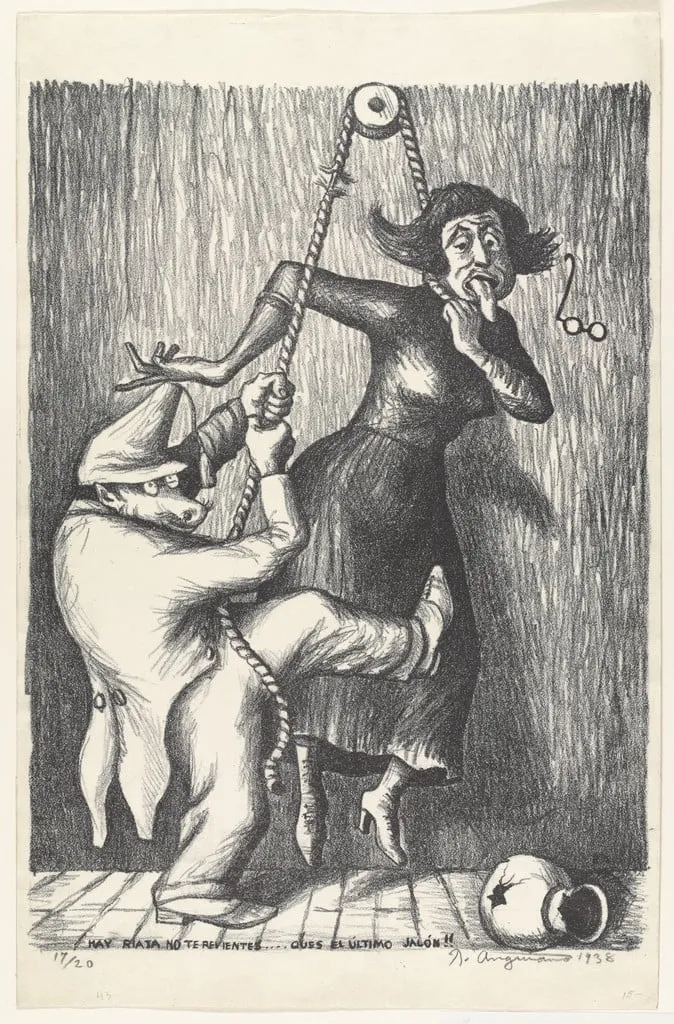
Untitled is an ink print by Raúl Anguiano. It dates from 1938 and is held in the collection of the Museum of Modern Art.
About this work
Overview
As a print, it reflects Anguiano’s engagement with accessible mediums and his interest in depicting human tension through simplified yet powerful imagery.
Raúl Anguiano produced this lithograph in 1938, part of his early graphic work during a period of intense social reflection in Mexico. The piece is held in the collection of The Museum of Modern Art, where it is recognized for its emotional intensity and formal clarity. As a print, it reflects Anguiano’s engagement with accessible mediums and his interest in depicting human tension through simplified yet powerful imagery.
Subject & Meaning
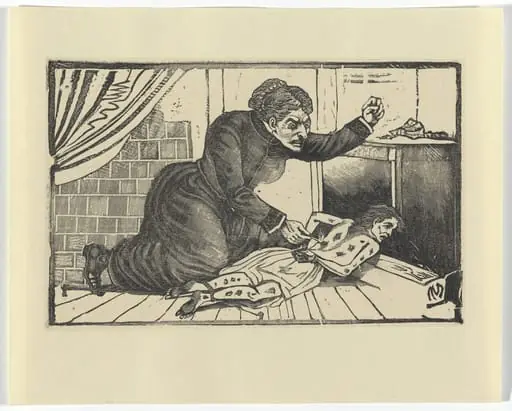
The composition centers on a man in white, gripping a rope tied to a woman who covers her face in apparent distress. Her elevated heels and long dress contrast with the domestic disruption implied by the shattered vase nearby. The scene suggests a moment of coercion or psychological conflict, possibly commenting on gendered power dynamics. The stark contrast between the figures and the dark background amplifies the sense of isolation and unease.
Technique & Style
Anguiano employed lithography to achieve sharp, expressive lines and strong tonal contrasts. The white robe of the male figure stands out against the deep, inked background, creating a dramatic chiaroscuro effect. Bold, deliberate shading defines the figures’ forms, while minimal detail in the surroundings focuses attention on their interaction. The technique allows for both precision and emotional immediacy, characteristic of his printmaking approach.
History & Provenance
Created in 1938, the work entered The Museum of Modern Art’s collection as part of its broader effort to document Latin American modernism. Its acquisition reflects institutional interest in politically and emotionally charged graphic art from the region during the interwar period. No earlier provenance is widely documented, but its presence in MoMA’s holdings ensures its continued visibility within 20th-century print discourse.
Context
Anguiano made this work amid Mexico’s post-revolutionary cultural renaissance, when artists frequently addressed social inequality and personal trauma through symbolic imagery. While not overtly political, the scene resonates with broader concerns about authority, vulnerability, and domestic strife prevalent in the era’s visual culture. Lithography, as a reproducible medium, aligned with efforts to make art more widely available to the public.
Legacy
Though less known than his murals, this lithograph exemplifies Anguiano’s ability to convey complex human relationships through minimal means. It remains a significant example of Mexican printmaking from the 1930s, illustrating how personal narratives could be rendered with universal resonance. Its inclusion in MoMA’s collection has helped sustain scholarly interest in his graphic work beyond his more prominent muralist output.
Artist & collection