Artwork
A Group of Peasants Loading Hay onto Boats
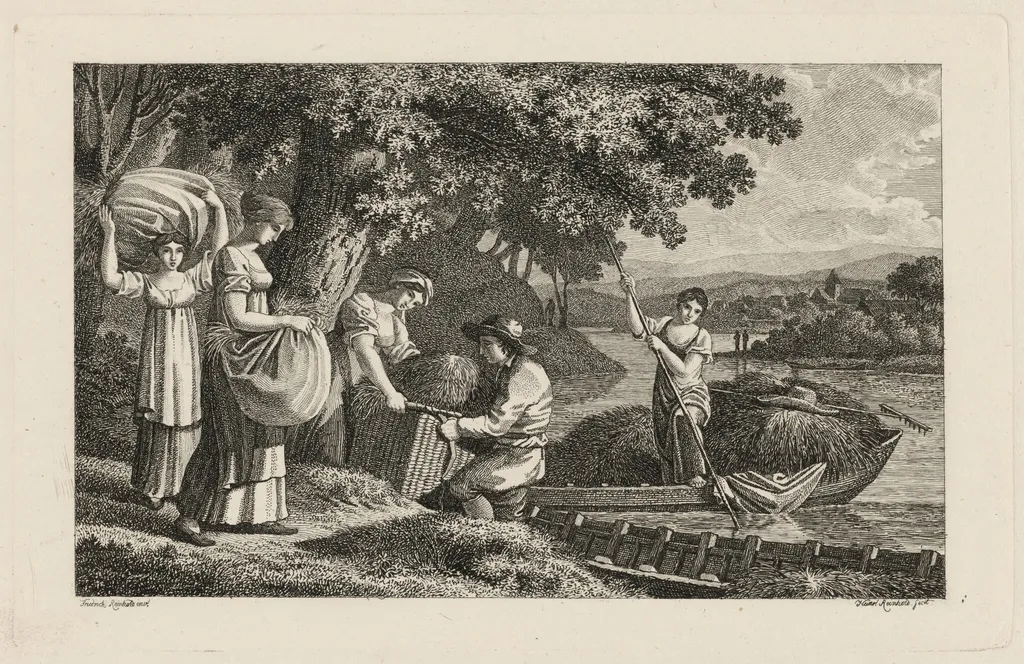
A Group of Peasants Loading Hay onto Boats is an ink print by the Romanticist artist Heinrich Carl Reinhold. It dates from 1816 and is held in the collection of the National Gallery of Art.
About this work
Overview
It captures a quiet moment of agricultural activity, rendered with fine linear detail typical of early 19th-century printmaking.
Created around 1816, this etching by Heinrich Carl Reinhold depicts rural labor along a riverbank. Executed on wove paper, the work is part of the National Gallery of Art’s collection in Washington, D.C. It captures a quiet moment of agricultural activity, rendered with fine linear detail typical of early 19th-century printmaking. The composition emphasizes collective effort, with figures arranged to guide the viewer’s eye along the river’s edge.
Subject & Meaning
The scene portrays five peasants engaged in the seasonal task of transporting hay by boat. Two women hold bundled hay, while others load it onto a small vessel. A third woman, standing at the water’s edge with a pole, likely assists in maneuvering the boat. The work reflects the daily rhythms of rural life, presenting labor not as dramatic spectacle but as unremarkable, enduring routine. There is no idealization—figures are shown in practical attire, engaged in unglamorous work.
Technique & Style
Reinhold employed etching to achieve subtle tonal variations through incised lines and controlled hatching. The shading suggests sunlight filtering through trees, casting soft shadows on figures and water. The brush-like quality of the lines conveys movement—the sway of hay bundles, the ripple of current. The background, rendered with lighter, sparser marks, recedes into hazy hills and a distant bridge, creating depth without detailed realism.
History & Provenance
The print was made during Reinhold’s active period in northern Germany, a time when landscape and genre scenes gained popularity among print collectors. It entered the National Gallery of Art’s collection through established acquisition channels, likely as part of a broader effort to document European print traditions. No earlier ownership records are publicly documented, but its preservation suggests it was valued within artistic circles of the 19th century.
Context
In the early 1800s, etching experienced a revival as artists turned away from grand historical themes toward intimate depictions of ordinary life. Reinhold’s work aligns with this trend, echoing the quiet realism found in Dutch and German genre prints. The riverbank setting reflects regional agricultural practices along the Elbe and other northern waterways, where transport by boat remained essential before rail networks expanded.
Legacy
Though Reinhold is not widely known today, this etching exemplifies the quiet documentary power of 19th-century printmaking. It contributes to a visual record of pre-industrial labor, preserving details of dress, tool use, and rural economy. Its inclusion in a major museum collection ensures its continued availability for study, offering insight into how everyday work was observed and rendered in the age before photography.
Artist & collection