Artwork
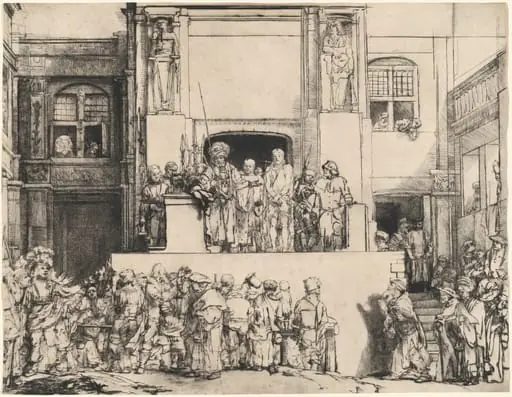
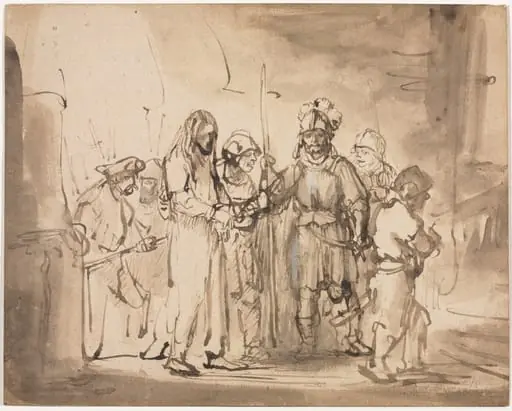
Ecce Homo. Christ Presented to the People
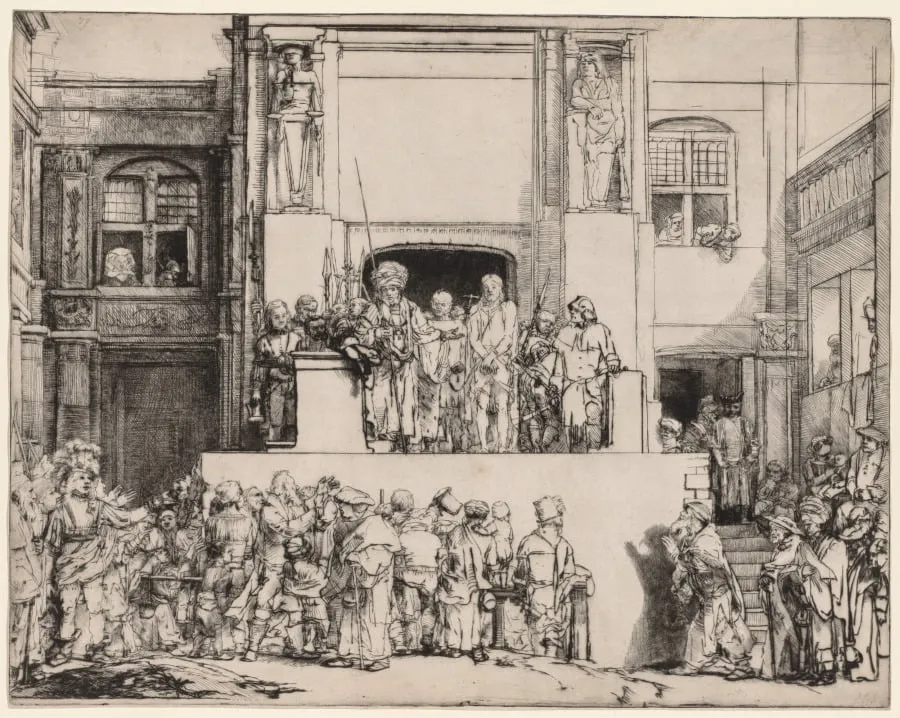
Ecce Homo. Christ Presented to the People is a print by the Baroque artist Rembrandt. It dates from 1655 and is held in the collection of the Cleveland Museum of Art.
About this work
Overview
Unlike traditional etching, drypoint creates dense, fuzzy lines by scratching directly into the plate, producing deep shadows that fade with each impression.
Rembrandt’s Ecce Homo is a large-scale drypoint print that pushes the technical boundaries of the medium. Unlike traditional etching, drypoint creates dense, fuzzy lines by scratching directly into the plate, producing deep shadows that fade with each impression. This fifth-state version captures the plate at its richest, before wear diminished its tonal depth, making it one of the most intense surviving impressions of the work.
Subject & Meaning
The scene depicts Christ standing calmly before a dense, varied crowd, as he is presented to the people. Rather than idealizing figures, Rembrandt portrays a cross-section of society—soldiers, elders, onlookers—each reacting with distinct posture and expression. The composition suggests collective moral ambiguity, framing Christ’s suffering not as divine spectacle but as a human moment witnessed by ordinary people.
Technique & Style
Rembrandt exploited drypoint’s inherent fragility to heighten emotional impact. He built shadows through layered, haphazard scratching, creating velvety blacks that contrast with untouched paper. The architecture behind Christ is left largely unworked, its blank spaces glowing against the darkened figures. This stark chiaroscuro directs focus to Christ’s stillness and the crowd’s agitation, enhancing psychological tension without narrative detail.
History & Provenance
This print emerged from Rembrandt’s sustained exploration of biblical subjects in the 1630s, a period when he increasingly turned to printmaking to test expressive limits. The fifth state, among the earliest and most fully realized, was likely pulled shortly after the plate’s creation. Surviving impressions are rare, and this example is valued for its preservation of the plate’s original tonal richness before significant wear.
Context
In early 17th-century Holland, printmaking was often used for reproduction, but Rembrandt treated it as an independent art form. His use of live models and attention to individual gesture broke from stylized religious imagery. The crowd’s diversity and the building’s looming presence reflect contemporary concerns about authority, judgment, and the role of the public in moral decisions.
Legacy
Rembrandt’s Ecce Homo redefined the potential of printmaking as a vehicle for psychological depth. By prioritizing emotional resonance over decorative precision, he influenced generations of artists to treat prints as expressive mediums rather than mere copies. The work’s raw humanity and technical innovation remain benchmarks in the history of graphic art.
Artist & collection
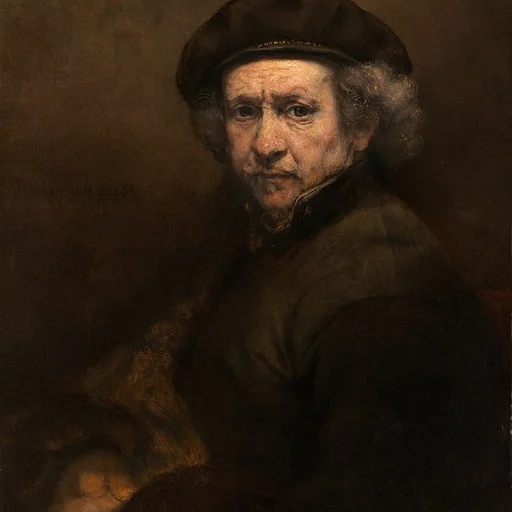
Artist
Rembrandt Harmenszoon van Rijn (15 July 1606 – 4 October 1669), known mononymously as Rembrandt, was a Dutch Golden Age painter, printmaker, and draughtsman.

 Christ Presented to the People: Oblong Plate
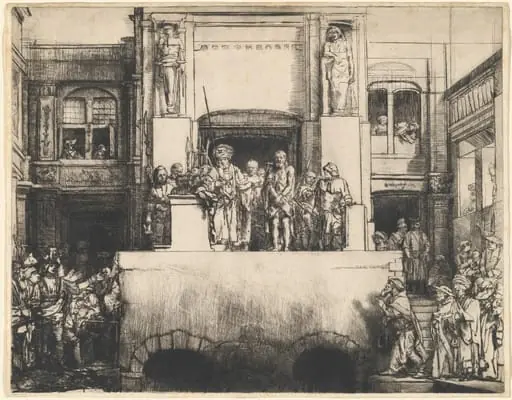 Christ Presented to the People: Oblong Plate
 The Slave Market
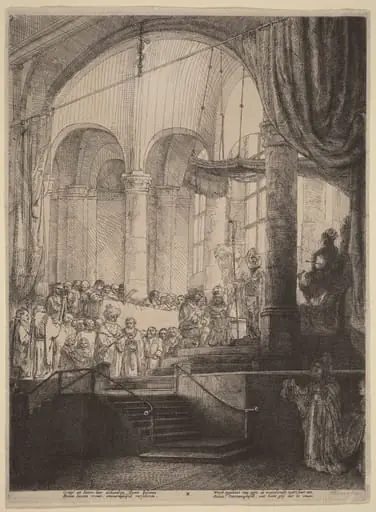 Medea, or the Marriage of Jason and Creusa
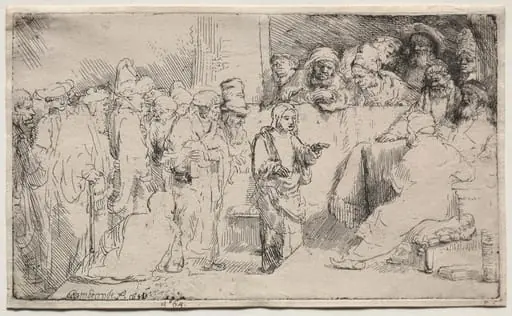 Christ Disputing with the Doctors: A Sketch
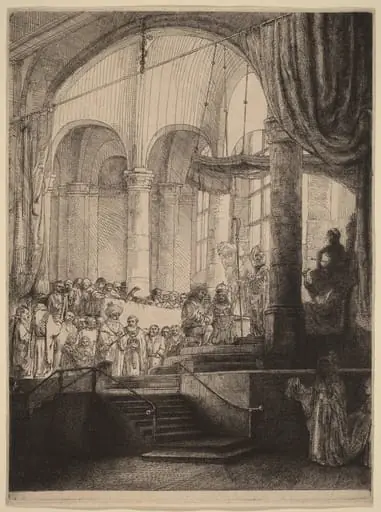 Medea, or the Marriage of Jason and Creusa
![The Slave Market [recto], by Alexandre Gabriel Decamps](https://artifactworldgallery.com/img/alexandre-gabriel-decamps--the-slave-market-recto--874eb665e814d110-w320.webp) The Slave Market [recto]
The Slave Market [recto] The Triumph of Mordecai
 Ecce Homo (John 19:5)
 Christ before Pilate: Large Plate
 The Market on the Molo
 Christ Taken before Caiaphas