Artwork
Sidi Hadji Abdurrahman Adja (1720–1792)
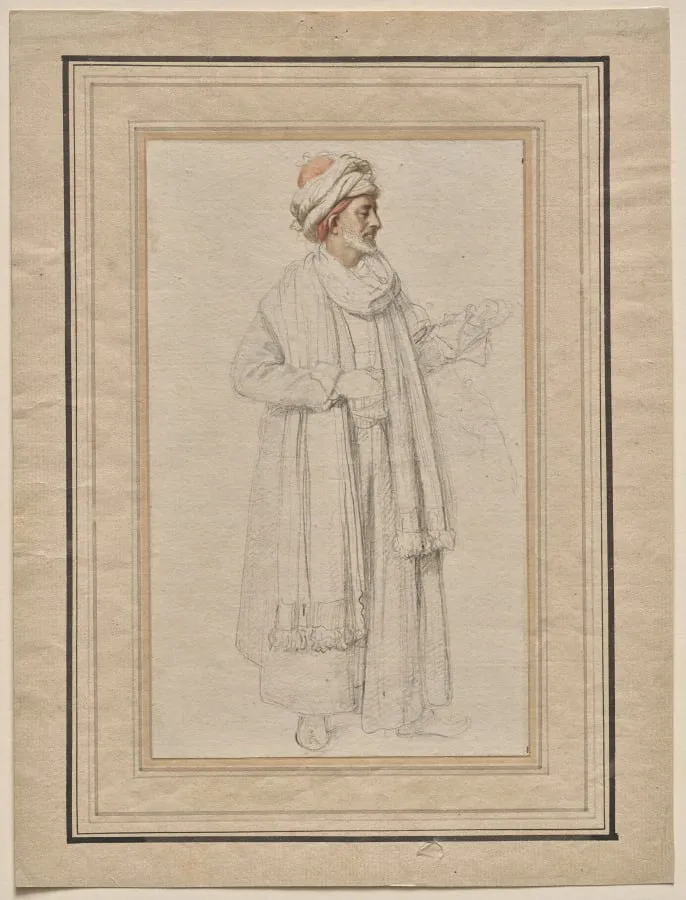
Sidi Hadji Abdurrahman Adja (1720–1792) is a drawing by the Romanticist artist Richard Cosway. It dates from 1786 and is held in the collection of the Cleveland Museum of Art.
About this work
The man was an ambassador from Tripoli, visiting to smooth things over between his country and Britain.
A man in a turban and dark robe looks straight at you. His face is lit softly, almost like a candle glow.
This sketch was made in London in 1786. The man was an ambassador from Tripoli, visiting to smooth things over between his country and Britain. Richard Cosway drew him quickly, probably in one sitting. The lines are loose but sure—no fuss, just the feeling of a person.
If you like this kind of quick, lively portrait, look up the technique called *sfumato*.
Overview
Richard Cosway, a prominent London portraitist known for delicate miniatures, created this ink drawing in 1786 during the visit of Sidi Hadji Abdurrahman Adja, ambassador from Tripoli. Executed swiftly, likely in a single session, the work captures a quiet, intimate moment rather than formal ceremony. Its immediacy reflects Cosway’s skill in conveying presence through minimal, assured lines, distinct from his more polished commissioned works.
Subject & Meaning
Sidi Hadji Abdurrahman Adja, a diplomatic envoy from Tripoli, was in London to mend relations between his nation and Great Britain. Cosway’s depiction, showing him with closed eyes and serene expression, suggests contemplation rather than performance. The focus on his beard and draped robes signals cultural distinction, respected by London’s elite, yet the portrait avoids exoticism, presenting the ambassador with quiet dignity.
Technique & Style
The drawing employs loose, fluid ink lines that suggest form without overdefinition. Soft modeling, achieved through subtle washes and careful shading, creates a gentle luminosity, particularly on the face, evoking the effect of candlelight. The absence of heavy detail invites the viewer to perceive character through gesture and tone, aligning with the expressive potential of rapid sketching over polished finish.
History & Provenance
Created in London in 1786, the drawing originated during Adja’s diplomatic mission. It likely emerged from Cosway’s personal circle, possibly made during a visit to the artist’s home, where cultural figures and foreign dignitaries mingled. The work remained within Cosway’s collection or among his circle, preserved as a record of an encounter rather than a public commission.
Context
In late 18th-century London, diplomatic visits from North African envoys were rare but significant, often drawing public interest. Cosway’s salon provided a space where such figures were encountered informally. This drawing reflects a moment of cross-cultural exchange, where artistic practice intersected with diplomacy, capturing a foreign dignitary not as a symbol but as an individual in repose.
Legacy
The drawing stands as a quiet testament to Cosway’s ability to convey humanity beyond formal portraiture. While his miniatures dominated his reputation, this sketch reveals a more spontaneous side of his artistry. It remains a rare visual record of a Tripolitan ambassador in Britain, valued for its sincerity and the unembellished presence it preserves.
Artist & collection
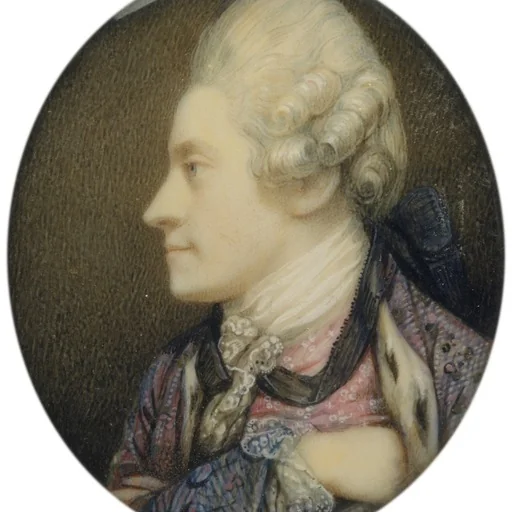
Artist
Richard Cosway (5 November 1742 – 4 July 1821) was a leading English portrait painter of the Georgian and Regency era, noted for his miniatures.