Artwork
Studies for "The Wise and Foolish Virgins" [recto]
![Studies for "The Wise and Foolish Virgins" [recto], by William Blake, Sir Richmond, chalk, 1880](https://artifactworldgallery.com/img/william-blake-sir-richmond--studies-for-the-wise-and-foolish-virgins-recto--b7a433b90f3e6c54-w1024.webp)
Studies for "The Wise and Foolish Virgins" [recto] is a chalk drawing by the Impressionist artist William Blake, Sir Richmond. It dates from 1880 and is held in the collection of the National Gallery of Art.
About this work
Overview
Created in 1880 by Sir William Blake Richmond, this red‑chalk drawing serves as a preparatory study for his larger composition titled “The Wise and Foolish Virgins.” Executed on wove paper, the work consists of a primary red‑chalk sketch on the recto side together with a counterproof, illustrating Richmond’s exploratory approach to figure placement.
Subject & Meaning
The study depicts two nude male figures viewed from behind, their heads, shoulders and arms rendered in simplified silhouette. Though the biblical narrative of the wise and foolish virgins concerns women, Richmond’s preliminary focus on male forms suggests an investigation of posture and movement that would later inform the composition’s overall spatial dynamics.
Technique & Style
Richmond employed red chalk, a medium that imparts a warm, earthy hue, and allowed the lines to remain soft and smudged. The drawing is executed rapidly, with loose, gestural strokes that capture the basic masses rather than fine detail, indicating a preliminary stage of visual problem‑solving rather than a finished artwork.
History & Provenance
The piece originates from Richmond’s studio in the late nineteenth century and remained within his personal collection before entering the museum’s holdings. Its presence as a recto study, accompanied by a counterproof, provides insight into the artist’s method of iterating compositional ideas before committing to the final oil painting.
Artist & collection


![Studies for "The Wise and Foolish Virgins" [recto], by William Blake, Sir Richmond](https://artifactworldgallery.com/img/william-blake-sir-richmond--studies-for-the-wise-and-foolish-virgins-recto--1be025a8df000843-w320.webp)
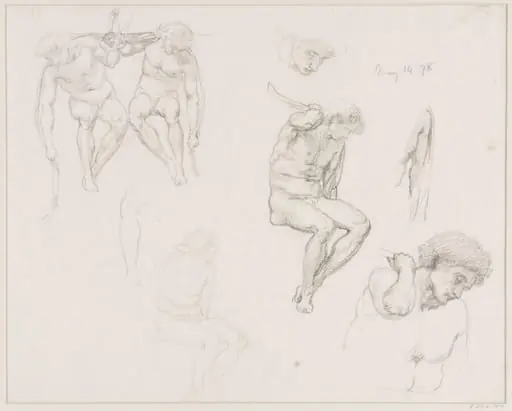 Figure studies and a head fot the mosaic decoration of the dome of St. Paul's Cathedral
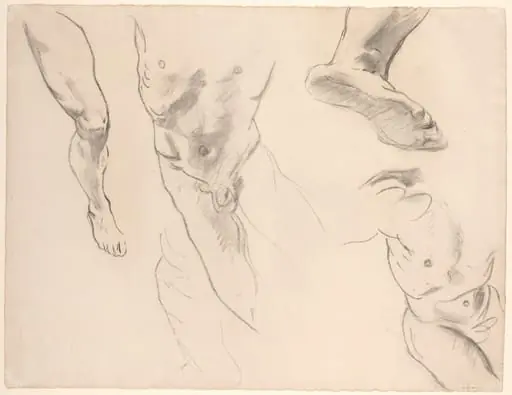 Figure Studies of a Nude Youth
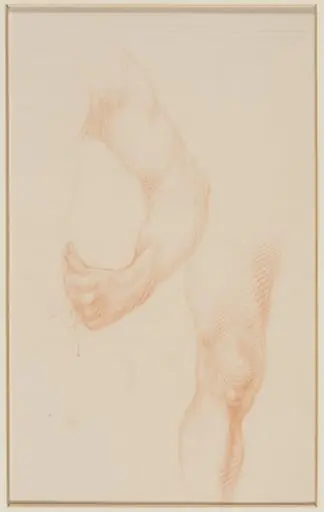 Arm and Leg
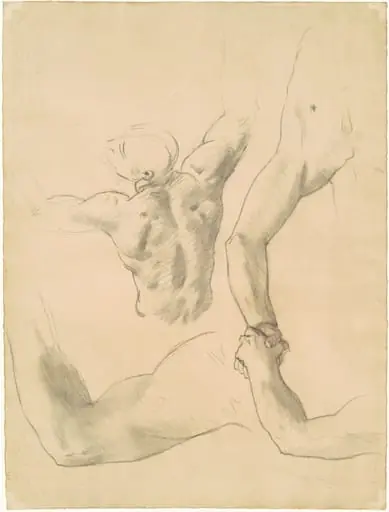 Studies for "Two Classical Male Figures Wrestling"
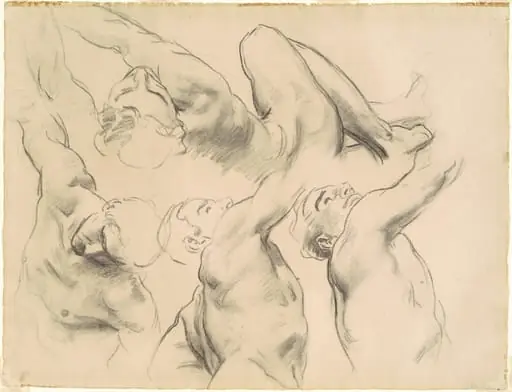 Studies for "Heaven" and "Hell"
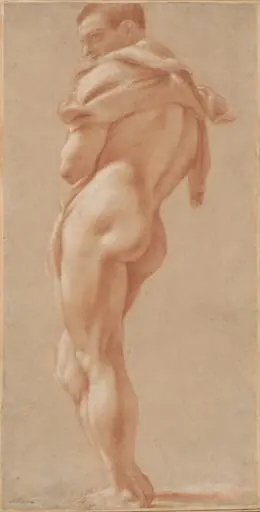 Standing Male Nude Seen from Behind
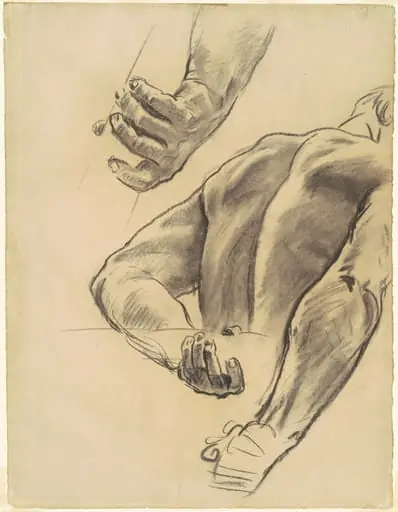 Studies for "Judgment"
![Studies of Male Nudes [verso], by John Singer Sargent](https://artifactworldgallery.com/img/john-singer-sargent--studies-of-male-nudes-verso--6a06b2ac3ad0c09a-w320.webp) Studies of Male Nudes [verso]
Studies of Male Nudes [verso]![Two Nude Figures [verso], by Luca Signorelli](https://artifactworldgallery.com/img/luca-signorelli--two-nude-figures-verso--5ebb2bdb5ab5c1db-w320.webp) Two Nude Figures [verso]
Two Nude Figures [verso] Study of a Man's Figure, Holding Rod behind Back
 Standing Male Nude