Artwork
Trees at Box Hill
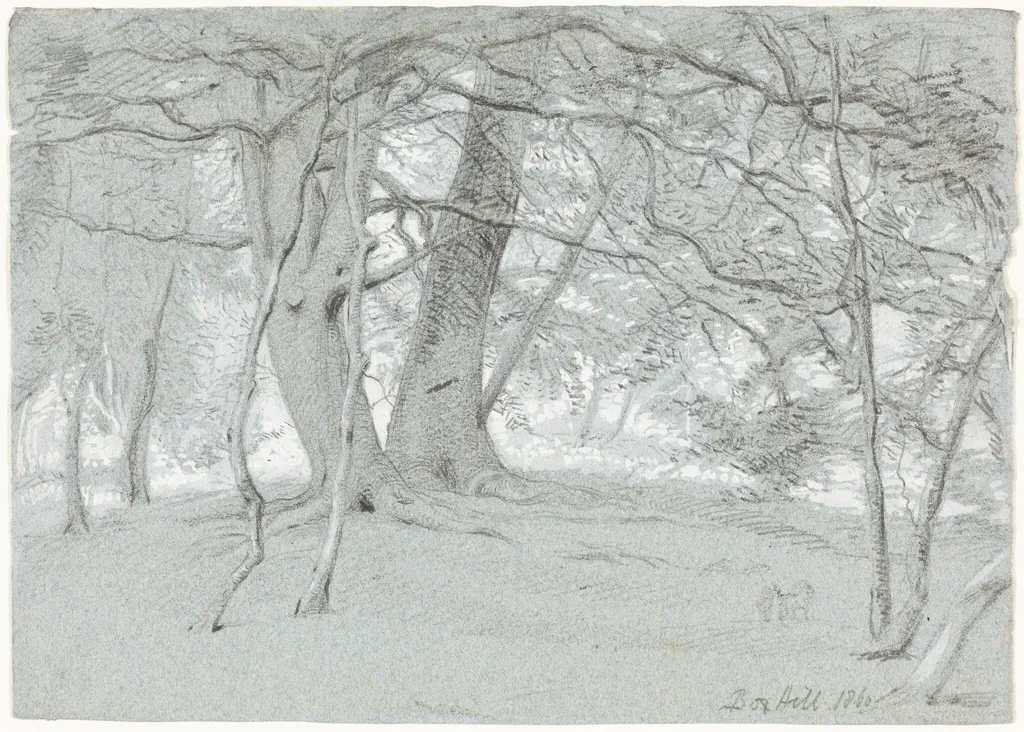
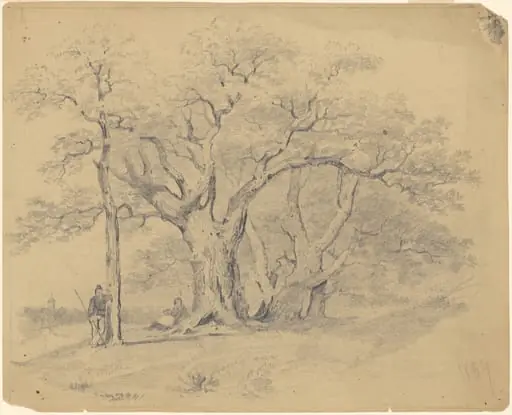
Trees at Box Hill is a chalk drawing by the Impressionist artist William Blake, Sir Richmond. It dates from 1860 and is held in the collection of the National Gallery of Art. Created in 1860, this drawing by William Blake Richmond depicts a winter landscape at Box Hill in Surrey.
About this work
Overview
Created in 1860, this drawing by William Blake Richmond depicts a winter landscape at Box Hill in Surrey. Executed in black chalk and graphite with white highlights on blue paper, it captures a quiet, open field dominated by bare trees. The composition conveys stillness through minimal detail and restrained tonal contrasts, suggesting a fleeting moment observed outdoors.
Subject & Meaning
The scene presents a solitary winter field with skeletal trees standing against a pale sky. No figures or structures interrupt the quiet, emphasizing nature’s quietude in seasonal dormancy. The absence of movement and the muted palette evoke a sense of solitude and temporal pause, reflecting a contemplative engagement with the landscape rather than a narrative intent.
Technique & Style
Richmond employed soft black chalk for the tree trunks and branches, using delicate, uneven lines to suggest texture and form. White heightening accentuates snow-lit surfaces and glints of light, while the blue paper underlayer contributes to the cool atmosphere. Subtle chiaroscuro defines volume without heavy modeling, favoring atmospheric suggestion over detailed rendering.
History & Provenance
The drawing was made during Richmond’s early career, likely as a plein air study. It remained in private hands until acquired by the Victoria and Albert Museum in 1958. Its modest scale and unfinished appearance indicate it was intended as a personal record rather than a finished work for exhibition.
Context
In the 1860s, British artists increasingly turned to direct observation of nature, influenced by the Pre-Raphaelites and emerging landscape traditions. Richmond’s sketch aligns with this trend, capturing seasonal change with quiet precision. Unlike grand Romantic vistas, it favors intimacy and immediacy, reflecting a shift toward personal, observational art.
Legacy
Though not widely exhibited, the drawing exemplifies Richmond’s early commitment to naturalism and his skill in conveying atmosphere with minimal means. It stands as a quiet testament to the value of sketching as a tool for understanding light, form, and seasonal rhythm in the English countryside.
Own this work as a print
Artist & collection


![Studies for "The Wise and Foolish Virgins" [recto], by William Blake, Sir Richmond](https://artifactworldgallery.com/img/william-blake-sir-richmond--studies-for-the-wise-and-foolish-virgins-recto--1be025a8df000843-w320.webp)
![Studies for "The Wise and Foolish Virgins" [recto], by William Blake, Sir Richmond](https://artifactworldgallery.com/img/william-blake-sir-richmond--studies-for-the-wise-and-foolish-virgins-recto--b7a433b90f3e6c54-w320.webp)
![Grove of Trees [verso], by Friedrich Salathé](https://artifactworldgallery.com/img/friedrich-salathe--grove-of-trees-verso--4013b539bd981a94-w320.webp)
![Bosco [Woods], by Mosè Bianchi](https://artifactworldgallery.com/img/mose-bianchi--bosco-woods--c857997776805c86-w320.webp)