Artwork
Fields near Norwich
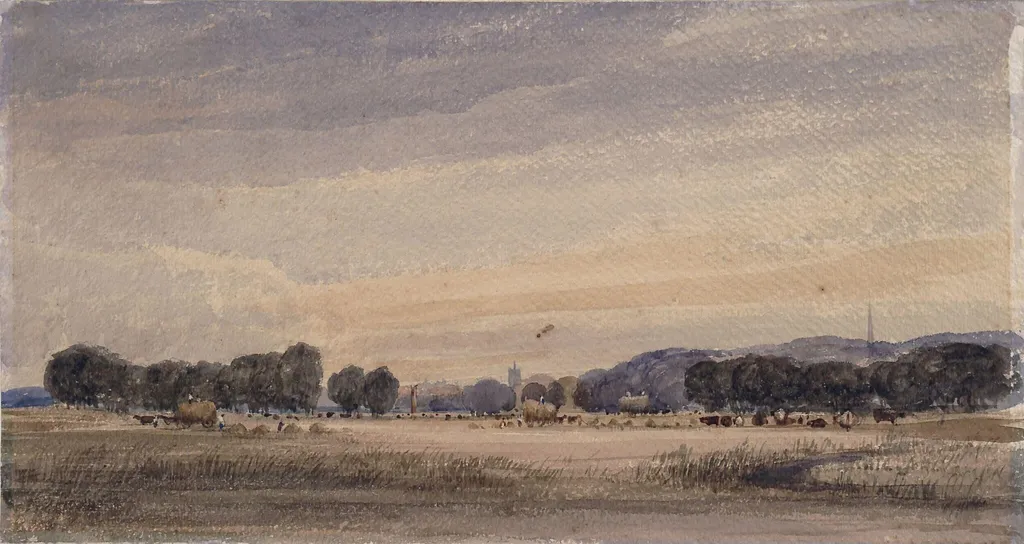
Fields near Norwich is a watercolor work on paper by the British Romanticist artist Robert Leman. It dates from 1820 and is held in the collection of the Victoria and Albert Museum.
About this work
Overview
Robert Leman’s watercolor, dated 1820, depicts an open landscape near Norwich. The composition is dominated by a broad, gently rolling field that extends toward a distant settlement, its church spire barely visible above the rooftops. The work is part of the Victoria and Albert Museum’s collection, representing an early‑19th‑century British rural scene rendered in transparent pigment.
Subject & Meaning
The painting presents a tranquil agrarian setting: a meadow populated by a few grazing sheep, bordered by a line of mature trees that separate the foreground from the village beyond. The modest scale of the animals and the softened horizon convey a sense of quiet continuity between human habitation and the surrounding countryside, reflecting a contemplative view of rural life.
Technique & Style
Leman employs the fluidity of watercolor to capture atmospheric light, using pale washes of yellow and blue for the sky that dissolve into one another.
Leman employs the fluidity of watercolor to capture atmospheric light, using pale washes of yellow and blue for the sky that dissolve into one another. Loose, rapid brushstrokes suggest movement in both clouds and grass, while the trees are rendered in darker, more defined silhouettes. The sheep appear as minimal, almost stippled forms, emphasizing the medium’s capacity for suggestion over detail.
History & Provenance
Created in 1820, the work entered the Victoria and Albert Museum’s holdings as part of its 19th‑century British watercolour collection. Its provenance traces back to the artist’s own output during a period when English painters were increasingly documenting local landscapes, contributing to the museum’s broader representation of early Romantic visual culture.
Artist & collection

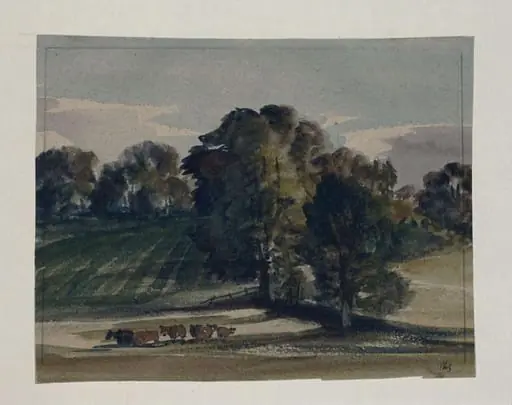 Coneycroft Farm, Compton
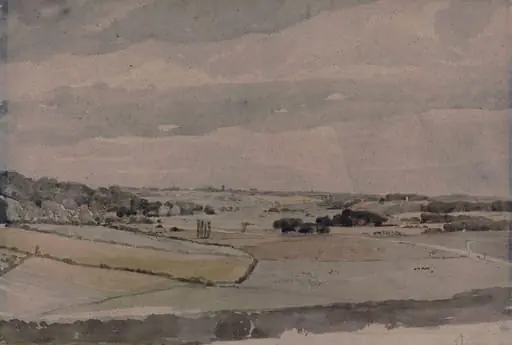 Landscape
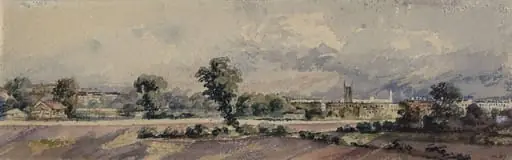 View from Gore Lane, Kensington, showing St. Luke's Church, Chelsea
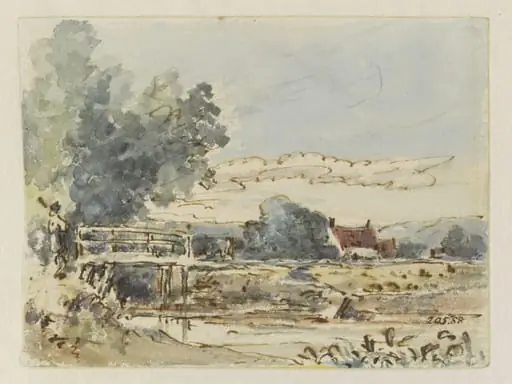 A bridge over a stream, with a cottage behind
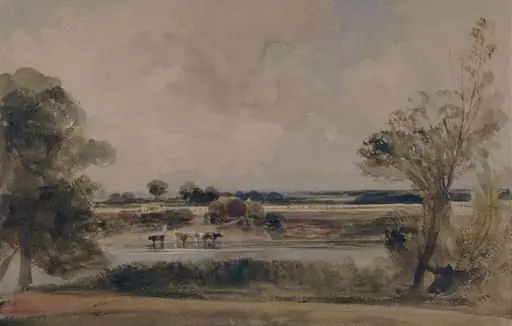 View near Salt Hill
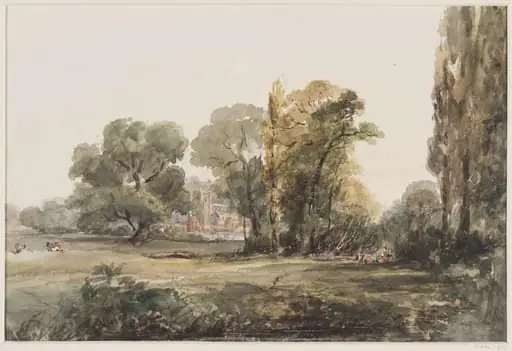 Stowe: a church in the distance, seen amid trees
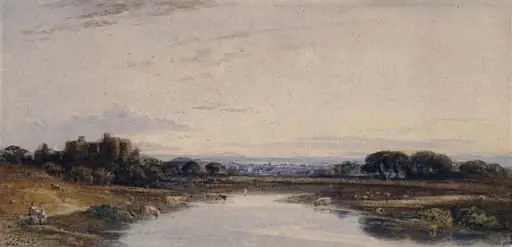 Landscape
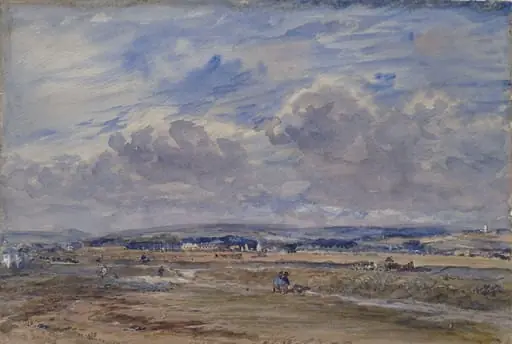 Copper's Gap, near Brighton
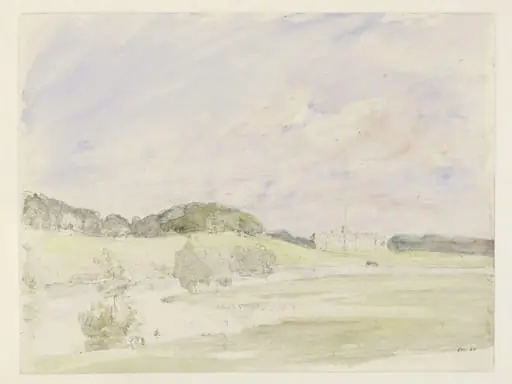 Petworth House from the Park
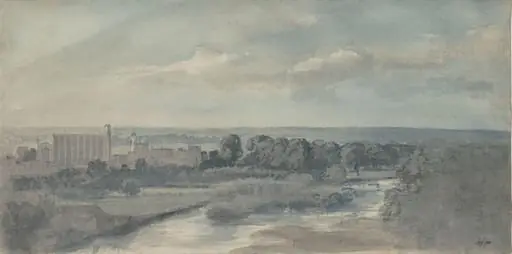 The Thames, with Eton College and chapel
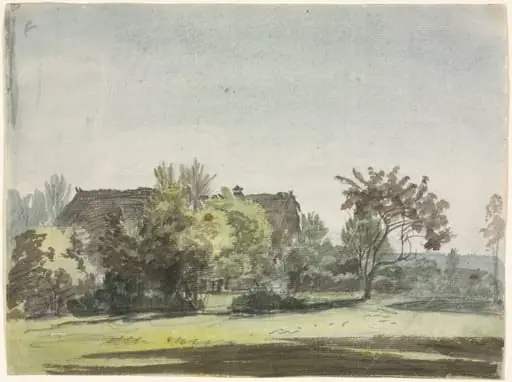 Farmhouse behind Trees
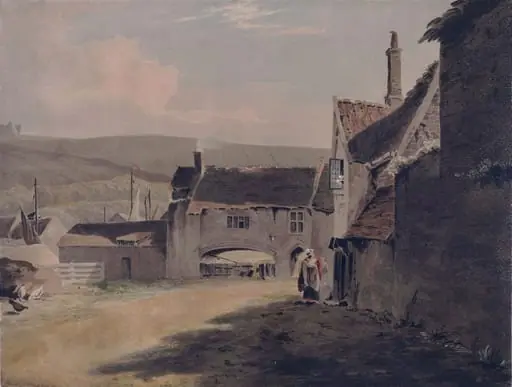 Water Gate, Lower Close, Norwich